Use sock puppets to act out everyday feelings — happy, sad, cross, scared — helping your toddler name and understand big emotions.
Activity details
2y–4y15 minslowindoorNo prepBlanketsSock Puppet
Instructions
Tiny Steps
Get ready
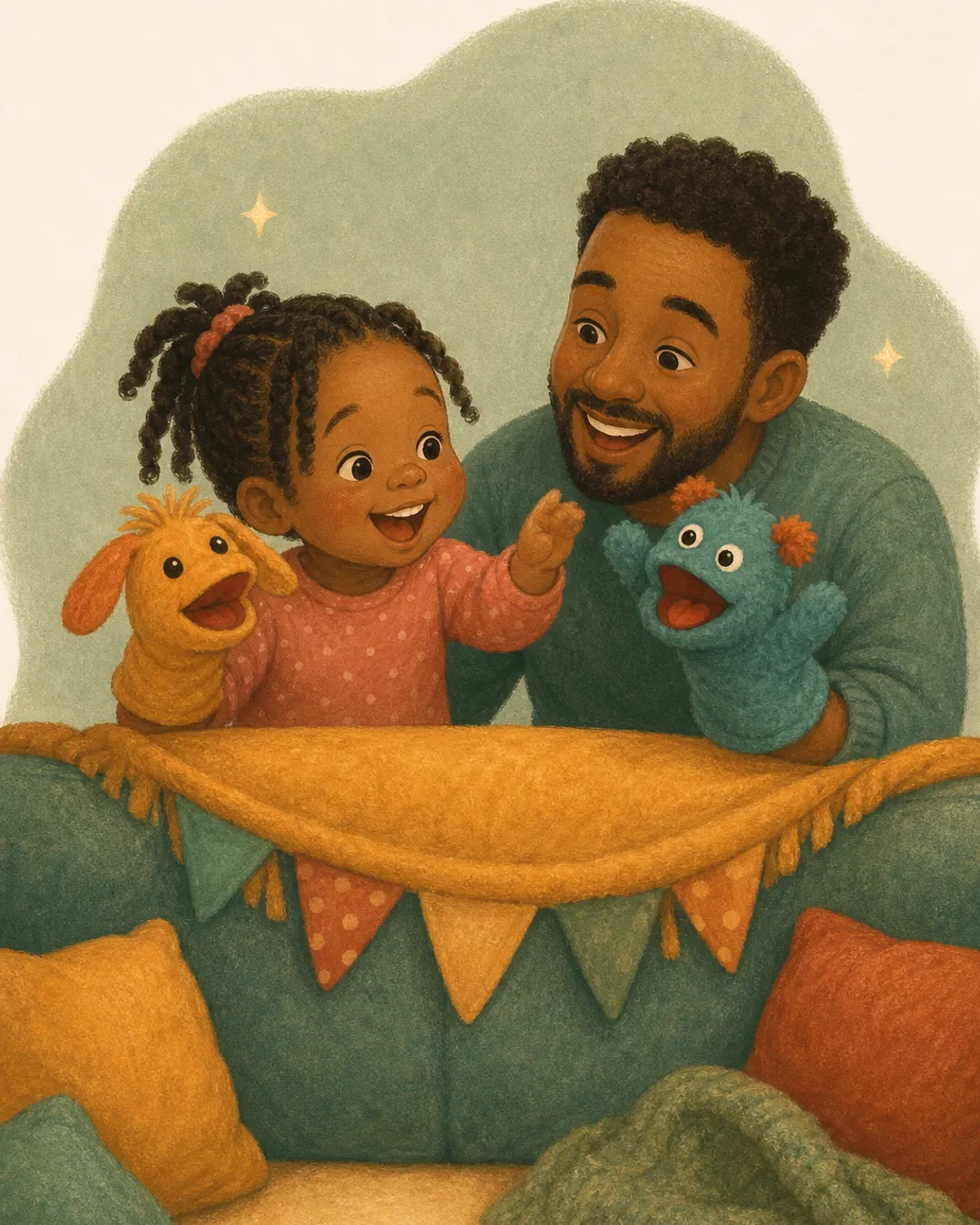
Set up a simple theatre by draping a blanket over the back of a sofa or between two chairs — you kneel behind it with the puppet.
Pop the puppet up above the blanket and have it greet your child in a cheerful voice.
1/4
Set up a simple theatre by draping a blanket over the back of a sofa or between two chairs — you kneel behind it with the puppet.
Pop the puppet up above the blanket and have it greet your child in a cheerful voice.
Start a short scene: 'Oh no — someone took my toy and I feel really cross!' Make the puppet's body language match — shaking, stomping.
Ask your child: 'The puppet feels cross. What could we do to help him feel better?'
Accept whatever your child suggests and act it out with the puppet — deep breaths, a cuddle, counting to five.
Show the puppet calming down: 'I took a big breath and now I feel a bit better. Thank you for helping me!'
Repeat with a different emotion — sadness, excitement, nervousness — keeping each scene to one or two minutes.
Finish by having the puppet ask your child how they feel right now, validating whatever they say: 'You feel happy? That's lovely!'
Parent tip
Start before you overthink it. No-prep activities work best when you begin while the moment is still recoverable.
What success looks like
Back-and-forth between you — words, gestures, shared pretend. Connection is the real outcome here.
Toddlers experience enormous emotions but often lack the words to describe them. This activity uses puppet theatre to externalise those feelings: the puppet gets cross when it can't have a biscuit, feels sad when its friend leaves, or is scared of a loud noise. By watching the puppet experience and work through these emotions, your child learns the vocabulary of feelings and sees that big emotions are normal, manageable, and temporary. The theatrical format makes the whole thing feel safe and playful rather than heavy or instructional.
Why it helps
Emotion coaching — helping children identify, name, and regulate their feelings — is one of the strongest predictors of healthy social-emotional development. Puppet theatre provides what psychologists call 'symbolic distance,' allowing children to explore difficult emotions without feeling personally threatened. Research from the Anna Freud Centre shows that children who regularly engage in dramatic emotion play develop a richer emotional vocabulary and greater empathy for others. Zero to Three explains that toddlers need repeated, safe chances to practise handling big feelings before they can manage them on their own.
Variations
Let your child operate a second puppet and have the two puppets talk to each other about their feelings.
Use the puppet to rehearse a real upcoming event that might cause anxiety — a doctor's visit, starting nursery, a new sibling arriving.
Draw simple faces on paper plates (happy, sad, cross, scared) and let your child hold up the matching face as the puppet acts out each emotion.
Safety tips
Keep the emotional scenarios mild and age-appropriate — avoid themes that might genuinely frighten your child, such as being lost or abandoned.
Watch your child's reactions carefully; if they seem upset rather than engaged, stop the scene and offer reassurance.
Ensure the blanket theatre is stable and cannot fall on your child — weigh down the edges with books if draping over chairs.
Try one of these next
A few connected ideas chosen by theme, energy, set-up, and age fit.