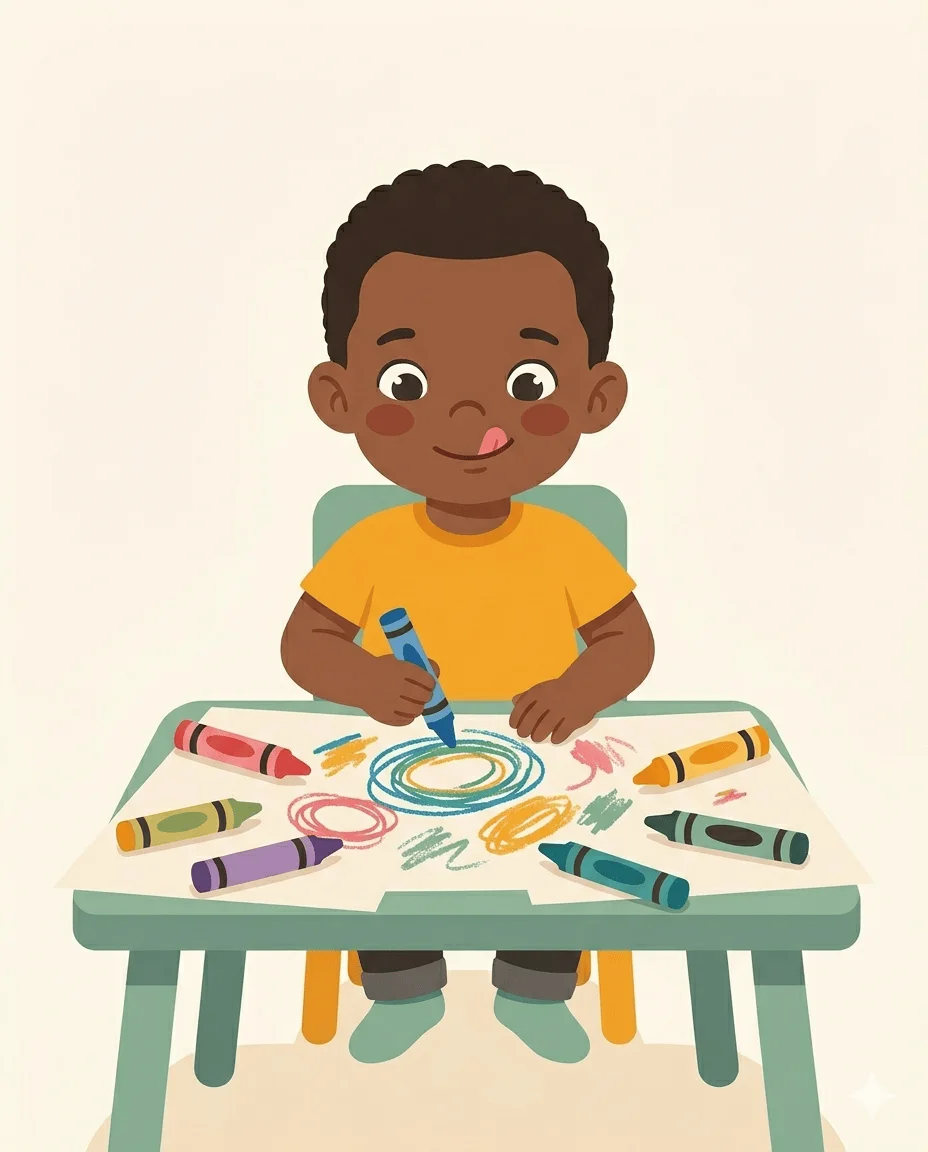
Sit at a table with paper and crayons or markers. Draw a big circle: 'Let us draw a face!'
Start with happy: draw two dots for eyes and a big curved smile. 'This face is happy! Look at the big smile!'
1/4
Sit at a table with paper and crayons or markers. Draw a big circle: 'Let us draw a face!'
Start with happy: draw two dots for eyes and a big curved smile. 'This face is happy! Look at the big smile!'
Ask: 'When do you feel happy? I feel happy when we read stories together.'
Draw another circle for sad: droopy eyes, downturned mouth. 'This face is sad. What makes you feel sad?'
Continue with angry (furrowed brows, gritted teeth) and scared (wide eyes, open mouth).
Let your child add to each face — scribbling hair, adding colour, decorating. Their contribution matters more than accuracy.
Line up all four faces and point to each: 'Which one is angry? Can you show me your angry face?'
Finish by saying: 'All of these feelings are OK. Everyone feels happy and sad and angry and scared sometimes.'
Parent tip
Set out construction paper and crayons before inviting your toddler in so the first minute feels smooth.
What success looks like
Messy hands and a child who doesn’t want to stop. The artwork doesn’t need to look like anything — the process is the point.
Emotional vocabulary is one of the most powerful tools a toddler can develop, yet many children reach nursery without words for their feelings beyond 'happy' and 'sad'. This activity uses the irresistible appeal of face-drawing to introduce emotion words in a calm, playful context. Drawing the face together — big smile for happy, downturned mouth for sad, wide eyes for scared — gives each emotion a visual anchor that helps the child recognise it in themselves and others.
Why it helps
Research from the NSPCC shows that children who can name their emotions experience fewer behavioural outbursts, because labelling a feeling activates the prefrontal cortex and dampens the amygdala's fight-or-flight response — a process neuroscientists call 'affect labelling'. By drawing the faces, you give the abstract concept of an emotion a concrete visual form that the child can point to when words fail them. This is foundational emotional literacy that supports both self-regulation and empathy.
Variations
Use paper plates instead of drawing on paper — the 3D round shape feels more like a real face and can be held up as masks.
Add more emotions as your child's vocabulary grows: worried, excited, surprised, proud, frustrated, jealous.
Make it interactive: 'I am going to make a face — you tell me which feeling it is!' Pull silly expressions for them to name.
Safety tips
Use washable markers or crayons — some toddlers will draw on themselves, the table, or the wall with enthusiasm.
If your child becomes upset when discussing sad or angry feelings, follow their lead and return to happy. Never push emotional exploration.
Scissors should only be used by the adult if cutting out faces — keep them out of reach during the activity.
Try one of these next
A few connected ideas chosen by theme, energy, set-up, and age fit.