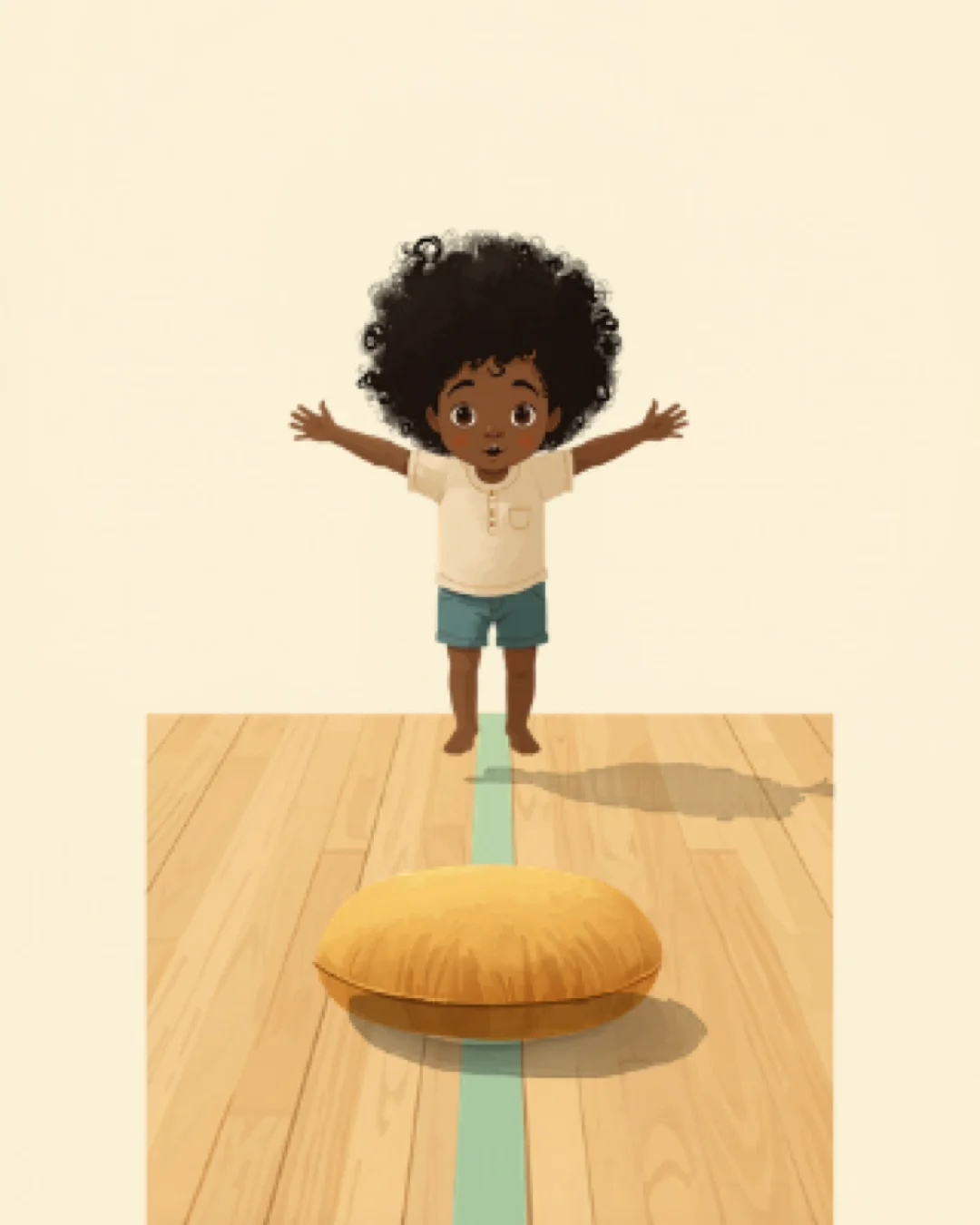
Announce: 'We're going to build the BEST obstacle course ever — but we have to do it as a team!'
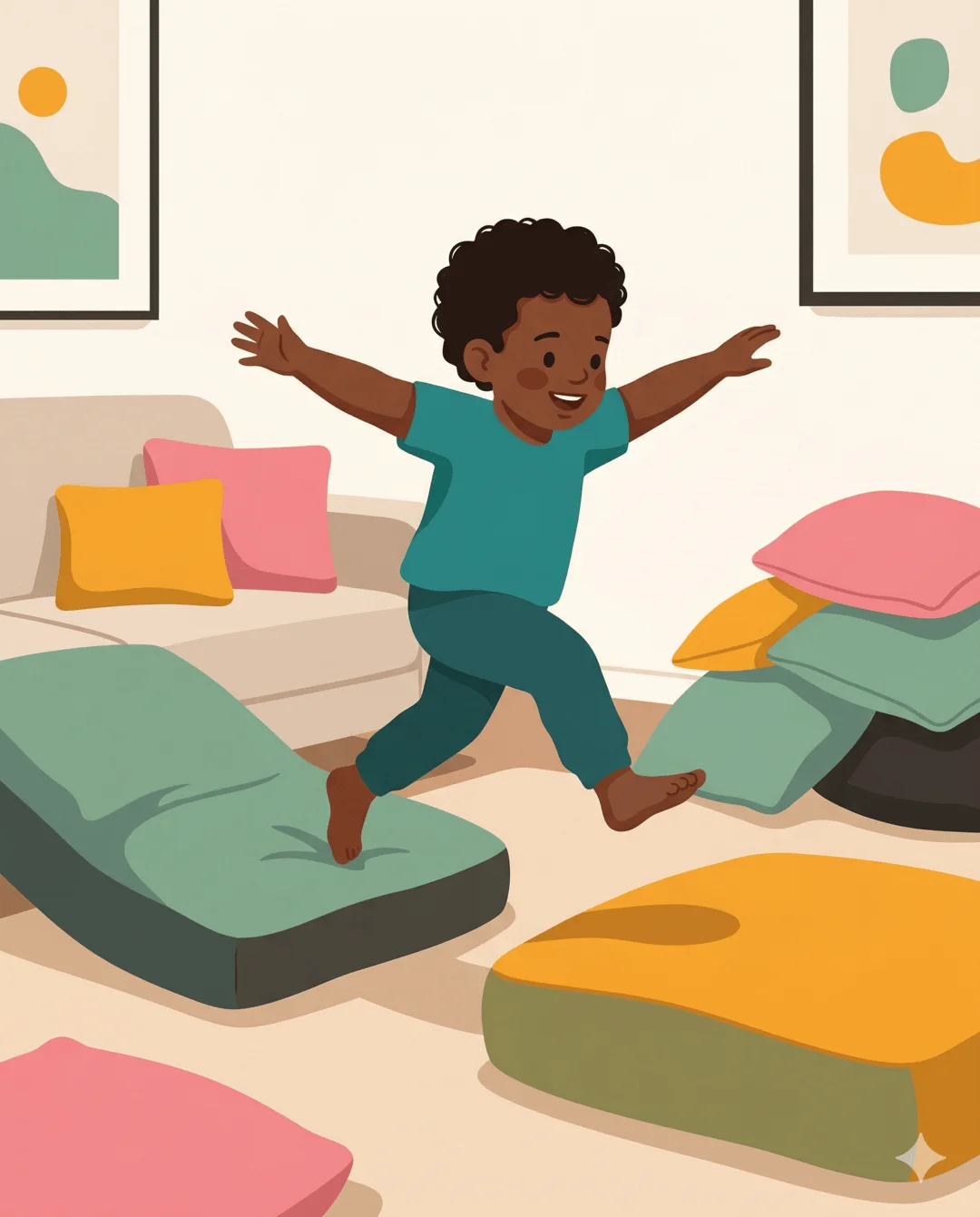
Point to available items: cushions, pillows, blankets, a cardboard box, a bed sheet. Let each child choose one item to place.
1/4
Announce: 'We're going to build the BEST obstacle course ever — but we have to do it as a team!'
Point to available items: cushions, pillows, blankets, a cardboard box, a bed sheet. Let each child choose one item to place.
Help them decide together where each obstacle goes: 'Where should the cushion mountain go? You two decide.'
Once the course is built (four to five obstacles is plenty), walk through it together to 'test' it.
One child goes first while the other stands at the finish line as the 'cheerleader' — teach them to shout 'Go! You can do it!'
Swap roles so the cheerleader becomes the runner. Emphasise: 'Your sister cheered you on — now it's your turn to cheer!'
For the final round, hold hands and do the course together — the physical connection reinforces the teamwork feeling.
Finish by dismantling the course together, carrying cushions back as a team: 'Building it together AND tidying it together — what a team!'
Parent tip
Set out bed sheet and blankets before inviting your toddler in so the first minute feels smooth.
What success looks like
Flushed cheeks, big smiles, and a calmer child afterwards. If they want to do it again, you’ve found a winner.
One of the most effective ways to reduce sibling conflict is to give children a shared creative project where both contributions matter. In this activity, each sibling places obstacles (cushions, blankets, boxes) to build a course, then they take turns navigating it while the other cheers them on. The building phase requires negotiation ('where should the tunnel go?'), and the cheering phase practises supportive rather than competitive interaction. The physical element also burns off the restless energy that often underlies sibling squabbles.
Why it helps
The EYFS framework identifies sharing and cooperative play as key social development milestones that children build through guided play experiences. Shared goal-setting and collaborative building are powerful conflict-reduction tools because they shift the sibling dynamic from 'you versus me' to 'us versus the challenge.' The cheering element specifically practises prosocial behaviour — celebrating another person's success — which does not come naturally to toddlers and requires structured opportunities to develop. Physical activity also lowers cortisol levels, reducing the physiological arousal that often precedes sibling conflict.
Variations
Give each child a stuffed animal to carry through the course — they're 'rescuing' the teddies together, adding a cooperative narrative.
Time each run with a sand timer and challenge the pair to beat their combined total — making it a team score, never individual.
Take the course outdoors using garden furniture, buckets, and cones for a bigger, more energetic version.
Safety tips
Check all obstacles are stable and won't collapse — test the course yourself before the children use it.
Stay close to younger toddlers who may stumble climbing over cushions or crawling through tunnels.
Avoid using furniture that could tip over, such as chairs balanced on their sides.
Try one of these next
A few connected ideas chosen by theme, energy, set-up, and age fit.