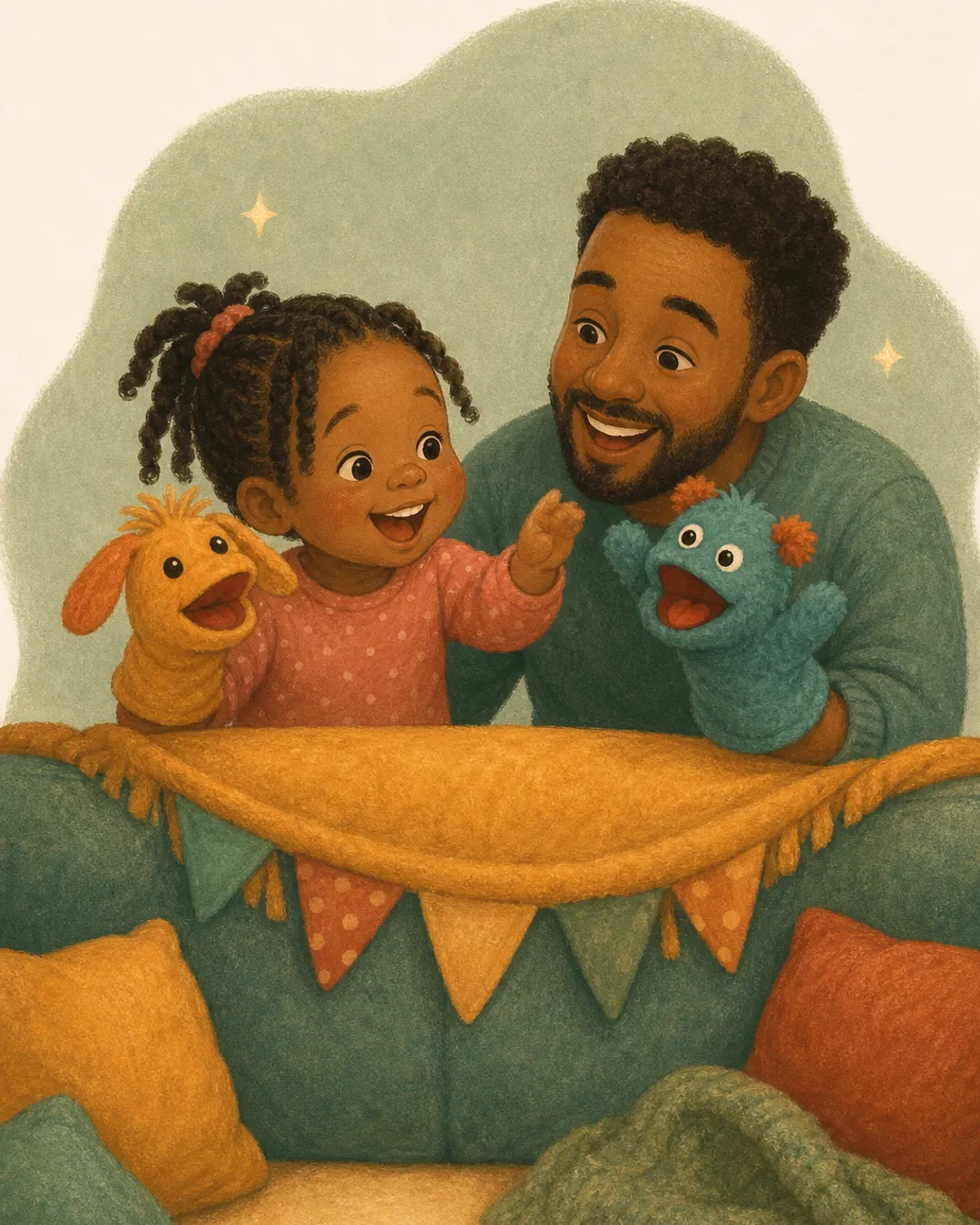
Sing simple songs about emotions — matching happy, sad, angry, and calm faces to melodies that help your toddler name what they feel.
Activity details
2y–4y10 minslowbothNo prep
Instructions
Tiny Steps
Get ready
Sit facing your toddler, close enough that they can see your face clearly.
Start with happy — sing 'If You're Happy and You Know It' with a big smile and clapping.
1/5
Sit facing your toddler, close enough that they can see your face clearly.
Start with happy — sing 'If You're Happy and You Know It' with a big smile and clapping.
Now try sad — slow the melody right down, make a sad face, and sing 'If you're sad and you know it, have a cry... waah waah.'
Move to angry — sing with a low, growly voice and a scrunchy face: 'If you're angry and you know it, stomp your feet.'
Try scared — whisper-sing with wide eyes: 'If you're scared and you know it, hold on tight' (hug yourself).
Finish with calm — sing very softly with slow breathing: 'If you're calm and you know it, breathe in deep... ahhhh.'
Ask your toddler: 'Which feeling shall we sing about again?'
Let them choose and lead — they pick the emotion, you both sing and act it out.
End on the calm verse every time — it is a natural wind-down that regulates the energy of the session.
Parent tip
Start before you overthink it. No-prep activities work best when you begin while the moment is still recoverable.
What success looks like
Back-and-forth between you — words, gestures, shared pretend. Connection is the real outcome here.
Emotions are big and confusing when you are two or three. This activity gives those feelings a soundtrack. You sing short, simple songs about different emotions — making the matching face and body language as you go — and your toddler learns to connect internal feelings with external words and expressions. Naming an emotion is the first step to managing it, and wrapping that naming in a catchy melody makes it stick.
Why it helps
Research from the NSPCC shows that children who can name their emotions experience fewer behavioural outbursts and develop stronger self-regulation. The EYFS framework positions emotional vocabulary as a key goal within Personal, Social, and Emotional Development. Wrapping emotion words in a familiar melody leverages what Speech and Language UK calls the 'rhyme advantage' — children remember words embedded in songs far more readily than spoken instructions alone.
Variations
Add more emotions as your toddler's vocabulary grows — excited, surprised, worried, proud.
Use a mirror so your toddler can see their own expressions while they sing.
For two or more children, take turns choosing the emotion — one child picks, everyone sings and acts.
Safety tips
Keep the angry verse playful, not frightening — exaggerated silly anger, not real intensity.
If your toddler becomes genuinely upset during the sad or scared verses, switch straight to the calm verse.
This activity is for building vocabulary, not processing real distress — save it for calm, connected moments.
Try one of these next
A few connected ideas chosen by theme, energy, set-up, and age fit.