Draw simple circle faces showing different emotions together.
Activity details
2y–4y12 minslowindoorConstruction PaperCrayons
Instructions
Tiny Steps
Get ready
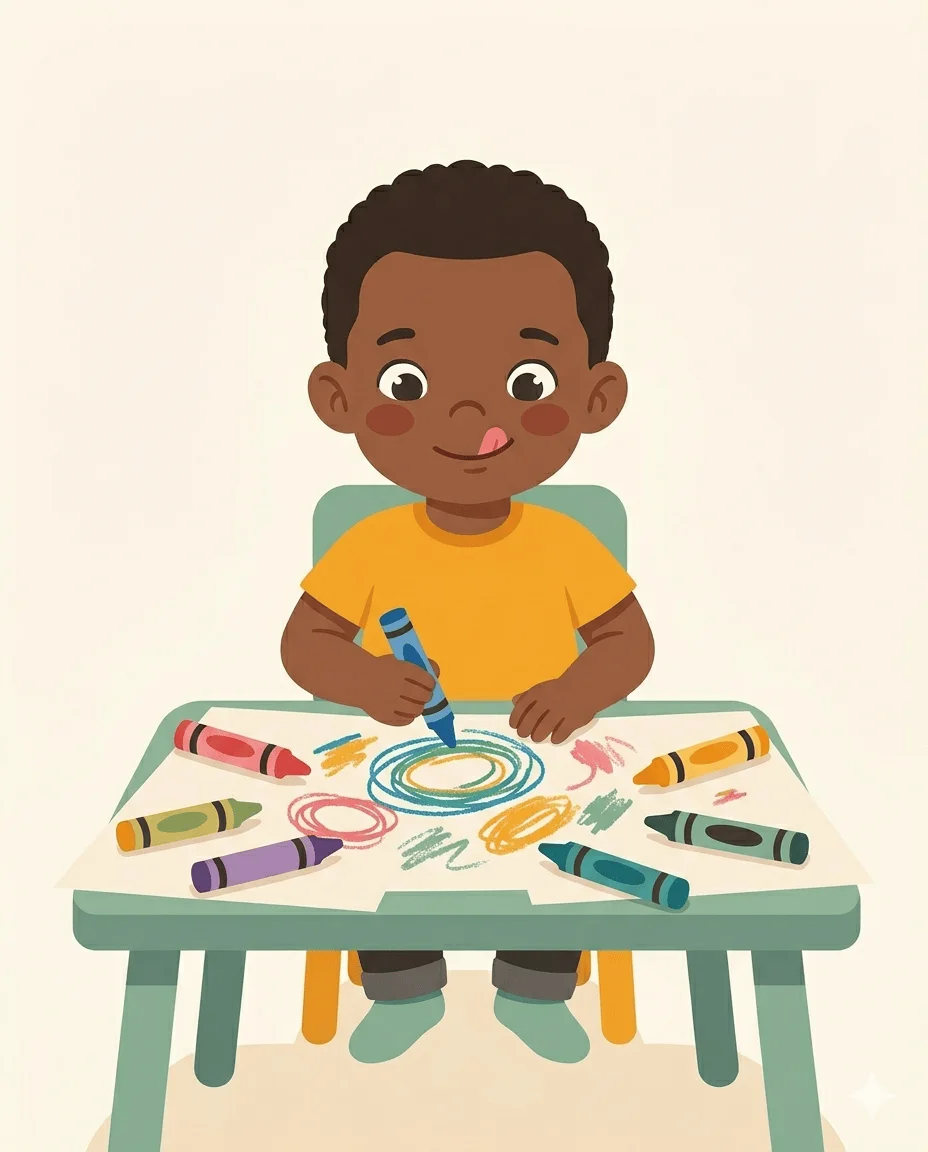
Set out paper and crayons at the table
Draw a big circle: 'This is going to be a face. What feeling shall we draw?'
1/4
Set out paper and crayons at the table
Draw a big circle: 'This is going to be a face. What feeling shall we draw?'
Start with happy — big smile, eyes curved up
Add angry: 'What do angry eyebrows look like? Down and pointy!'
Draw sad, surprised, scared — let your toddler choose colours and help draw
Point to each face and name it together
Ask: 'Which face do you feel like right now?' — validate whatever they choose
Keep the faces somewhere visible to reference later: 'Show me on the faces how you feel'
Parent tip
Set out construction paper and crayons before inviting your toddler in so the first minute feels smooth.
What success looks like
Messy hands and a child who doesn’t want to stop. The artwork doesn’t need to look like anything — the process is the point.
Sit down with crayons and paper and draw big circle faces together, each showing a different feeling — happy, sad, angry, surprised, scared, calm. As you draw each face, name the emotion and talk about when you feel that way: 'This is the angry face. I feel angry when something breaks.' Research consistently shows that children who can name their emotions have significantly fewer aggressive outbursts.
Why it helps
Zero to Three notes that 'some toddlers love learning new words to describe their feelings, such as furious, irate, and livid' — and drawing faces is one of the most concrete ways to attach those words to something the child can see. Building emotional vocabulary early gives toddlers a way to name what they feel before it spills out as a tantrum, which is the foundation of self-regulation.
Variations
Use paper plates instead of drawn circles for a more tactile experience.
Cut out the faces and stick them on lolly sticks as feeling puppets.
For older toddlers, add more nuanced feelings: frustrated, excited, worried, proud.
Safety tips
Use chunky crayons suitable for small hands — avoid sharp pencils.
Supervise to ensure crayons stay on paper and out of mouths.
Keep the conversation light — don't force discussions about difficult feelings.
Try one of these next
A few connected ideas chosen by theme, energy, set-up, and age fit.