Echo your baby's babbles and extend them into real words — a conversation that builds language from the very first sounds.
Activity details
12m–18m5 minslowindoorNo prep
Instructions
Tiny Steps
Get ready
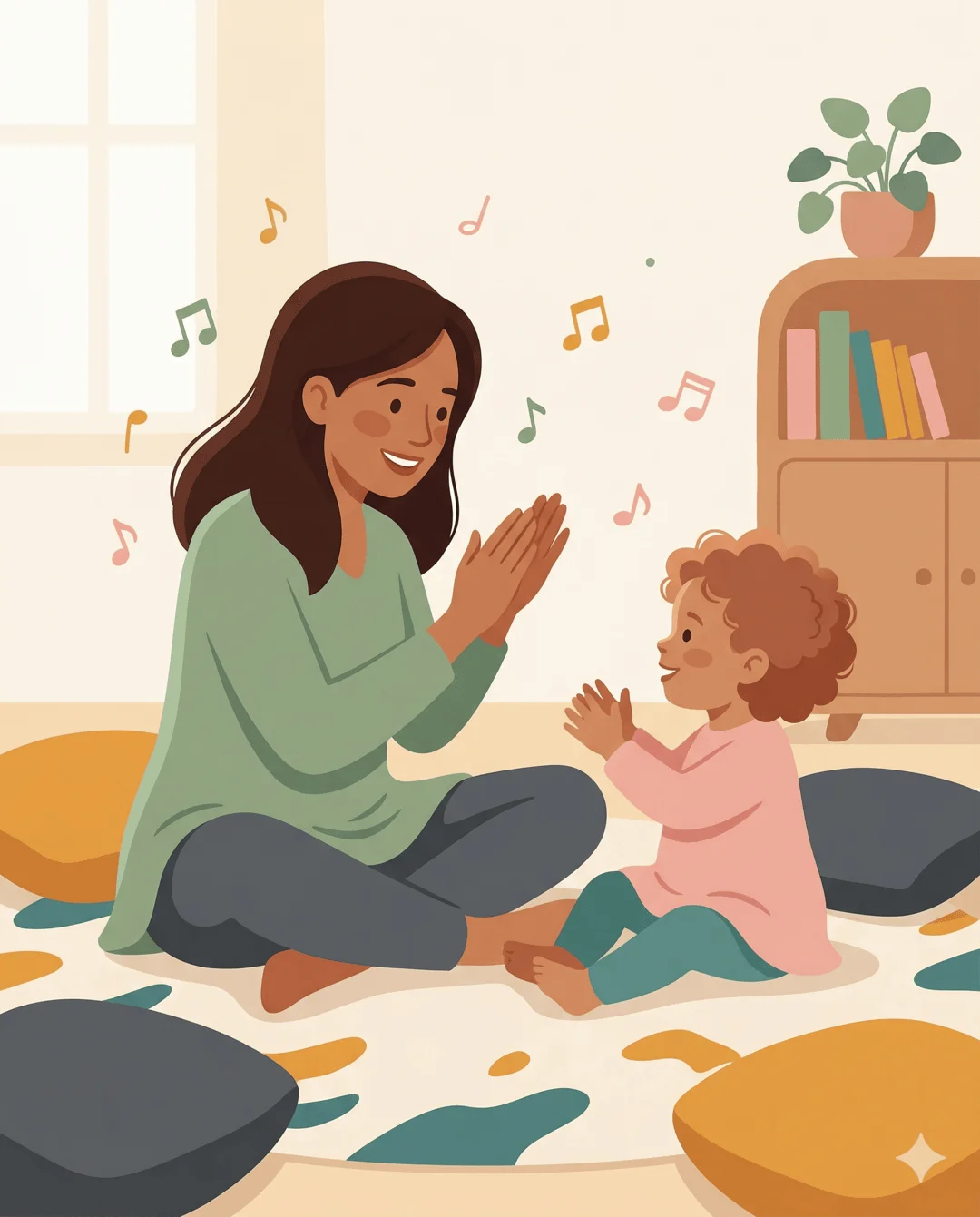
Sit face-to-face with your child at their level — floor, highchair, or your lap.
Wait for them to make a sound — any babble, coo, or squeal counts.
1/4
Sit face-to-face with your child at their level — floor, highchair, or your lap.
Wait for them to make a sound — any babble, coo, or squeal counts.
Repeat their sound back to them with the same rhythm and expression: 'Da da da!'
Then extend it into a real word: 'Da da — Daddy! Yes, Daddy is here!'
Pause and wait — give them at least 5 seconds to respond. Toddlers need processing time.
If they babble again, repeat the cycle: echo, then extend.
Point to objects as you name them, linking the sound to something visible: 'Ma — milk! Here is your milk.'
Keep sessions short — 3-5 minutes is plenty. Stop when their attention drifts naturally.
Parent tip
Start before you overthink it. No-prep activities work best when you begin while the moment is still recoverable.
What success looks like
Back-and-forth between you — words, gestures, shared pretend. Connection is the real outcome here.
When your baby says 'ba ba ba', you say 'ba ba — ball! You can see the ball!' This simple call-and-response turns babbling into the building blocks of language. The child leads, you follow and expand — creating a feedback loop that reinforces the connection between sounds and meaning. It requires nothing but your attention, and it works anywhere.
Why it helps
The NCB's ORIM framework identifies 'Interaction' and 'Recognition' as two of the four pillars of early language development. When you echo a babble, you recognise the child's communication attempt; when you extend it into a word, you model the next step. Research from the National Literacy Trust shows that children whose babbles are responded to consistently develop larger vocabularies by age two, because the serve-and-return pattern wires the brain's language circuits during this critical window.
Variations
Try this during nappy changes — a captive audience and a natural conversation window.
Use a mirror so your child can see both faces during the exchange — visual feedback strengthens the connection.
Record a short clip and play it back — some babies are fascinated by hearing their own voice and will babble more in response.
Safety tips
Keep face-to-face distance comfortable — about 30cm for young babies, further for older toddlers.
If your child seems overstimulated (turning away, arching back), take a break — they are telling you they need a pause.
Avoid correcting their sounds — 'ba' is not wrong, it is a stepping stone. Correction discourages attempts.
Try one of these next
A few connected ideas chosen by theme, energy, set-up, and age fit.