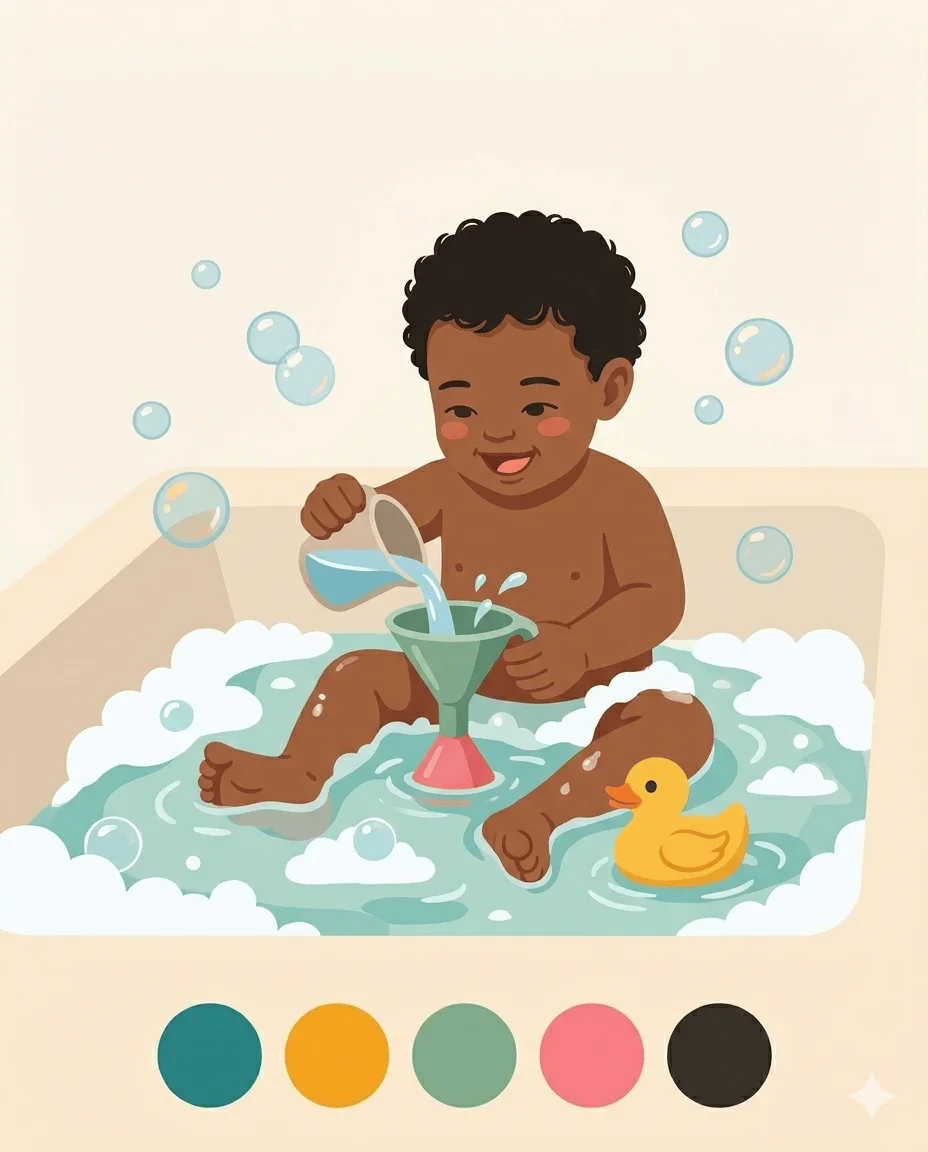
Fill three small pitchers or plastic cups with water, each tinted a different primary colour using food colouring — red, yellow, and blue.
Set them on a tray with several empty cups, a few spoons, and a towel underneath to catch spills.
1/4
Fill three small pitchers or plastic cups with water, each tinted a different primary colour using food colouring — red, yellow, and blue.
Set them on a tray with several empty cups, a few spoons, and a towel underneath to catch spills.
Show your child how to hold a pitcher with both hands and pour slowly into an empty cup: 'Tip it gently — watch the water come out.'
Let them pour freely between containers, experimenting with how much goes where.
When they mix two colours, react with wonder: 'Red and yellow made orange! What a brilliant potion!'
Introduce new empty cups if they run out of space, encouraging them to pour back and forth.
Add spoons so they can stir their potions and watch the colours swirl: 'Give it a big stir — what colour is it now?'
When interest fades, pour all the potions into one big bowl together for a final grand mix, then tip it down the sink together.
Parent tip
Set out food colouring and plastic cups before inviting your toddler in so the first minute feels smooth.
What success looks like
Watch for focused exploration — fingers digging in, pouring back and forth, or sorting by feel. Even a few minutes of this builds concentration.
Pouring is one of the foundational Montessori practical life activities because it demands sustained concentration, bilateral coordination, and fine motor control all at once. This potion lab gives your child multiple containers of coloured water and the freedom to pour, mix, and discover what happens when colours combine. The slow, deliberate nature of pouring naturally calms an active child, while the colour-mixing element adds an irresistible element of surprise and scientific discovery.
Why it helps
Pouring activities develop bilateral coordination — the ability to use both hands together in a controlled way, with one hand stabilising and the other directing. This is a prerequisite skill for later tasks like cutting with scissors, tying laces, and handwriting. The colour-mixing element introduces early scientific reasoning: prediction, observation, and cause-and-effect thinking. Many children find the rhythmic nature of pouring deeply regulating, making this an excellent choice after high-energy play. The EYFS framework puts hands-on exploration at the heart of physical development — these small, focused movements are the building blocks of hand control.
Variations
Add a drop of washing-up liquid to one cup so that stirring creates colourful bubbles — a magical addition.
Freeze coloured water in ice cube trays beforehand and let your child drop coloured ice cubes into warm water, watching them melt and spread.
Use pipettes or turkey basters instead of pouring for an extra fine motor challenge suited to older toddlers.
Safety tips
Use food-safe colouring only, in case your child drinks the water — a small sip of diluted food colouring is harmless but best avoided.
Place a large towel or plastic sheet under the tray to protect floors and make clean-up easier.
Supervise closely to ensure your child does not pour water onto electrical items, books, or other water-sensitive surfaces nearby.
Try one of these next
A few connected ideas chosen by theme, energy, set-up, and age fit.