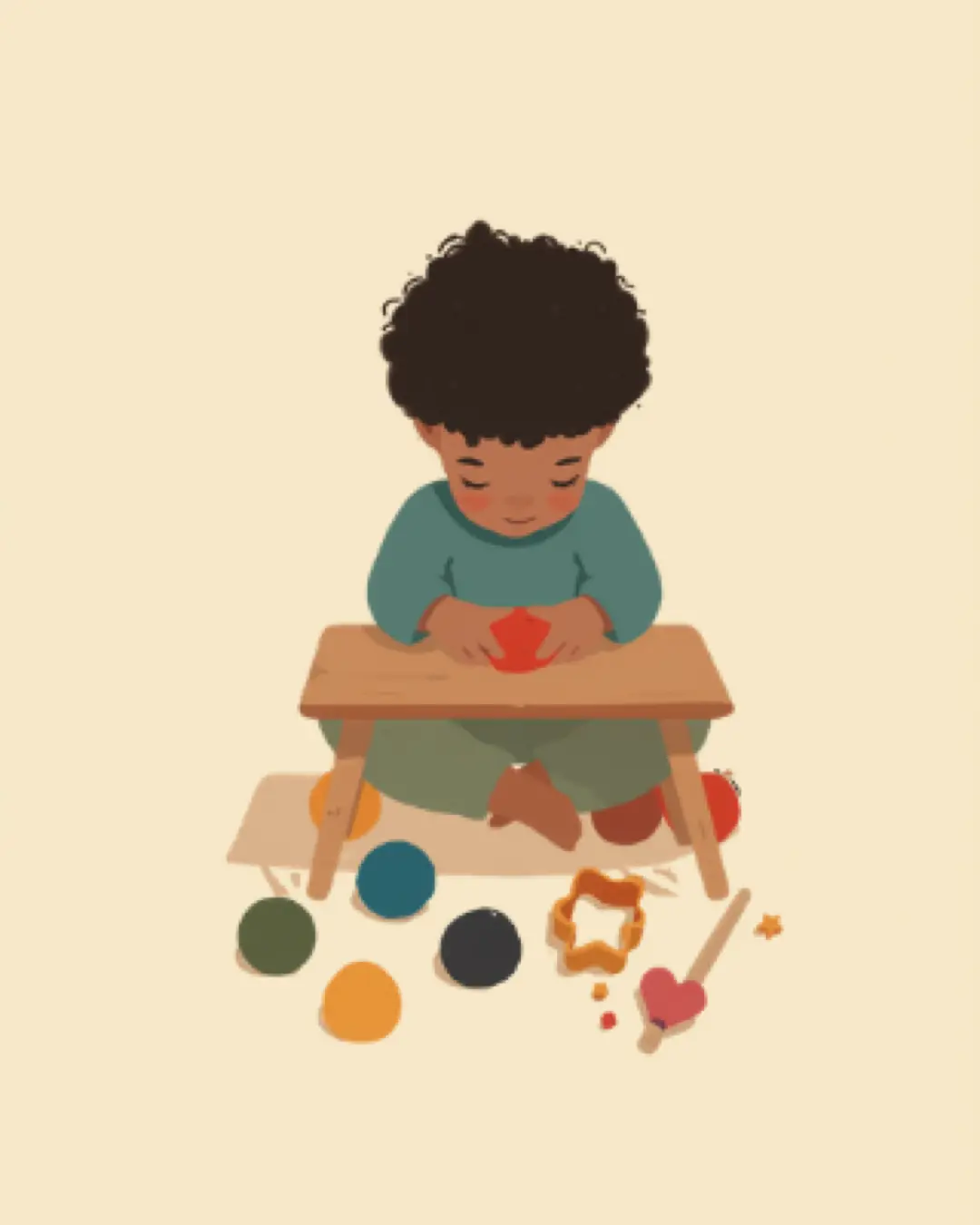
Set up a clear table space with a large sheet of cling film or a clean mat to protect the surface.
Give your child a ball of play dough or homemade salt dough and show them how to press it flat with their palms.
1/4
Set up a clear table space with a large sheet of cling film or a clean mat to protect the surface.
Give your child a ball of play dough or homemade salt dough and show them how to press it flat with their palms.
Offer a small rolling pin (or a plastic bottle) and demonstrate rolling outwards from the centre: 'Push it away from you — watch it get flat!'
Once the dough is roughly flat, set out three or four cookie cutters and let your child choose one.
Show them how to press the cutter firmly into the dough and then carefully lift it away to reveal the shape: 'Push hard — now peel it off. Look, a star!'
Encourage them to arrange their cut shapes on a plate or tray, naming each one.
When the dough is full of holes, gather it up, knead it back into a ball, and start again — this re-rolling is excellent for hand strength.
Finish by letting your child choose their favourite shape to keep on display, and tidy the rest away together.
Parent tip
Set out cling film and cookie cutters before inviting your toddler in so the first minute feels smooth.
What success looks like
Messy hands and a child who doesn’t want to stop. The artwork doesn’t need to look like anything — the process is the point.
Rolling and cutting dough is one of the most naturally absorbing activities for toddlers because it combines deep pressure input through the hands with a visible, satisfying result. The resistance of the dough strengthens the small muscles of the hand and wrist, while using cookie cutters requires the precise downward pressure and twist-and-lift coordination that prepares fingers for later writing tasks. This is an activity where time stretches and children often enter a state of deep focus.
Why it helps
The sustained hand pressure required to roll and cut dough builds intrinsic hand strength — the deep muscles within the palm that are essential for pencil grip, scissor use, and button-fastening. Occupational therapists frequently recommend dough activities as a precursor to handwriting. The repetitive cycle of roll-cut-gather also promotes sustained attention, and the open-ended nature of choosing shapes and arrangements supports creative decision-making. The EYFS framework highlights this kind of hands-on work as essential for building the grip and control children need before they can hold a pencil.
Variations
Press small items into the dough before cutting — buttons, dried pasta, sequins — to create textured shapes.
Use the shapes for a pretend bakery, setting up a small shop where your child sells their creations to stuffed animals.
Make real salt dough (flour, salt, water), cut shapes, bake them, and paint them the next day for a two-day project.
Safety tips
If using homemade salt dough, ensure your child does not eat it — the high salt content is harmful if ingested in large amounts.
Check cookie cutters for sharp edges before handing them to your child — plastic cutters are safest for toddlers.
Wash hands thoroughly after play, especially if the dough contains food colouring.
Try one of these next
A few connected ideas chosen by theme, energy, set-up, and age fit.