Take turns adding blocks to a shared tower, practising the 'one for you, one for me' rhythm that underpins all sharing.
Activity details
18m–3y10 minslowindoorNo prepBuilding Blocks
Instructions
Tiny Steps
Get ready
Sit on the floor facing your child with a pile of building blocks between you — divide them roughly equally.
Say 'Let's build the tallest tower TOGETHER — we take turns. You put one on, then I put one on.'
1/4
Sit on the floor facing your child with a pile of building blocks between you — divide them roughly equally.
Say 'Let's build the tallest tower TOGETHER — we take turns. You put one on, then I put one on.'
Let your child place the first block: 'Your turn — one block. Now it's MY turn — one block.'
Keep a steady, predictable rhythm: 'Your turn... my turn... your turn...' — the verbal cue helps internalise the pattern.
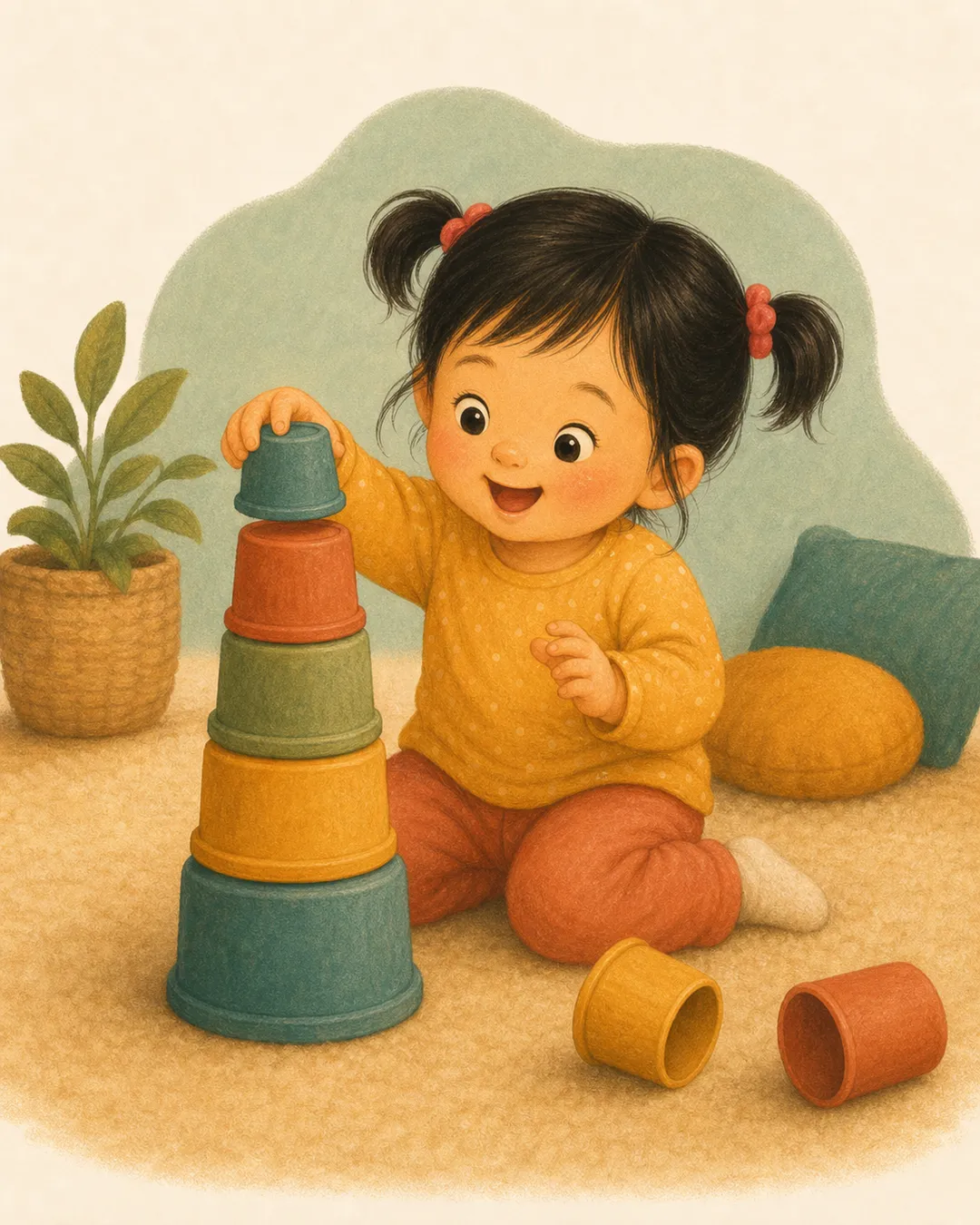
Count the blocks together as the tower grows: 'Three, four, five — we're building it together!'
When the tower wobbles or falls, laugh and celebrate: 'It fell! That was SIX blocks — shall we try for seven?'
Vary the game: let your child choose which colour block you add, or challenge them to balance a tricky one.
Finish by knocking the final tower down together — on the count of three — 'We built that TOGETHER, and we knocked it down together too!'
Parent tip
Start before you overthink it. No-prep activities work best when you begin while the moment is still recoverable.
What success looks like
A few quiet minutes together without pressure. If your child relaxes even slightly, that’s self-regulation building.
Turn-taking is the gateway skill to sharing — if a child can wait for their turn and then take it, they have the foundational self-regulation needed for sharing objects too. This simple block-building game makes turn-taking visible and concrete: each person adds one block, then waits. The growing tower provides instant, satisfying feedback that cooperation produces something better than either person could create alone, making the waiting worthwhile.
Why it helps
The EYFS framework identifies sharing and cooperative play as key social development milestones that children build through guided play experiences. Turn-taking is a foundational social cognition skill that develops from around 18 months. It requires inhibitory control (waiting when you want to go), working memory (remembering whose turn it is), and social reciprocity (understanding that both people contribute). Block tower games are used by developmental psychologists in assessments of cooperative play precisely because they make these invisible skills visible. The predictable 'your turn, my turn' rhythm also supports emerging language as children learn the social scripts of sharing and collaboration.
Variations
Add a third person (sibling, other parent, stuffed animal) so the turn-taking sequence becomes longer — increasing the wait time gradually.
Use different materials: cardboard boxes, yoghurt pots, or cushions — larger items make the tower more dramatic and the turn-taking more physical.
For younger toddlers, start with just two blocks each and build up — keeping the wait time very short at first.
Safety tips
Use lightweight blocks that won't hurt if the tower falls on small hands or feet.
Supervise closely with younger toddlers who may throw blocks rather than stack them — redirect gently to the tower.
Ensure the building surface is stable — a wobbling table will frustrate the activity and may cause blocks to fall onto the child.
Try one of these next
A few connected ideas chosen by theme, energy, set-up, and age fit.