Sit in a circle and 'pass' a smile from person to person — a simple game that teaches emotional contagion and connection.
Activity details
12m–3y10 minslowindoorNo prep
Instructions
Tiny Steps
Get ready
Sit in a small circle on the floor — this works with just you and your child, or with siblings and other family members.
Say: 'We're going to play Pass the Smile. Watch — I'm going to give my smile to YOU.' Make eye contact and smile warmly.
1/4
Sit in a small circle on the floor — this works with just you and your child, or with siblings and other family members.
Say: 'We're going to play Pass the Smile. Watch — I'm going to give my smile to YOU.' Make eye contact and smile warmly.
When your child smiles back (they almost certainly will), say: 'You caught it! Now pass it to Teddy!' (or the next person in the circle).
Go round the circle two or three times, each person 'passing' their smile with eye contact and a genuine grin.
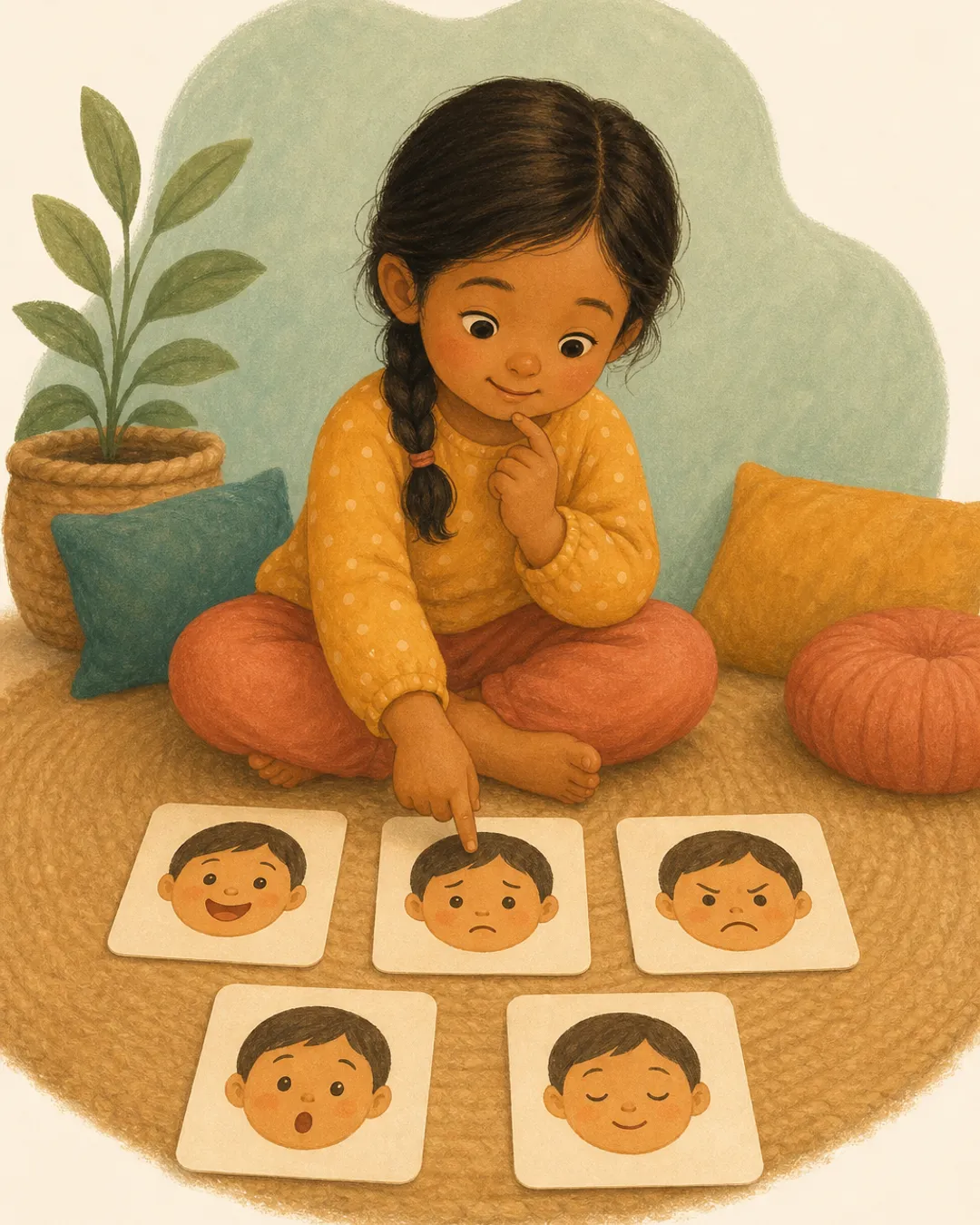
Now try passing different expressions: a surprised face, a silly face, a gentle 'I love you' face.
Ask: 'How does it feel when someone smiles at you?' Let your child answer in their own way.
Try a 'group smile' — everyone smiles at the same time on the count of three. Notice how this feels different from the one-to-one pass.
End with a 'smile hug' — smile at each other and then lean in for a cuddle. Say: 'Smiles are the kindest thing you can give someone.'
Parent tip
Start before you overthink it. No-prep activities work best when you begin while the moment is still recoverable.
What success looks like
A few quiet minutes together without pressure. If your child relaxes even slightly, that’s self-regulation building.
Smiling is neurologically contagious — mirror neurons fire when we see someone smile, triggering the same facial muscles and the associated positive emotions in the observer. This activity harnesses that mechanism intentionally, creating a structured moment of shared joy in a small group. The game is beautifully simple: one person smiles at the next, who 'catches' the smile and passes it on. For toddlers learning about social connection, this provides a visceral experience of how emotions travel between people, building empathy and social bonding through direct felt experience rather than abstract explanation.
Why it helps
Zero to Three identifies the toddler years as a critical period for developing empathy and social understanding through guided play and interaction. Mirror neurons — brain cells that fire both when we perform an action and when we observe it — are the neurological basis of empathy. When a toddler watches someone smile and involuntarily smiles back, they are experiencing emotional contagion: the felt sense that other people's feelings affect their own. This is a precursor to full empathy, which requires understanding another person's perspective. Practising this in a structured game builds the neural circuits that underpin social connection and prosocial behaviour.
Variations
Pass the smile using a mirror — each child smiles at their reflection and then at the next person, adding a self-recognition element.
In a larger group, pass the smile with eyes closed — one person taps the next gently, who opens their eyes to receive the smile.
Add a 'frown pass' followed by a 'smile rescue' — one person passes a sad face, and the next person turns it into a smile, teaching emotional repair.
Safety tips
Keep the circle small — two to four people is ideal. Large groups can be overwhelming for toddlers.
Never force a child to smile or participate if they are not in the mood — sit them on your lap and let them watch until they choose to join.
Be mindful that some children find sustained eye contact uncomfortable — a gentle glance is enough, there is no need to insist on long eye contact.
Try one of these next
A few connected ideas chosen by theme, energy, set-up, and age fit.