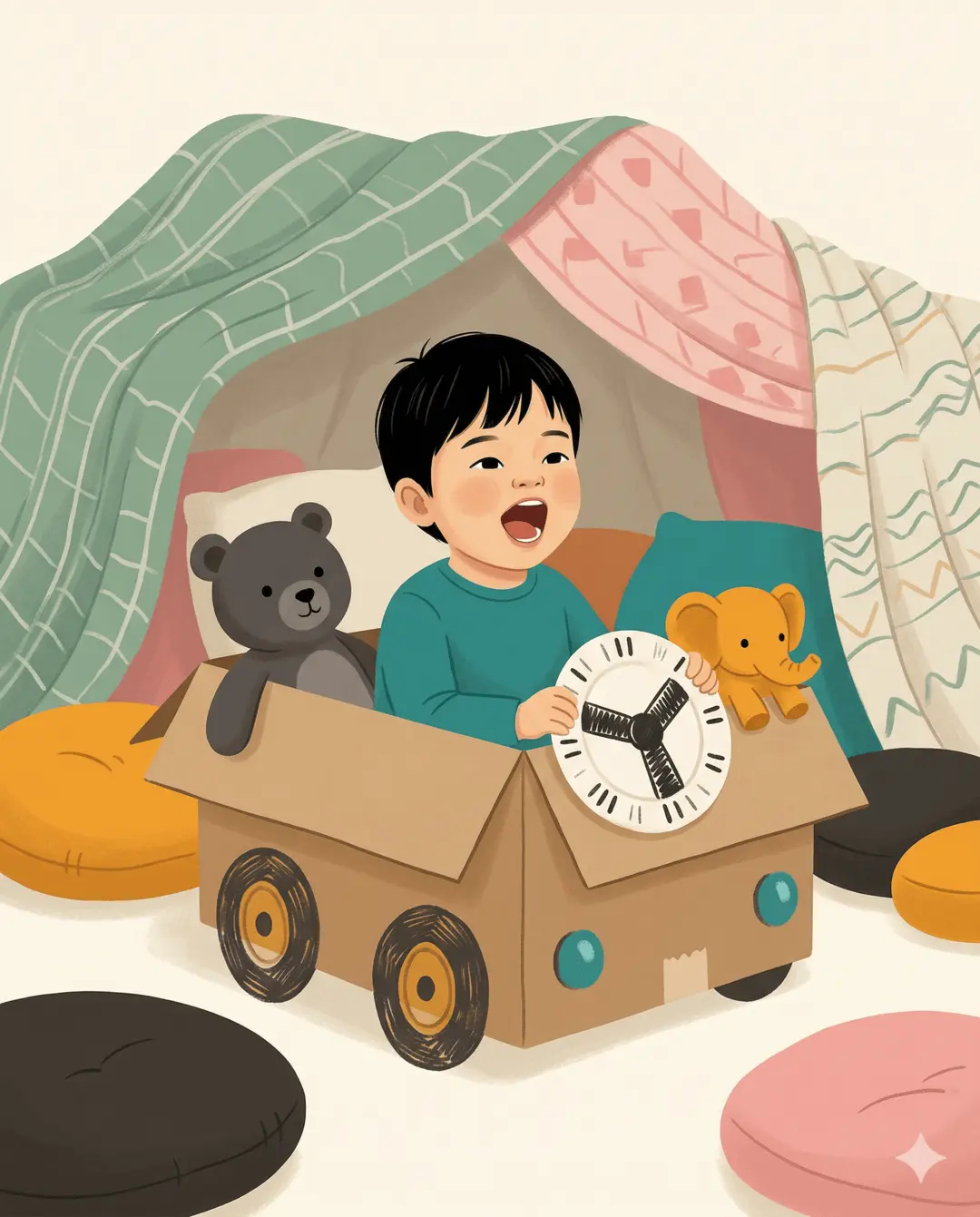
After reading a favourite story, act it out together — your child becomes the main character and relives the plot.
Activity details
3y–4y20 minsmediumindoorBlanketsPicture BooksScarves or Fabric
Instructions
Tiny Steps
Get ready
Choose a book your child knows well and loves — familiarity is essential so they can focus on the acting, not the plot.
Read it through once together as a warm-up, pointing out the key events: 'First this happens, then this.'
1/4
Choose a book your child knows well and loves — familiarity is essential so they can focus on the acting, not the plot.
Read it through once together as a warm-up, pointing out the key events: 'First this happens, then this.'
Assign roles: 'You be the bear and I'll be the mouse. Ready?'
Gather quick props from around the house — a blanket for the bear's cave, a basket for the picnic.
Act out the first scene together, using lines from the book where your child remembers them.
Prompt with story language: 'And then the bear said…' — pause and let your child fill in the words.
Move through three or four key scenes, keeping the energy playful and celebrating dramatic moments.
At the story's end, take a bow together: 'What a brilliant show! Shall we do it again or try a different book?'
Parent tip
Set out blankets and picture books before inviting your toddler in so the first minute feels smooth.
What success looks like
Back-and-forth between you — words, gestures, shared pretend. Connection is the real outcome here.
Reading a book is the beginning; acting it out is where comprehension deepens. After sharing a familiar story, you and your child replay key scenes using simple props and costumes. This transforms passive listening into active embodiment, strengthening story comprehension, sequencing ability, and character understanding. Children who dramatise stories show significantly better recall and deeper comprehension than those who only listen.
Why it helps
Speech and Language UK recommends looking at books together as a great way to help children learn new words and build communication skills. Story dramatisation requires children to recall plot events in sequence, adopt a character's perspective, and use book language in a new context — all of which are advanced comprehension skills. Research in literacy education shows that enactment of text improves story recall by up to 50% compared to passive listening alone. This activity also bridges oral and written language by helping children internalise the syntax and vocabulary of books.
Variations
Film the performance and watch it back — children adore seeing themselves as story characters.
Invite your child to change the ending: 'What if the bear went to the beach instead?' — this builds creative narrative thinking.
Use the same story but swap roles — your child plays the other character, which builds perspective-taking skills.
Safety tips
Ensure the performance space is clear of obstacles, especially if the story involves running or jumping scenes.
Check that any improvised costumes (scarves, blankets) cannot become a tripping or strangling hazard.
If the story has a scary scene, let your child skip it or change it — they should feel in control of the narrative.
Try one of these next
A few connected ideas chosen by theme, energy, set-up, and age fit.