Put them all in a central pile with an empty plate for each person
Demonstrate: 'One cracker for you... one cracker for me. Fair!'
Let your toddler distribute the next item: 'Your turn — one for you, one for me'
When all food is divided, look at both plates: 'We both have the same!'
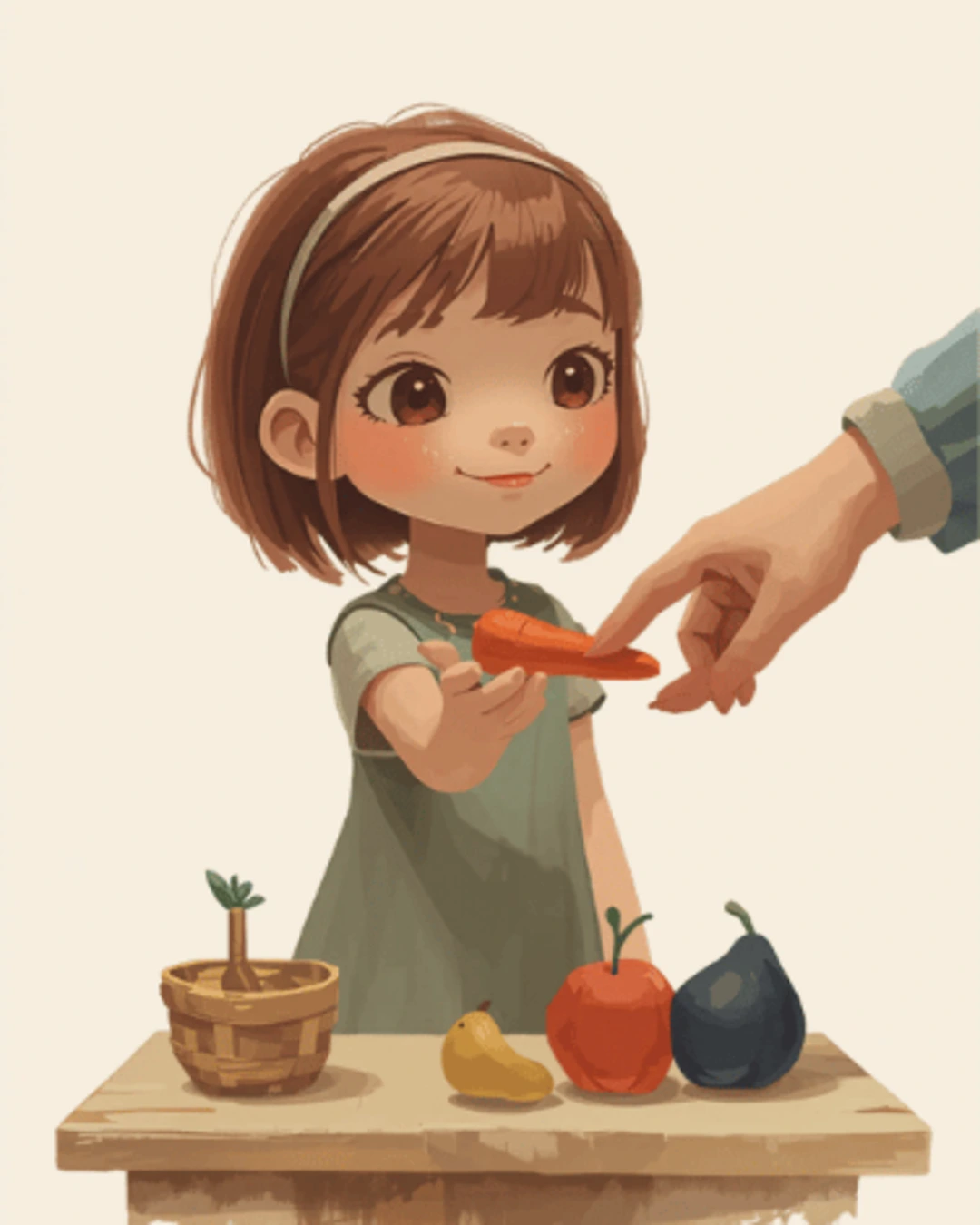
Practise serving: 'Would you like a piece of apple? Here you go!'
Model gratitude: 'Thank you for sharing with me — that's so kind'
Eat together and talk about how sharing made enough for both of you
Parent tip
Set out plastic containers before inviting your toddler in so the first minute feels smooth.
What success looks like
Back-and-forth between you — words, gestures, shared pretend. Connection is the real outcome here.
Put a pile of snack items on the table and one plate per person. Your toddler helps divide the food: 'One for you, one for me. One for you, one for me.' Then serve each other: 'Would you like a cracker? Here you go!' This concrete, one-to-one distribution makes fairness visible and tangible. The food element adds genuine motivation — they want what is on your plate too, creating a real-world sharing scenario with natural consequences and real rewards.
Why it helps
The EYFS framework identifies sharing and cooperative play as key social development milestones that children build through guided play experiences. One-to-one correspondence — giving one item at a time to each person — is both an early mathematical concept and the most concrete form of fairness a toddler can understand. This activity makes sharing visible and reciprocal rather than abstract. The food motivation ensures genuine engagement, and the turn-taking rhythm builds procedural memory for the sharing sequence. Over time, the pattern generalises from snacks to toys.
Variations
Include a teddy or doll as a third 'guest' who also needs a share — this adds counting and extends the fairness concept.
Let your toddler be the sole distributor while you say 'thank you' for each item — they experience the pleasure of giving.
Use the same technique with non-food items: stickers, crayons, building blocks.
Safety tips
Choose age-appropriate foods — avoid choking hazards like whole grapes, nuts, or hard sweets.
Supervise the distribution to ensure both plates end up roughly equal — perceived unfairness will backfire.
Never force your toddler to share food from their own plate once it has been distributed — the distributed plate is theirs.
Try one of these next
A few connected ideas chosen by theme, energy, set-up, and age fit.