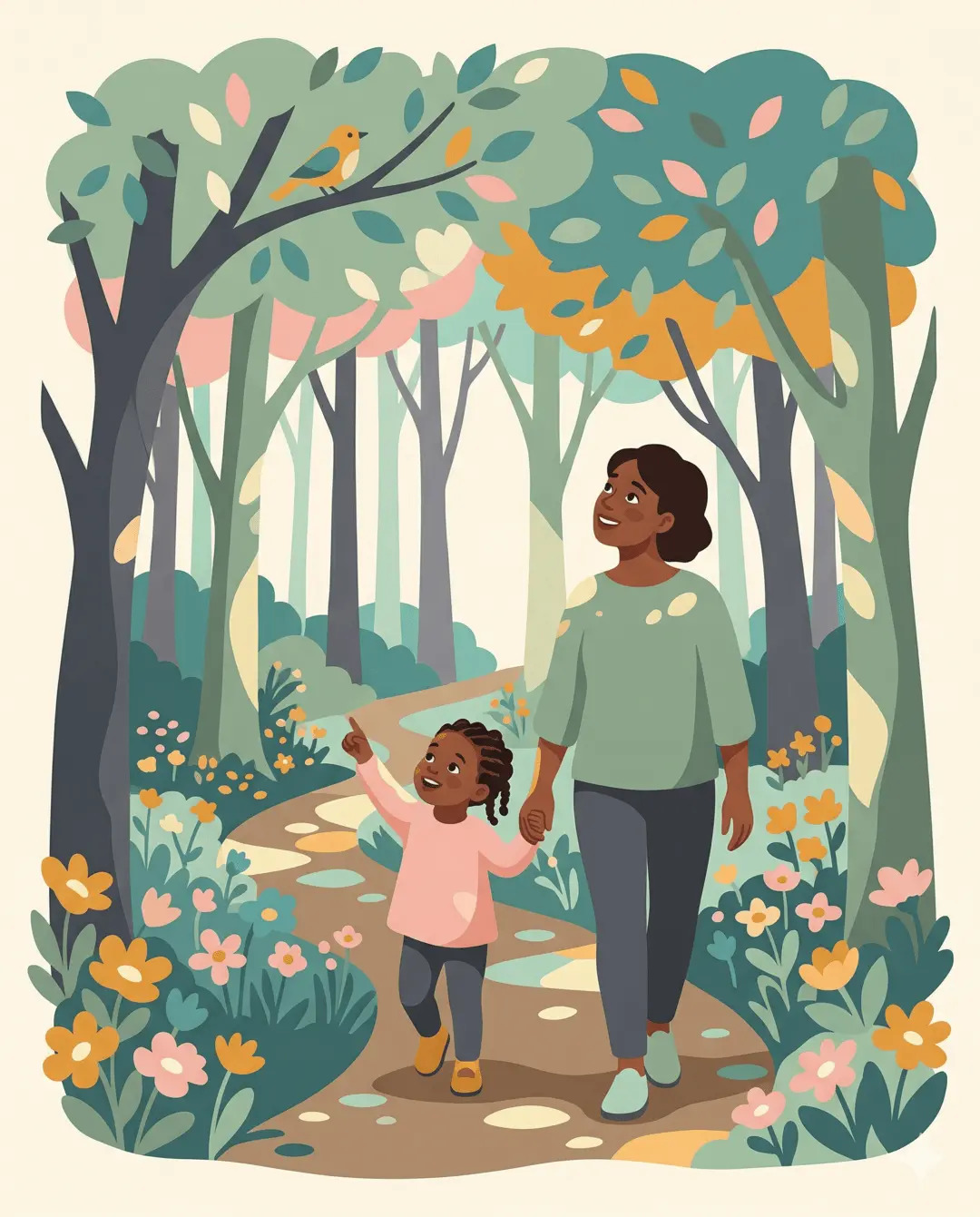
Slow down and explore outdoors using all five senses — touch bark, smell flowers, listen for birds, and feel the breeze.
Activity details
12m–4y20 minslowoutdoorNo prep
Instructions
Tiny Steps
Get ready
Choose a quiet outdoor route — a garden, park path, or nature trail works well. There's no destination; the walk itself is the activity.
Start with touch: 'Let's feel this tree — is it rough or smooth?' Guide your child's hand across bark, leaves, grass, and stones.
1/4
Choose a quiet outdoor route — a garden, park path, or nature trail works well. There's no destination; the walk itself is the activity.
Start with touch: 'Let's feel this tree — is it rough or smooth?' Guide your child's hand across bark, leaves, grass, and stones.
Move to smell: 'Close your eyes and sniff — what can you smell?' Hold flowers, herbs, or damp soil near their nose.
Listen: 'Let's stand very still and see what we can hear.' Cup your hands behind your ears and wait for birds, rustling, or distant sounds.
Look: 'What can you see that's moving?' Point out a butterfly, swaying branches, or a cloud drifting past.
If safe, taste: let a raindrop land on an outstretched tongue or nibble a washed berry from a known safe bush.
Collect one small treasure for each sense you explored — a textured leaf, a fragrant petal, an interesting stone.
Sit together at the end of the walk and lay out your treasures: 'This one we touched, this one we smelled — what a lot we noticed today!'
Parent tip
Start before you overthink it. No-prep activities work best when you begin while the moment is still recoverable.
What success looks like
Curiosity in action — pointing, collecting, asking ‘what’s that?’ A child engaged with nature is learning without knowing it.
A sensory nature walk turns an ordinary outing into an immersive exploration by deliberately engaging each sense one at a time. Instead of rushing to a destination, you pause to touch rough bark, smell damp earth, listen for birdsong, watch clouds move, and even taste a raindrop on a tongue. For toddlers whose sensory processing systems are still calibrating, this structured approach helps them attend to and make sense of the sensory-rich outdoor world. It is deeply calming and often works wonders for children who are overwhelmed or overstimulated.
Why it helps
Sensory integration — the brain's ability to organise and interpret information from the senses — is a critical developmental process in the first three years. NHS occupational therapy guidance recommends multi-sensory outdoor experiences as one of the best ways to support this development. By naming each sensation, you also build rich descriptive vocabulary and teach your child to consciously attend to one sensory channel at a time, which strengthens selective attention.
Variations
Create a simple 'senses checklist' with pictures (an eye, ear, hand, nose, mouth) and tick off each sense as you use it.
Do the same walk in different seasons and compare — winter smells different from summer, and the sounds change too.
For non-verbal or younger toddlers, model the sensory language yourself and watch for their reactions as you guide their hands and attention.
Safety tips
Never let your child taste unknown berries, mushrooms, or plants — only offer items you are certain are safe and clean.
Watch for stinging nettles, thorny bushes, and animal waste along the path, especially at toddler height.
Keep hold of your child's hand near water features, ponds, or uneven ground where a stumble could lead to a fall.
Try one of these next
A few connected ideas chosen by theme, energy, set-up, and age fit.