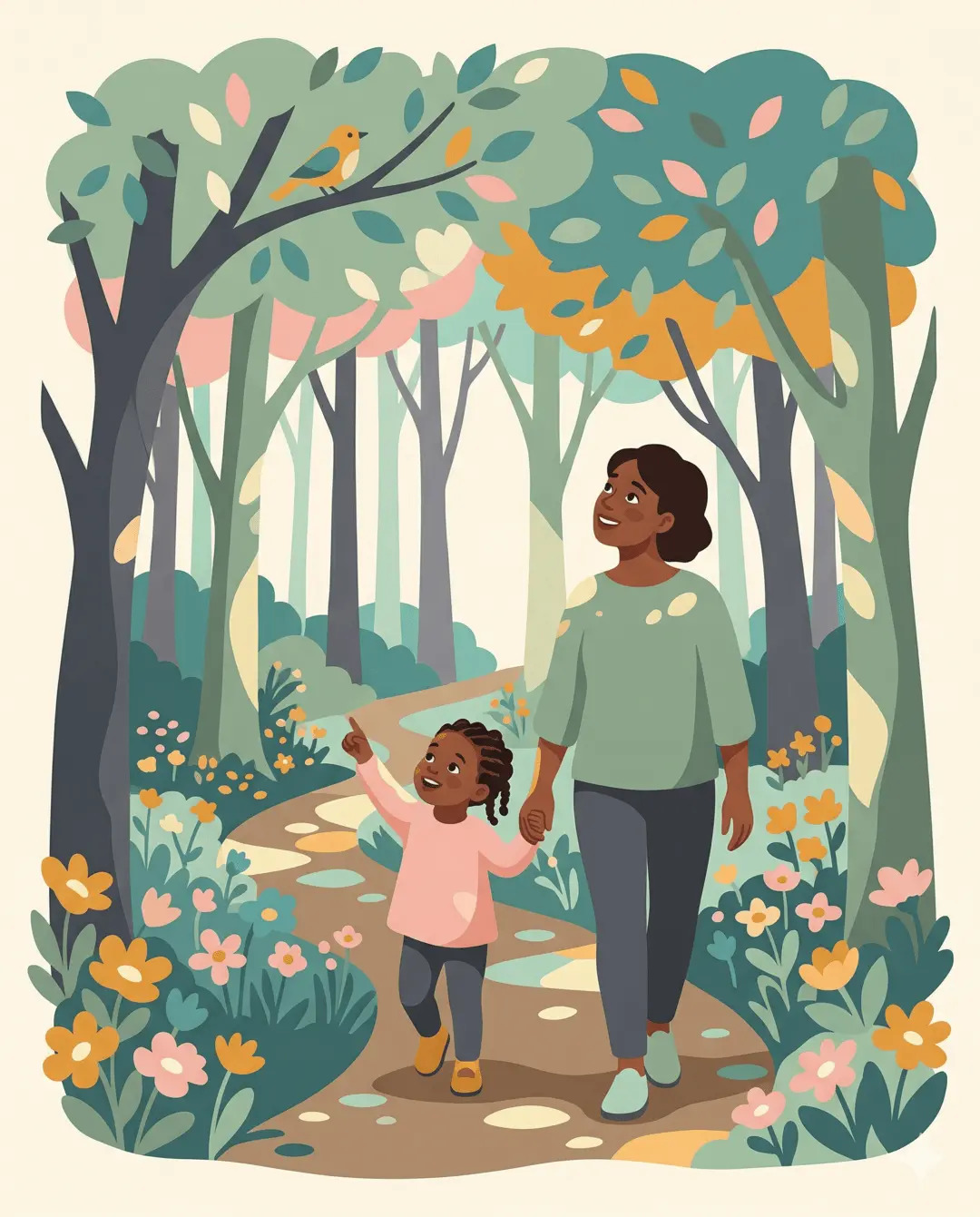
Lie on a blanket, look up at the sky, and take turns naming what the clouds look like.
Activity details
2y–4y10 minslowoutdoorNo prepBlankets
Instructions
Tiny Steps
Get ready
Spread a blanket on the grass in an open area with a clear view of the sky.
Lie down together on your backs, heads close so you can point in the same direction.
1/4
Spread a blanket on the grass in an open area with a clear view of the sky.
Lie down together on your backs, heads close so you can point in the same direction.
Point at a cloud and say: 'I think that one looks like a rabbit — can you see its ears?'
Wait for your child to respond — they might agree or see something completely different.
Ask: 'What do you see? What does that big one look like to you?'
Follow up with questions: 'Where is the rabbit going? What is it doing?'
Watch a cloud change shape together: 'Look — the rabbit is turning into a whale!'
When you are ready to finish, take three deep breaths together looking at the sky.
Parent tip
Start before you overthink it. No-prep activities work best when you begin while the moment is still recoverable.
What success looks like
Curiosity in action — pointing, collecting, asking ‘what’s that?’ A child engaged with nature is learning without knowing it.
You and your child lie on a blanket in the garden or park, looking up at the sky. Together you spot shapes in the clouds — a dog, a castle, a dinosaur. This gentle, no-equipment activity builds imaginative language, encourages shared attention, and provides a natural calm-down after active play.
Why it helps
Identifying shapes in ambiguous forms is a cognitive skill called pareidolia — it requires the brain to match incomplete visual information against known concepts. This activity also develops joint attention and descriptive language. Play England's research shows that unstructured outdoor downtime like this reduces cortisol levels and supports emotional regulation. The NHS advises that helping toddlers name and understand their feelings is one of the most important things parents can do for emotional development.
Variations
Bring crayons and paper, and draw what you saw in the clouds afterwards — extends the activity and adds a mark-making element.
For older toddlers, try building a cloud story together: 'Once upon a time, a cloud rabbit met a cloud dragon...'
Do it at sunset when clouds turn pink and orange — the colour change adds wonder and new vocabulary.
Safety tips
Never look directly at the sun — choose a position where the sun is behind you.
Check the ground for insects, animal droppings, or damp patches before laying the blanket.
Apply sun cream on sunny days, even if you are just lying down.
Try one of these next
A few connected ideas chosen by theme, energy, set-up, and age fit.