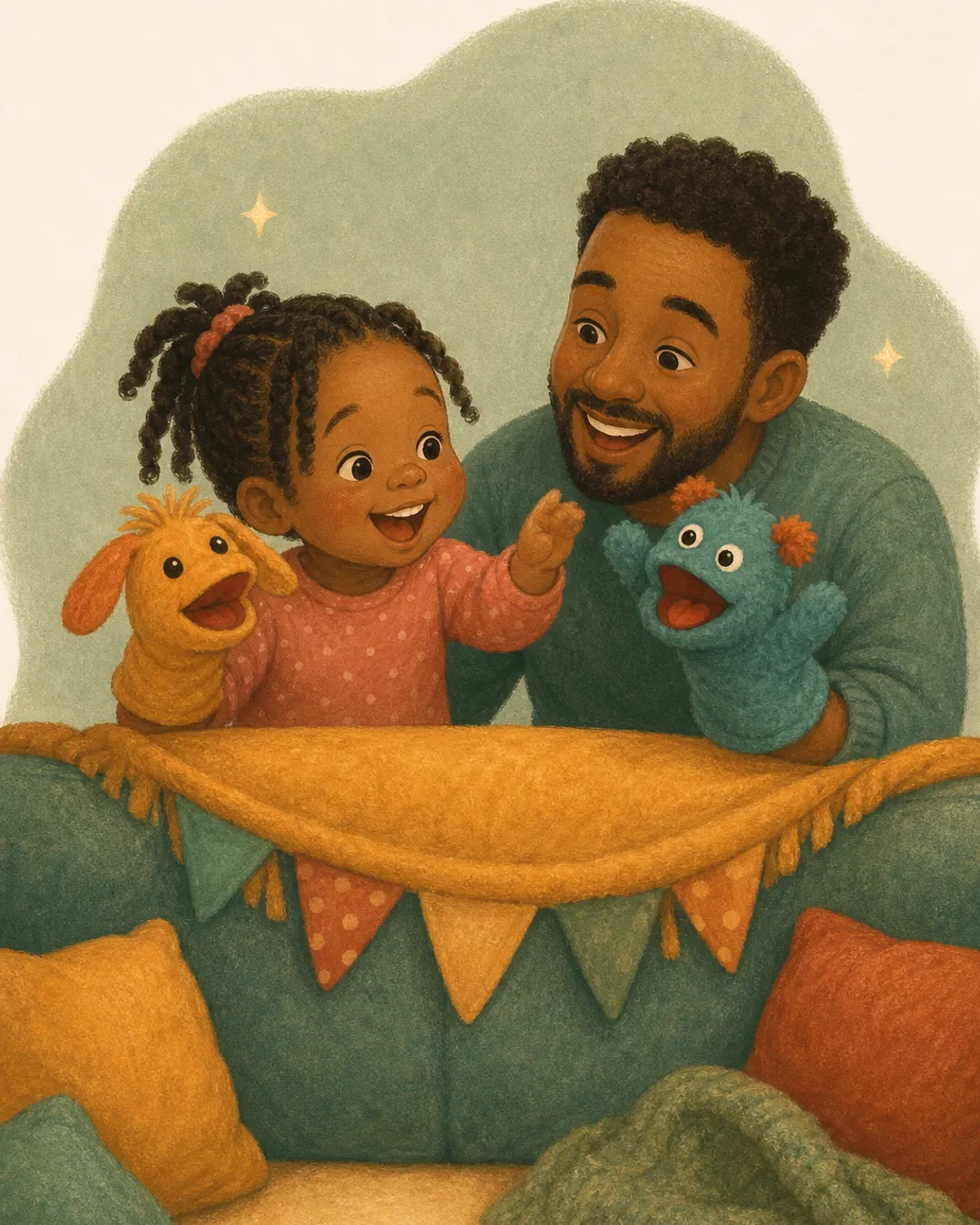
Make two simple sock puppets together — draw eyes with a marker or stick on felt pieces. Name each character.
Drape a blanket over two chairs to create a simple stage, or just sit behind the sofa.
1/4
Make two simple sock puppets together — draw eyes with a marker or stick on felt pieces. Name each character.
Drape a blanket over two chairs to create a simple stage, or just sit behind the sofa.
Put one puppet on your hand and ask your child 'Where is your puppet going today?'
Follow your child's lead — if they say 'to the moon,' go to the moon. Their story is always right.
Model story language: 'One day, Socky went to the moon and — oh no! — what did Socky find there?'
Use your puppet to ask questions: 'Hello! What's your name? Where are we going?' — this keeps the dialogue flowing.
When the story reaches a natural pause, say 'And then what happened?' to gently prompt the next event.
End with a clear story finish: 'And Socky went home and had a lovely nap. The end!' — clap and cheer together.
Parent tip
Set out blankets and felt pieces before inviting your toddler in so the first minute feels smooth.
What success looks like
Back-and-forth between you — words, gestures, shared pretend. Connection is the real outcome here.
Your child creates and performs a story using sock puppets, with you as the enthusiastic audience (and occasional co-actor). Inventing a narrative — even a simple one like 'the puppet went to the park and found a biscuit' — requires sequencing events, creating characters, and building a plot arc. These are the foundations of narrative competence, which research links directly to later reading comprehension and writing ability.
Why it helps
Speech and Language UK recommends looking at books together as a great way to help children learn new words and build communication skills. Narrative competence — the ability to construct and tell a coherent story — is strongly linked to reading comprehension because both require understanding character, sequence, and causation. When a child creates a puppet story, they are practising narrative schema construction: setting up a character, creating a problem, and resolving it. This oral storytelling skill transfers directly to understanding written stories and, later, to writing their own.
Variations
Record the puppet show on your phone and watch it back together — children love seeing their stories 'on screen.'
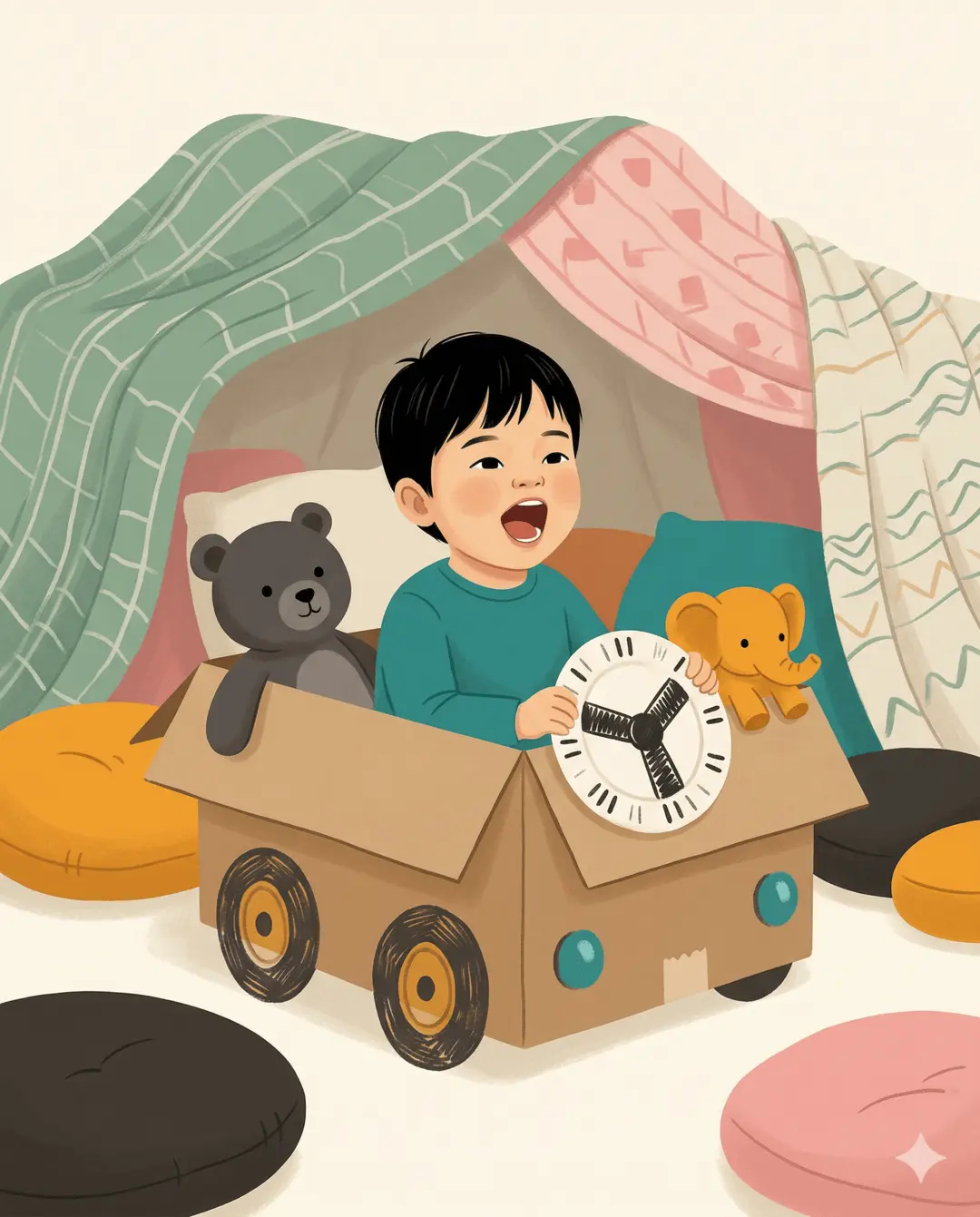
Add cardboard scenery: a paper plate sun, a blue scarf for a river — simple props deepen the world-building.
Invite a sibling or friend to join with their own puppet, creating collaborative storytelling.
Safety tips
If using markers on socks, ensure they are non-toxic in case the puppet ends up in a mouth.
Supervise blanket-fort stage construction — ensure it cannot collapse onto a child.
Keep small decorative items like buttons or felt eyes securely attached to prevent choking hazards.
Try one of these next
A few connected ideas chosen by theme, energy, set-up, and age fit.