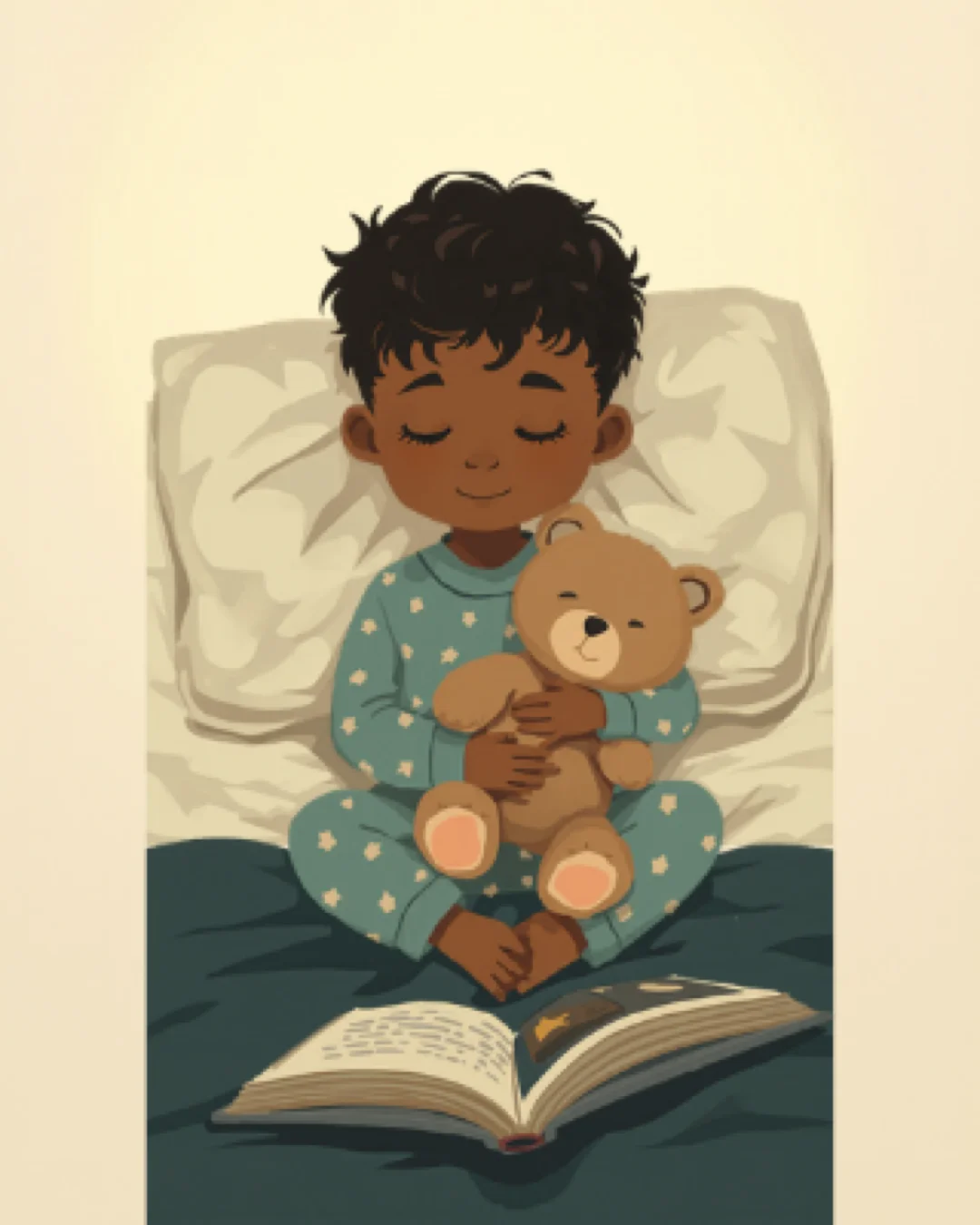
Flip through a picture book before reading it and guess what happens next from the illustrations alone.
Activity details
2y–4y15 minslowindoorNo prepPicture Books
Instructions
Tiny Steps
Get ready
Choose a picture book your child hasn't heard before — one with expressive illustrations and a clear story arc works best.
Show the cover and ask 'What do you think this story is about? Look at the picture — who can you see?'
1/4
Choose a picture book your child hasn't heard before — one with expressive illustrations and a clear story arc works best.
Show the cover and ask 'What do you think this story is about? Look at the picture — who can you see?'
Open to the first page and cover the text with your hand — only the picture is visible.
Ask 'What's happening here? What do you think will happen next?' Accept all answers warmly.
Turn to the next page and compare: 'You said the bear would go swimming — look, he's putting on his boots! Where might he be going?'
Continue through five or six pages, pausing at each to predict and then discover.
At a dramatic moment, stop and ask 'Oh no! What do you think happens now?' — build suspense and excitement.
After the picture walk, go back and read the actual text — your child will be deeply engaged because they already have their own version to compare.
Parent tip
Start before you overthink it. No-prep activities work best when you begin while the moment is still recoverable.
What success looks like
A few quiet minutes together without pressure. If your child relaxes even slightly, that’s self-regulation building.
Before reading the words, you and your child 'walk' through the pictures of a book, page by page, predicting what might happen in the story. This builds narrative schema — the mental framework for understanding that stories have a beginning, middle, and end — and teaches children to use visual clues to make meaning. It also shows that books carry stories even before a child can decode the text, building motivation to read.
Why it helps
Speech and Language UK recommends looking at books together as a great way to help children learn new words and build communication skills. Picture walks develop inferential thinking — the ability to make meaning beyond what is directly stated. This is a higher-order comprehension skill that transfers directly to reading comprehension later. Building a narrative schema (understanding story structure) through prediction also activates working memory and strengthens the brain's ability to hold and update mental models, both of which are critical for fluent reading.
Variations
Do a picture walk with a wordless picture book — your child narrates the entire story from the illustrations.
After the walk, ask your child to draw what they think the last page looks like before you reveal it.
Use a favourite book they know well and ask them to 'read' the pictures to a teddy — this builds retelling skills.
Safety tips
Choose books with age-appropriate content — some picture books have themes that may be too intense for younger toddlers.
Ensure the reading area is comfortable and well-lit to avoid eye strain during close-up picture study.
If your child loses interest, stop after a few pages — the activity should feel like a treat, not a task.
Try one of these next
A few connected ideas chosen by theme, energy, set-up, and age fit.