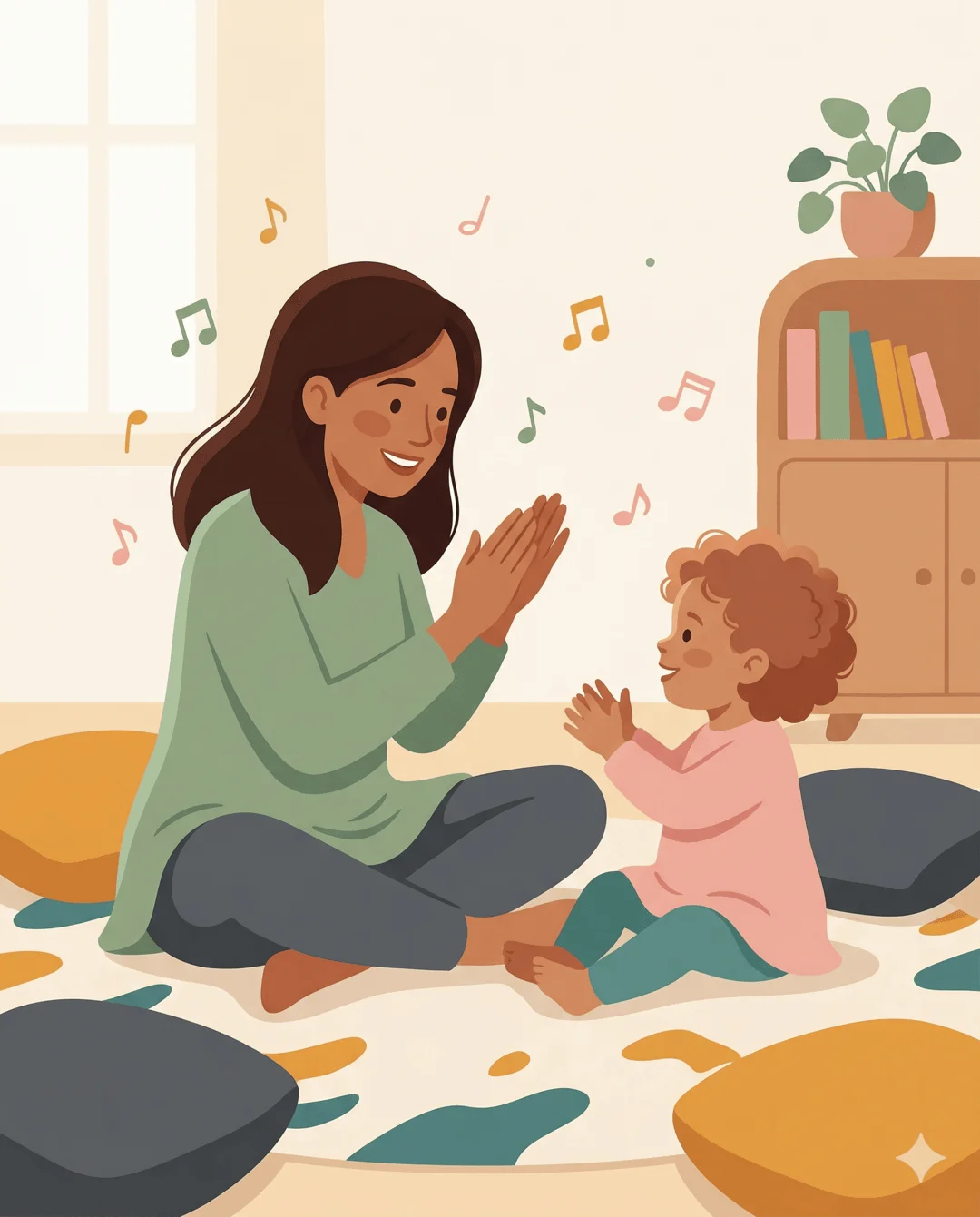
Tap simple rhythms on pots, tubs, and cushions together — following and creating patterns through sound and touch.
Activity details
12m–3y10 minslowindoorNo prepCushionsPlastic ContainersPots and Pans
Instructions
Tiny Steps
Get ready
Gather two or three tappable objects — an upturned pot, a cushion, and a plastic container all make distinct sounds.
Sit facing your child so they can see your hands clearly, and place the objects between you.
1/4
Gather two or three tappable objects — an upturned pot, a cushion, and a plastic container all make distinct sounds.
Sit facing your child so they can see your hands clearly, and place the objects between you.
Tap a very simple pattern: two slow taps on the pot. Pause. Smile. Wait for your child to try.
If they tap anything at all, celebrate warmly — matching the exact pattern is not the goal at first; joining in is.
Gradually add a second element: two taps on the pot, then one tap on the cushion. Keep it slow and steady.
Let your child lead a pattern and copy whatever they do — this reversal builds agency and confidence.
Try tapping the rhythm of a familiar word like their name: 'E-mi-ly' = three taps. Do it together several times.
Wind down by tapping more and more softly until you are barely touching the surface, then whisper 'All done' together.
Parent tip
Start before you overthink it. No-prep activities work best when you begin while the moment is still recoverable.
What success looks like
Watch for focused exploration — fingers digging in, pouring back and forth, or sorting by feel. Even a few minutes of this builds concentration.
This activity invites toddlers to explore rhythm by tapping objects with their hands or a wooden spoon, copying simple patterns you model. Rhythm is deeply connected to language processing — the brain uses the same timing mechanisms to parse speech and to track a beat. By keeping the patterns short and repeatable, children with processing differences can join in at their own pace without feeling rushed or left behind.
Why it helps
The EYFS framework identifies sequencing and planning as key cognitive skills that emerge through structured play activities in the early years. Rhythmic awareness supports auditory processing and temporal sequencing — the ability to understand that events happen in a predictable order. Research by Goswami (2011) shows that rhythmic sensitivity is strongly linked to phonological awareness and early reading. For children with cognition and learning differences, the multisensory nature of tapping (hearing the sound, feeling the vibration, seeing the movement) provides multiple pathways into the same concept.
Variations
Use body percussion instead of objects — tap knees, clap hands, pat tummy — so no materials are needed at all.
Add a visual cue by placing coloured stickers on each object and calling out the colour before you tap: 'Red, red, blue!'
For children who prefer less noise, use soft fabric squares or felt pieces on a table — the quiet tapping is just as rhythmic.
Safety tips
Check that pots and containers have no sharp edges or loose handles before your child taps them.
Wooden spoons can be swung enthusiastically — sit close enough to gently guide if needed.
Keep the volume comfortable; if your child covers their ears, switch to softer surfaces immediately.
Try one of these next
A few connected ideas chosen by theme, energy, set-up, and age fit.