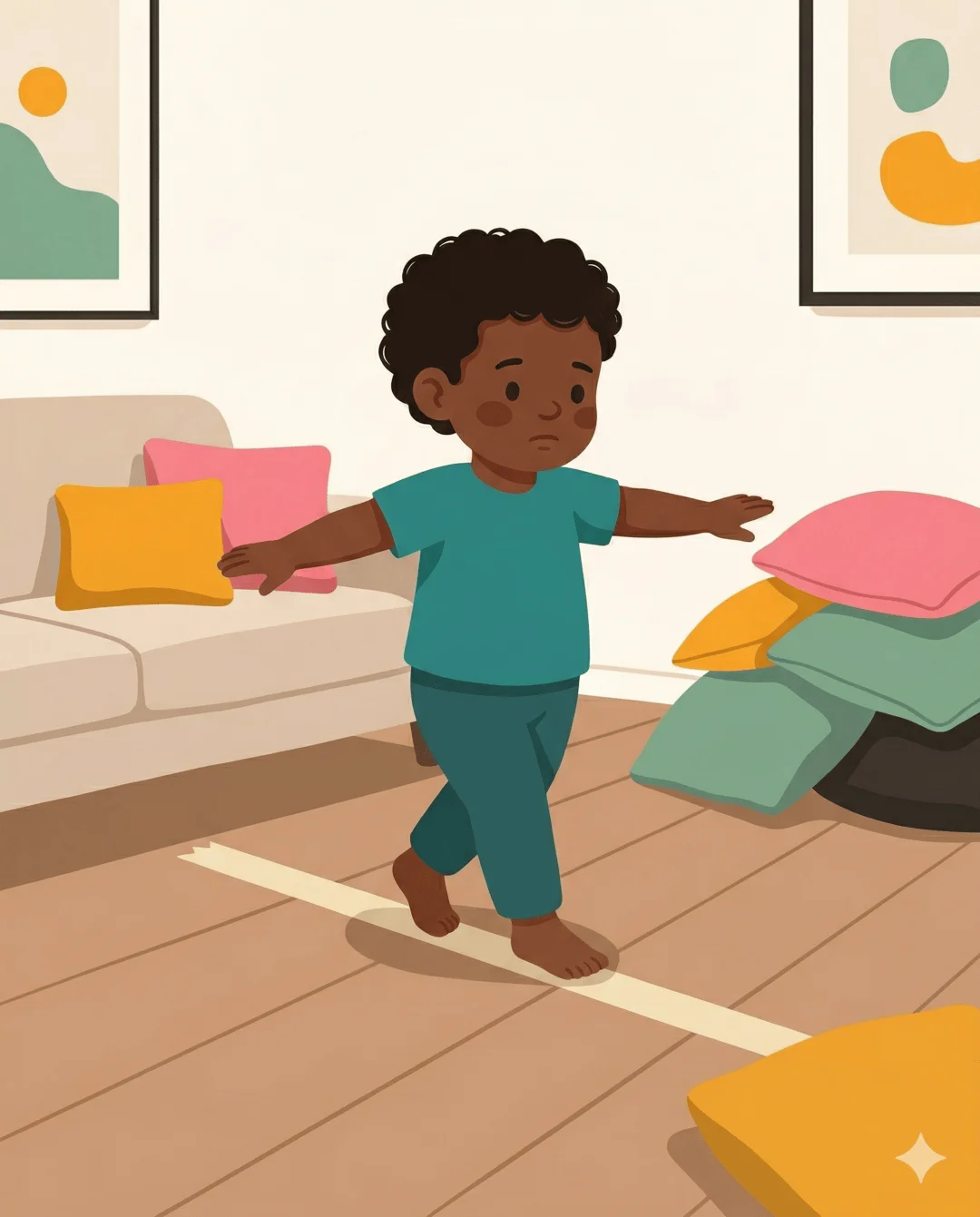
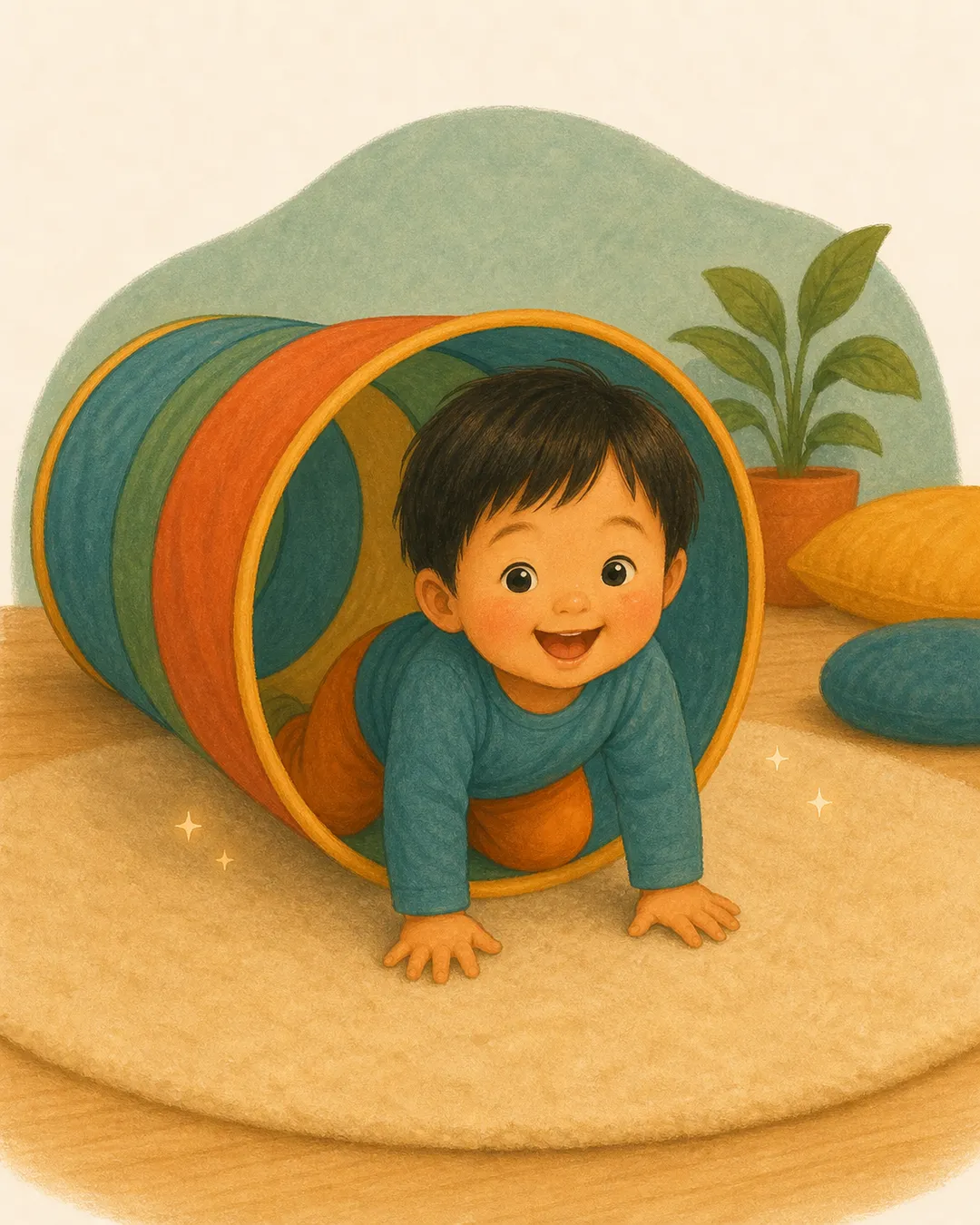
Set up a simple walking trail with textured stations for your early walker to toddle between and tap with their hands.
Activity details
12m–2y10 minsmediumbothNo prepCushionsFoilPots and PansWooden Spoons
Instructions
Tiny Steps
Get ready
Choose three or four household items with different textures — a metal pot lid, a cushion, a sheet of foil scrunched loosely, and a wooden spoon on the floor.
Place them in a rough line or circle about one to two metres apart in a clear space.
1/4
Choose three or four household items with different textures — a metal pot lid, a cushion, a sheet of foil scrunched loosely, and a wooden spoon on the floor.
Place them in a rough line or circle about one to two metres apart in a clear space.
Walk your child to the first station and tap it together: 'Tap tap! That's cold and hard!'
Point to the next station and encourage them to toddle over: 'Can you walk to the squishy one?'
At each station, tap together and name what you feel — cold, soft, crinkly, smooth.
Once your child knows the route, stand at the far end and call them towards you: 'Come and tap the crinkly one!'
Let them toddle back and forth freely, choosing their favourite stations — repetition is exactly what their legs need.
When interest wanes, gather the items together and let your child help carry one back — a satisfying job to finish.
Parent tip
Start before you overthink it. No-prep activities work best when you begin while the moment is still recoverable.
What success looks like
Flushed cheeks, big smiles, and a calmer child afterwards. If they want to do it again, you’ve found a winner.
New walkers crave purposeful destinations — give them a reason to toddle and they will practise those wobbly steps all morning. This activity places three or four textured items (a pot, a cushion, a crinkly sheet of foil) at short distances apart so your child walks between them, tapping each one as they arrive. The combination of walking and hand contact provides proprioceptive feedback through both legs and arms, strengthening the neural pathways that stabilise upright balance.
Why it helps
The EYFS framework places understanding cause and effect at the heart of early cognitive development, recognising it as a building block for scientific and mathematical thinking. Early walkers need frequent, low-pressure opportunities to practise upright locomotion with a clear purpose. Goal-directed walking — toddling towards something interesting — activates the motor planning centres of the brain more effectively than aimless wandering. The tactile element at each station adds sensory feedback that reinforces the cause-and-effect connection: 'I walked there, and something interesting happened.'
Variations
Take the trail outdoors and use natural textures — a smooth stone, a patch of grass, a wooden bench leg — for an entirely different sensory experience.
Add a bell or rattle at one station so your child hears a reward sound when they arrive and tap it.
For confident walkers, increase the distance between stations gradually, building stamina and confidence over days.
Safety tips
Ensure the walking path is free of tripping hazards and that floor surfaces are non-slip — avoid polished wood or tiles in socks.
Check all items are stable and won't topple onto your child when tapped.
Stay within arm's reach throughout, as early walkers can lose balance suddenly and without warning.
Try one of these next
A few connected ideas chosen by theme, energy, set-up, and age fit.