Parent tip
Set out balls and basket or bin before inviting your toddler in so the first minute feels smooth.

Create a 'YES throw' zone and a 'NO throw' zone on the floor — teaching throwing rules through clear, visual boundaries.
Tiny Steps
Set out balls and basket or bin before inviting your toddler in so the first minute feels smooth.

Flushed cheeks, big smiles, and a calmer child afterwards. If they want to do it again, you’ve found a winner.
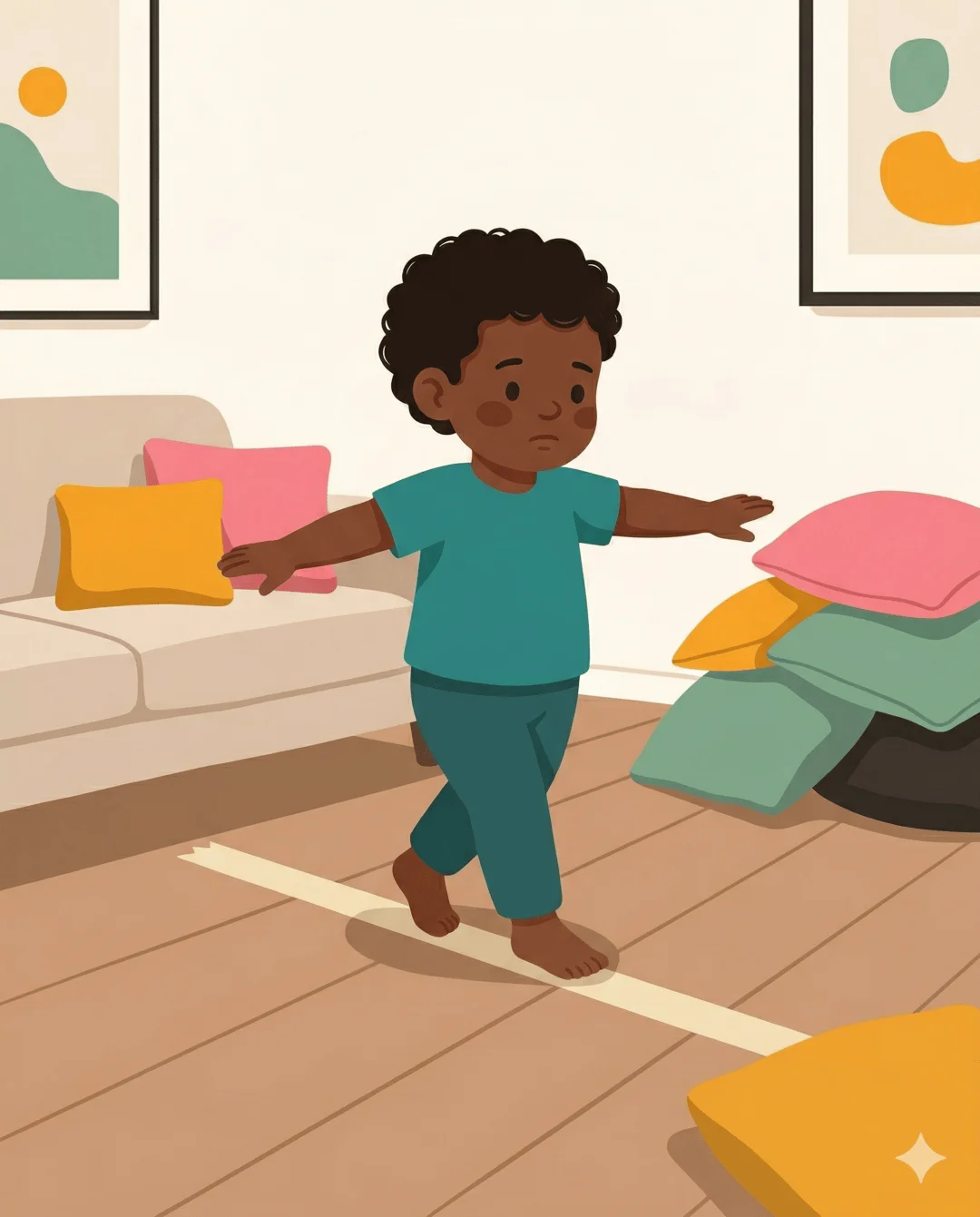
Use masking tape to mark two zones on the floor. The 'YES' zone has a basket, cushions, and soft balls — throwing is celebrated here. The 'NO' zone has books, cups, and toys — these are placed gently. Practise together: 'Balls go in the YES zone — throw!' Then: 'Books live in the NO zone — we put them gently.' This concrete, visual rule system works because toddlers think in absolutes. Instead of the abstract 'don't throw things,' they learn a physical, repeatable rule they can see.
NHS Best Start in Life recommends practising throwing, catching and kicking a ball as simple activities that teach coordination, balance and agility. Toddlers learn rules best when they are concrete, visual, and consistent. Abstract rules like 'don't throw' are cognitively impossible to follow because they suppress a natural motor urge without offering an alternative. This activity leverages categorical thinking — a cognitive skill developing rapidly between 18 and 36 months — by teaching 'what to throw' rather than 'not to throw,' which aligns with how the developing prefrontal cortex processes rules.
One email a week with practical toddler activities, behaviour tips, and developmental insights. No spam, unsubscribe any time.