Shake hidden containers filled with different items and guess what is inside by listening carefully to the sound.
Activity details
12m–2y8 minslowindoorRice or PastaYoghurt Pots
Instructions
Tiny Steps
Get ready
Take 4 small containers with lids (yoghurt pots, plastic bottles, or small Tupperware). Fill each with something different: dry rice, a few buttons or coins, water, dry pasta.
Seal the lids securely — tape them shut if needed.
1/4
Take 4 small containers with lids (yoghurt pots, plastic bottles, or small Tupperware). Fill each with something different: dry rice, a few buttons or coins, water, dry pasta.
Seal the lids securely — tape them shut if needed.
Show your child each container before hiding them: 'This one has rice — listen!' Shake it. 'This one has water — listen!' Shake it.
Now hide the containers behind a scarf or towel.
Pick one up and shake it: 'What can you hear? Is it the rice or the water?'
Let your child point or babble their answer. If they are unsure, shake the visible reference containers to compare.
Reveal the answer: 'It was the pasta! Well done for listening!'
Swap roles — let your child shake one for you to guess. Exaggerate your thinking: 'Hmm, that sounds rattly... is it the rice?'
Parent tip
Set out rice or pasta and yoghurt pots before inviting your toddler in so the first minute feels smooth.
What success looks like
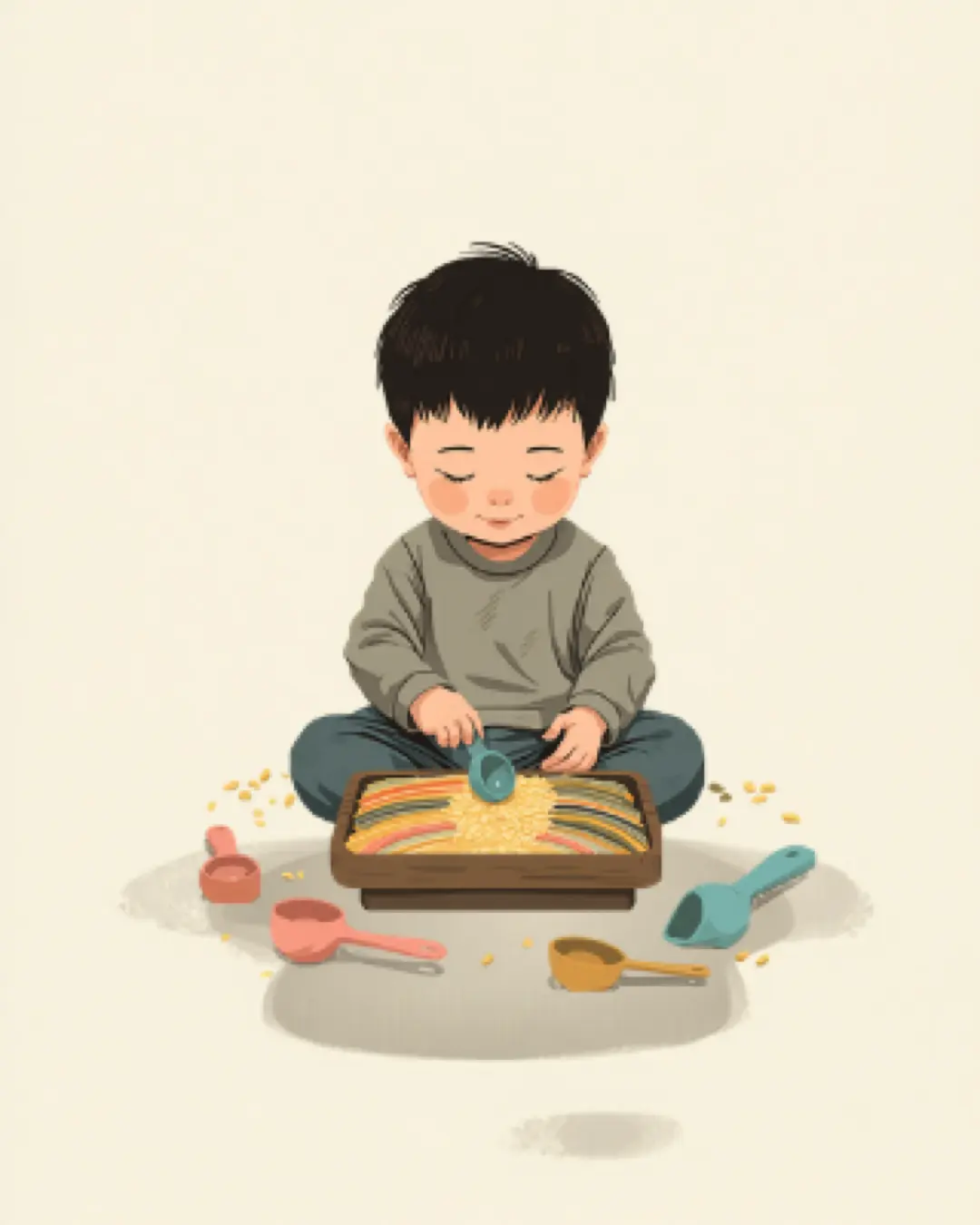
Watch for focused exploration — fingers digging in, pouring back and forth, or sorting by feel. Even a few minutes of this builds concentration.
Fill small containers with rice, buttons, water, and pasta. Shake each one behind a scarf so your child cannot see, then let them guess which is which. The listening element builds auditory discrimination — the ability to distinguish between similar sounds — which is a foundational skill for later phonics and reading. The guessing adds a cognitive challenge that keeps even young toddlers engaged.
Why it helps
Auditory discrimination — the ability to tell the difference between similar sounds — is a precursor to phonemic awareness, which research identifies as the strongest predictor of early reading success. Speech and Language UK highlights that children who practise distinguishing between environmental sounds in the first two years find it easier to distinguish between speech sounds (like 'b' and 'p') when they begin learning to read.
Variations
Use musical instruments instead of containers — a drum, a bell, a maraca — for bolder sound contrasts with younger children.
Add more containers with subtler differences (lentils vs rice, sand vs salt) for older toddlers who need more challenge.
Play 'which one is missing?' — shake three in a row, then remove one and shake the remaining two. Can they identify the absent sound?
Safety tips
Seal all containers securely — small items like rice and buttons are choking hazards if lids come off.
Supervise throughout and do not let your child open the containers independently.
Avoid glass containers — use plastic only, in case they are dropped or thrown.
Try one of these next
A few connected ideas chosen by theme, energy, set-up, and age fit.