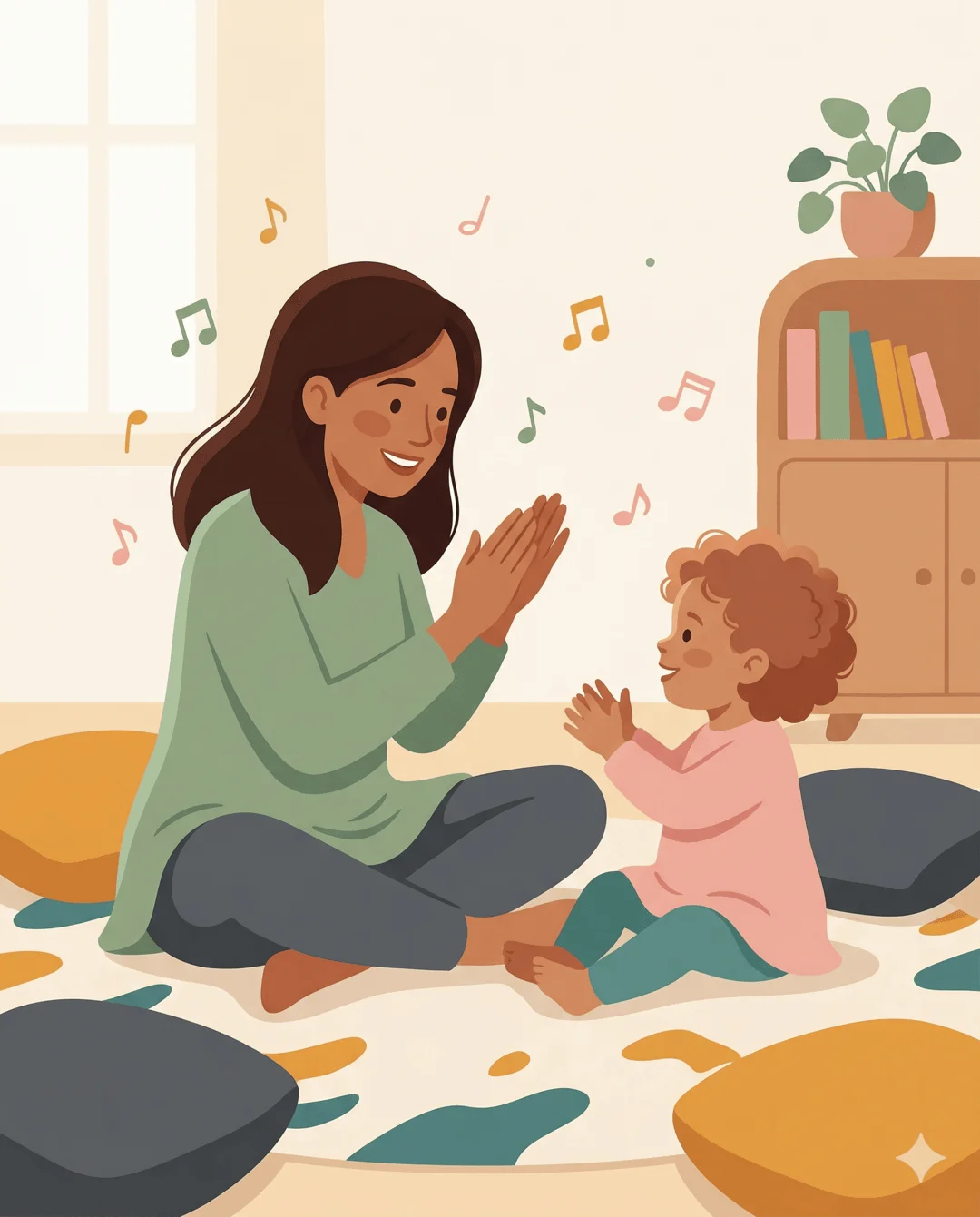
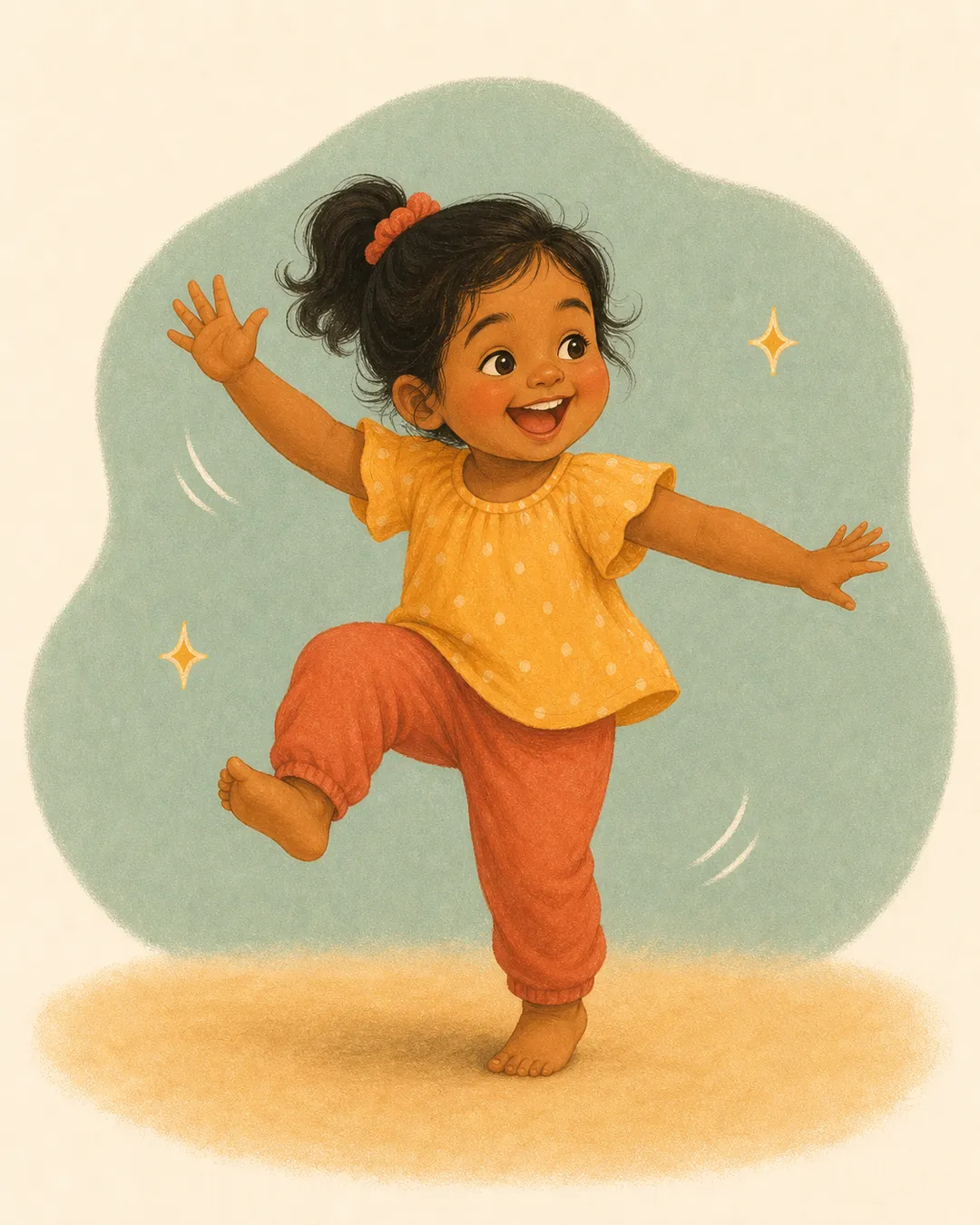
Sing familiar nursery rhymes with simple hand signs and gestures — bridging the gap between understanding and speaking for early communicators.
Activity details
12m–2y10 minsmediumbothNo prep
Instructions
Tiny Steps
Get ready
Sit facing your child so they can see your face, hands, and mouth clearly.
Start with a familiar song — 'Twinkle Twinkle Little Star' works beautifully — and sing it slowly.
1/4
Sit facing your child so they can see your face, hands, and mouth clearly.
Start with a familiar song — 'Twinkle Twinkle Little Star' works beautifully — and sing it slowly.
For 'twinkle,' open and close your hands like twinkling stars. For 'star,' point upwards. Make the signs big and clear.
Sing the song twice through, repeating the same gestures each time.
On the third round, pause before a key word and wait — does your child attempt the sign or the word? Either counts.
Move to an action song like 'Wind the Bobbin Up' where the whole body gets involved — winding, pulling, clapping.
Follow your child's lead: if they want the same song five times in a row, that repetition is building their confidence to try the words.
Finish with a calm song like 'Twinkle Twinkle' sung very softly, with your child on your lap, signs shrinking to gentle finger movements.
Parent tip
Start before you overthink it. No-prep activities work best when you begin while the moment is still recoverable.
What success looks like
Flushed cheeks, big smiles, and a calmer child afterwards. If they want to do it again, you’ve found a winner.
Between 12 and 18 months, most toddlers understand far more words than they can say. Simple signing alongside familiar songs gives them a way to communicate before their spoken vocabulary catches up. This activity pairs well-known nursery rhymes — 'Twinkle Twinkle,' 'Wind the Bobbin Up,' 'Row Row Row Your Boat' — with easy hand movements that represent key words. The rhythmic, repetitive nature of songs makes them the fastest route to both gestural and spoken language, because melody and rhythm support memory and recall.
Why it helps
Research in developmental linguistics consistently shows that children who learn simple signs alongside spoken language develop larger spoken vocabularies by age two, because signing reduces frustration and keeps the communication channel open during the pre-verbal period. The NHS 12-18 month communication milestones include gesturing, pointing, and understanding simple instructions — all of which this activity directly targets. Music is a particularly effective vehicle because the rhythmic patterns are processed by both hemispheres of the brain, strengthening memory encoding.
Variations
Introduce signs for everyday words beyond songs — 'more,' 'milk,' 'all done' — and use them consistently at mealtimes and play.
Use a mirror so your child can see their own hands while signing, which strengthens the motor-visual connection.
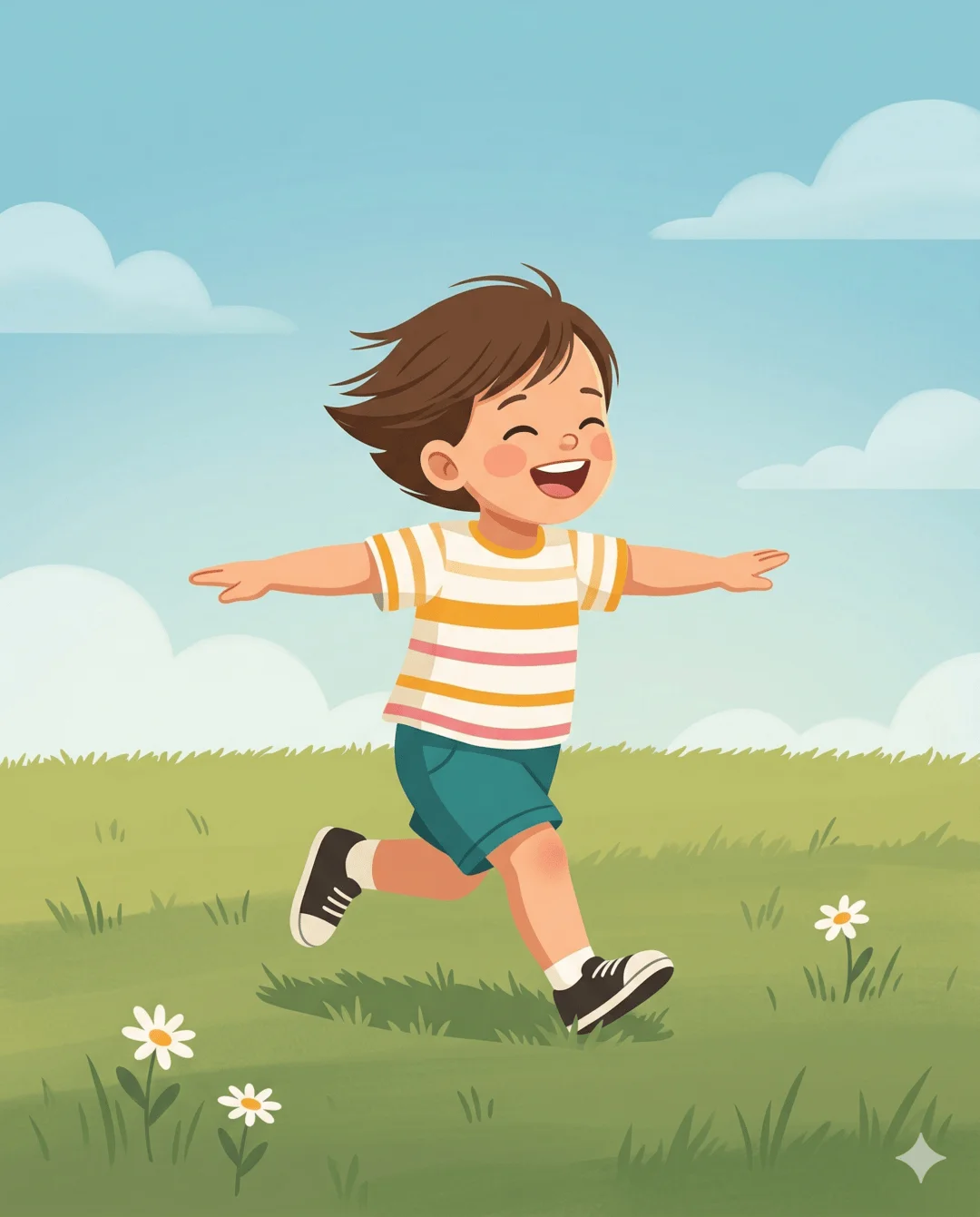
For toddlers who love movement, stand up and add whole-body actions — jumping for 'star,' crouching for 'under' — combining gross motor with language.
Safety tips
Sing at a moderate volume — very loud singing close to a toddler's face can be overwhelming or startle them.
If your child seems frustrated by the signs, drop back to simply singing and enjoying the music together — there is no rush.
Ensure the space is clear if you move to standing action songs, as excited toddlers may topple when clapping or waving.
Try one of these next
A few connected ideas chosen by theme, energy, set-up, and age fit.