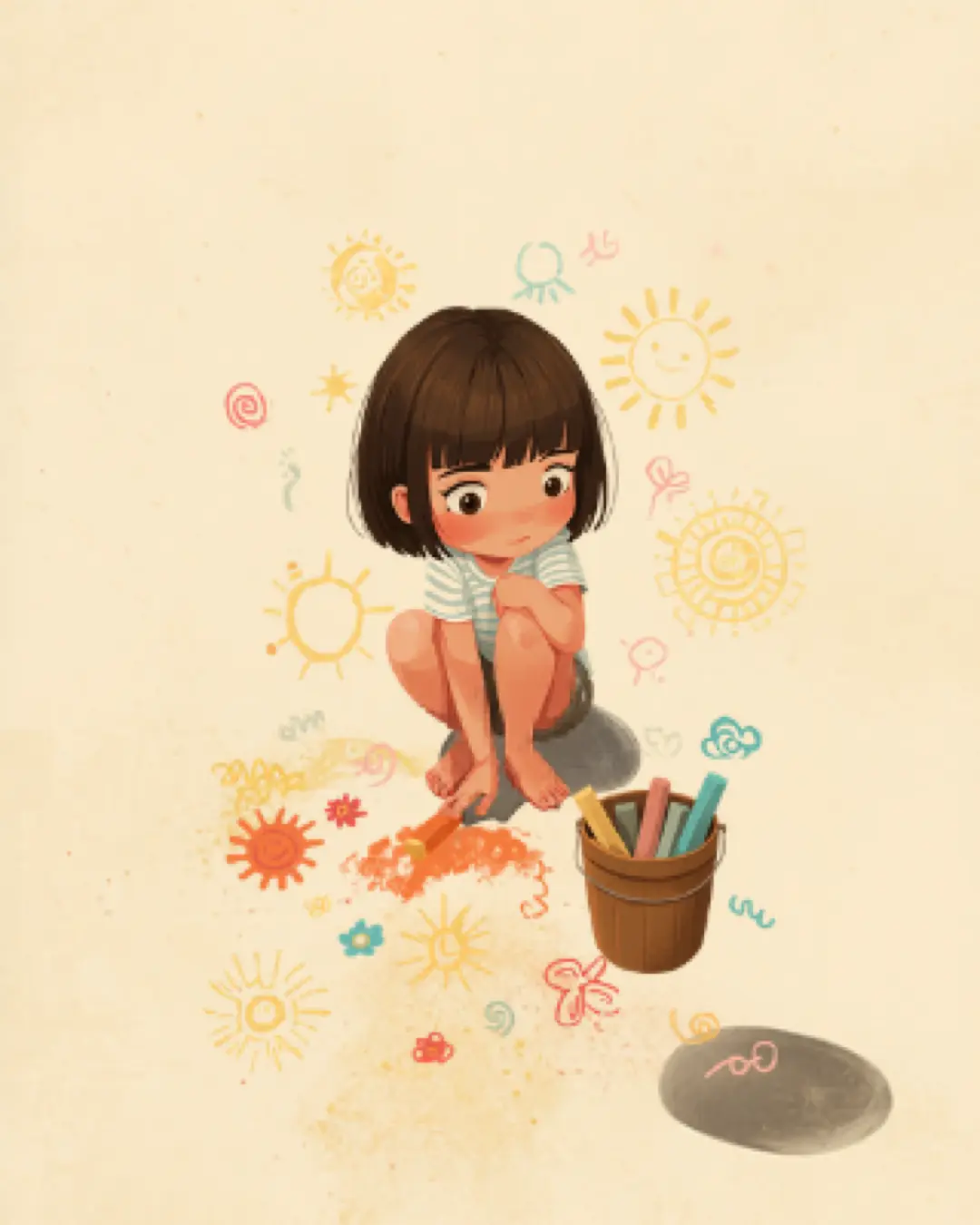
Fill a tray with a thin layer of sand or salt and let your child draw with their fingers — an endlessly erasable, mess-contained canvas.
Activity details
19m–3y15 minslowindoorSaltTowels
Instructions
Tiny Steps
Get ready
Pour a thin layer of sand, salt, or semolina into a shallow tray (a baking tin works perfectly).
Smooth the surface flat: 'Look — a blank canvas! What shall we draw?'
1/4
Pour a thin layer of sand, salt, or semolina into a shallow tray (a baking tin works perfectly).
Smooth the surface flat: 'Look — a blank canvas! What shall we draw?'
Demonstrate: draw a circle with your finger. 'Your turn!'
Step back and let them explore. Fingers, sticks, the back of a spoon — any tool works.
When the surface is full of marks, show the magic: shake the tray gently. 'It is blank again! Draw something new!'
If they want to copy letters or shapes, draw one and let them trace beside it.
Let them play freely — lines, swirls, dots, scribbles are all valid.
When finished, pour the sand back into a jar for next time: 'Your sand tray is always ready for drawing.'
Parent tip
Set out salt and towels before inviting your toddler in so the first minute feels smooth.
What success looks like
Watch for focused exploration — fingers digging in, pouring back and forth, or sorting by feel. Even a few minutes of this builds concentration.
Spread a thin layer of sand, salt, or semolina in a shallow tray. Your child draws with their finger, a stick, or the back of a spoon. A gentle shake erases everything and they start again. The low-stakes, infinitely erasable surface encourages experimentation without fear of 'getting it wrong'. Children draw lines, circles, letters, faces, and patterns — then shake and start fresh. The tactile sensation of the gritty surface adds a calming sensory dimension.
Why it helps
Mark-making in sand or salt develops the same pre-writing muscles and movements as pencil-on-paper but without the performance anxiety. The EYFS Literacy framework identifies mark-making as a key early writing milestone, and research shows that varied writing surfaces (sand, clay, finger paint) build stronger motor patterns than pencil-only practice. The erasable nature of sand removes the fear of mistakes, encouraging children to experiment with larger, bolder movements that build the shoulder stability needed for controlled handwriting.
Variations
Add a few drops of essential oil (lavender) to the sand for a calming, multi-sensory experience.
Use coloured sand or mix food colouring into salt for a more visually interesting surface.
Bury small flat objects under the sand and let your child 'discover' them by brushing the sand away — combines archaeology with mark-making.
Safety tips
Supervise sand or salt play — these materials should not be eaten in large quantities or rubbed in eyes.
Lay a towel under the tray to catch spills — sand on hard floors creates a slip hazard.
If using coloured sand, check it is non-toxic — craft sand from reputable suppliers is safest.
Try one of these next
A few connected ideas chosen by theme, energy, set-up, and age fit.