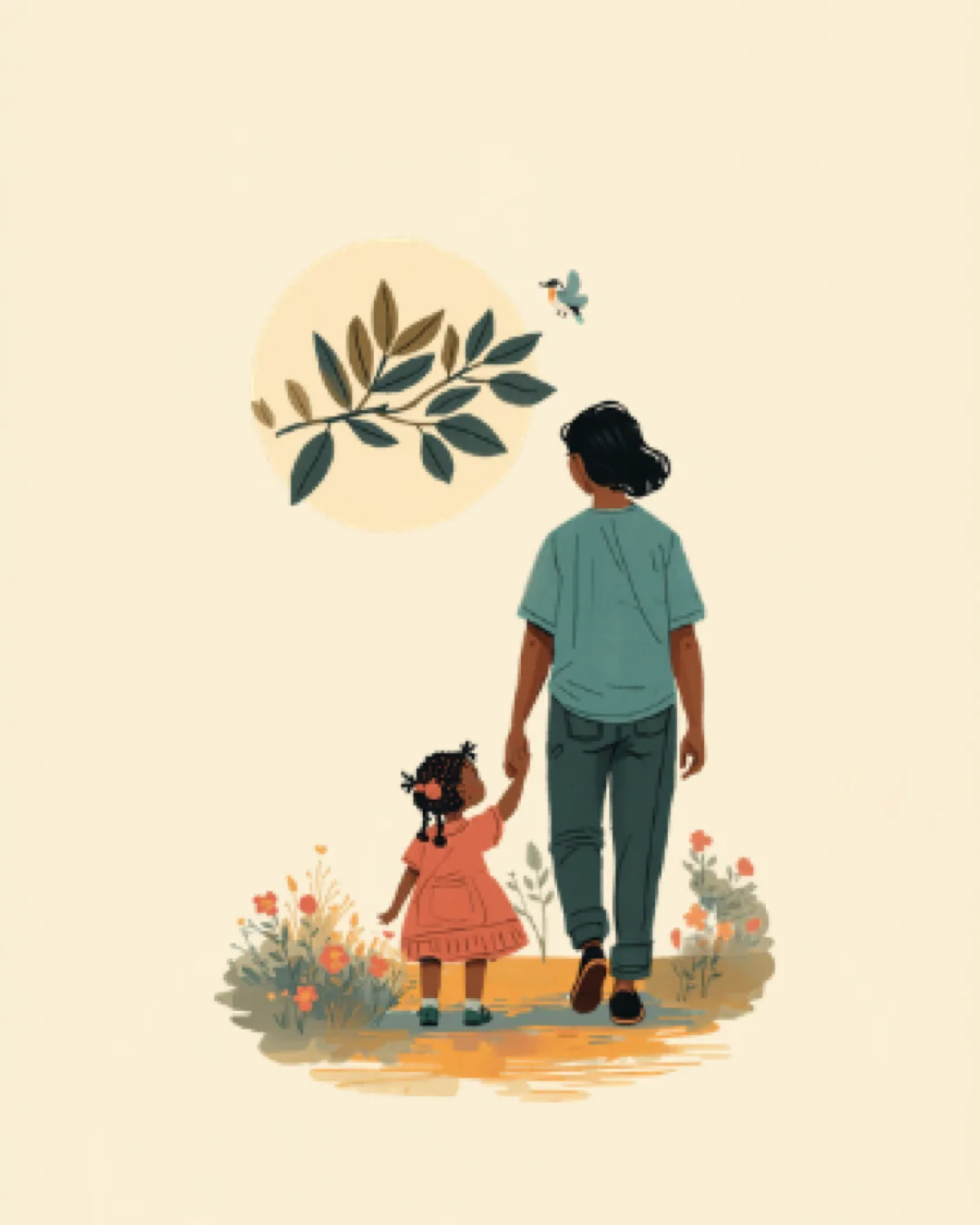
A smooth pebble carried in a pocket as a tangible stand-in for parental love.
Activity details
2y–4y10 minslowbothRocks
Instructions
Tiny Steps
Get ready
On a walk together, find a smooth, palm-sized pebble.
Let your child choose the one that feels right to them.
1/4
On a walk together, find a smooth, palm-sized pebble.
Let your child choose the one that feels right to them.
Wash it together at home and let it dry.
Hold it in your hands and say: 'I am putting all my love into this pebble. Can you feel it getting warm?'
Place it in your child's pocket: 'Now you have my love right there whenever you need it.'
Practise: 'If you feel wobbly, squeeze the pebble. That is me giving you a hug.'
Remind them at key moments: nursery drop-off, bedtime, or when you leave the room.
Let the pebble live in a special spot at home when not being carried.
Parent tip
Set out rocks before inviting your toddler in so the first minute feels smooth.
What success looks like
Curiosity in action — pointing, collecting, asking ‘what’s that?’ A child engaged with nature is learning without knowing it.
Find a smooth pebble together on a walk and declare it the love pebble. Your child carries it in their pocket. When they miss you or feel wobbly, they squeeze it. 'That is my love in that pebble — can you feel it?' The sensory weight in their pocket is a concrete, tangible stand-in for your presence. Toddlers think in physical terms — love they can hold in their hand is more real than love they are told about.
Why it helps
AAP HealthyChildren describes transitional objects as items that help children 'make the emotional transition from dependence to independence,' noting that 'when they are separated from you, it will reassure them' and that such objects 'are not a sign of weakness or insecurity.' A pebble in a pocket provides both the sensory weight of something to squeeze and the emotional weight of a shared ritual. The child can feel it without anyone seeing, which makes it work in contexts — nursery, the supermarket, a friend's house — where a larger comfort object would not.
Variations
Paint the pebble together with a heart or your child's initial to make it personal.
Make two matching pebbles — one for the child, one for the parent — so you are both carrying the connection.
For older toddlers, let them choose a different pebble for different feelings: one for bravery, one for calm.
Safety tips
Choose a pebble large enough not to be a choking hazard — bigger than a golf ball for under-threes.
Check pockets before washing clothes to avoid damage to machines.
If the pebble is taken to nursery, inform staff so they understand its significance and do not confiscate it.
Try one of these next
A few connected ideas chosen by theme, energy, set-up, and age fit.