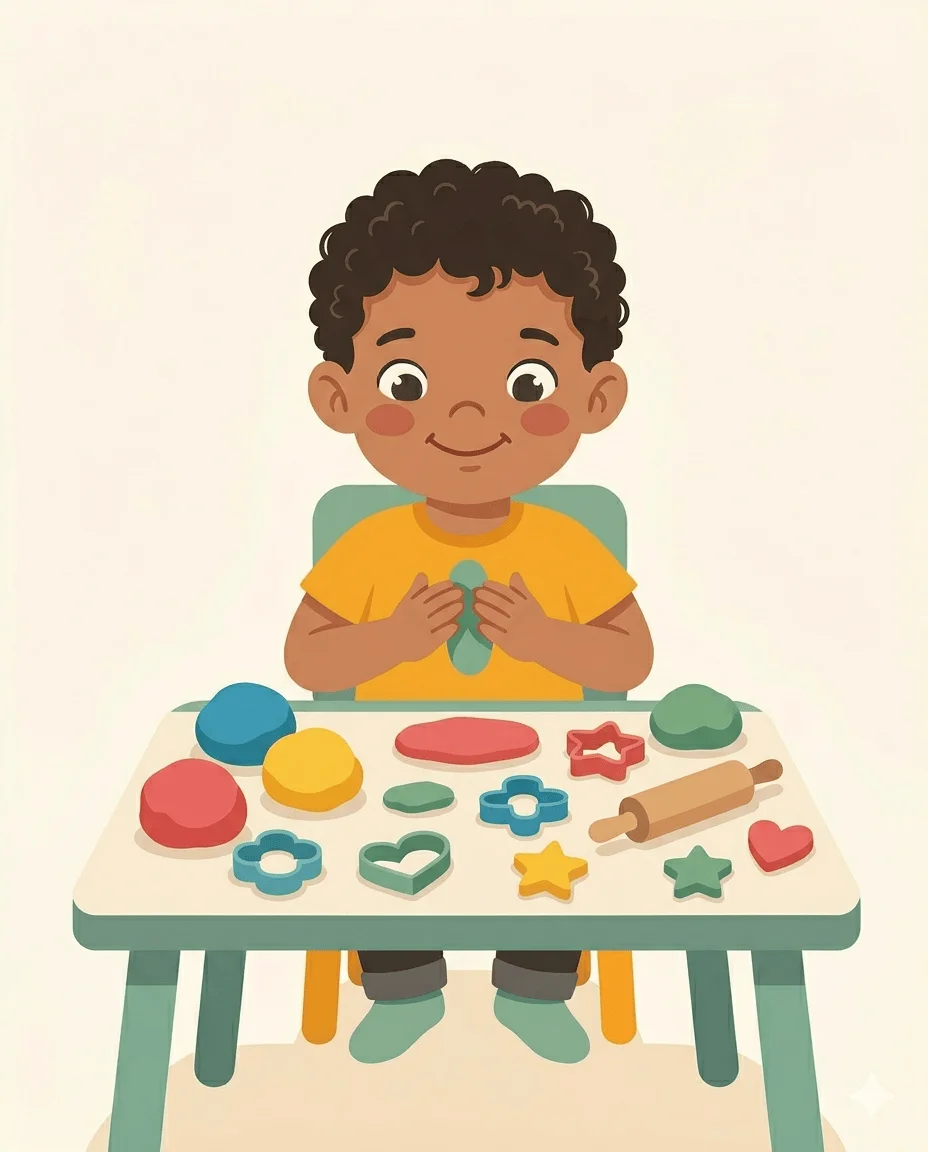
Set out play dough in several colours on a protected table surface, along with a rolling pin, cookie cutters, and plastic plates or lids.
Announce the plan: 'Teddy and Bunny are hungry — shall we make a picnic for them?'
1/4
Set out play dough in several colours on a protected table surface, along with a rolling pin, cookie cutters, and plastic plates or lids.
Announce the plan: 'Teddy and Bunny are hungry — shall we make a picnic for them?'
Show your child how to roll a sausage shape: 'Roll the dough back and forth — look, a sausage for the picnic!'
Demonstrate flattening a ball into a biscuit shape, then pressing a pattern with a fork: 'Push the fork in — see the dots? That's how bakers do it.'
Let your child create freely — any shape counts as food. Name what they make: 'That looks like a pizza! And those are grapes!'
Arrange the finished food on plates, and set out a blanket with stuffed animals seated around it.
Role-play serving the food: 'Would Teddy like a sandwich? Here you are, Teddy — enjoy!'
After the picnic, 'wash up' together by gathering all the dough back into balls and putting it away in containers.
Parent tip
Set out blankets and cookie cutters before inviting your toddler in so the first minute feels smooth.
What success looks like
Messy hands and a child who doesn’t want to stop. The artwork doesn’t need to look like anything — the process is the point.
This activity blends creative dough play with imaginative role play by giving children a clear purpose: making food for a pretend picnic. They roll sausages, flatten circles into biscuits, shape balls into apples, and arrange everything on plates for their stuffed animal guests. The dual focus on sculpting and storytelling keeps children engaged far longer than open-ended dough play alone, and the picnic setup at the end provides a natural, satisfying conclusion.
Why it helps
This activity sits at the intersection of creative play and symbolic play, which Vygotsky identified as the leading activity of the preschool period. When a child shapes dough into a 'sandwich' and serves it to a teddy, they are using one thing to represent another — the cognitive foundation of literacy, mathematics, and abstract thinking. The fine motor demands of rolling, pressing, and shaping simultaneously build the hand strength needed for later writing.
Variations
Provide real kitchen tools — a garlic press for spaghetti, a potato masher for waffles — to create more realistic-looking food.
Take the picnic outdoors on a real blanket, adding natural items like leaves as plates and sticks as cutlery.
Extend the activity by making a menu: draw pictures of the food your child made, and use it to 'order' at the picnic.
Safety tips
Ensure your child understands the difference between play dough food and real food — remind them gently if they try to eat it.
If using homemade dough, avoid adding essential oils or strong fragrances that might irritate sensitive skin.
Wash hands after play, particularly before eating any real snacks that follow.
Try one of these next
A few connected ideas chosen by theme, energy, set-up, and age fit.