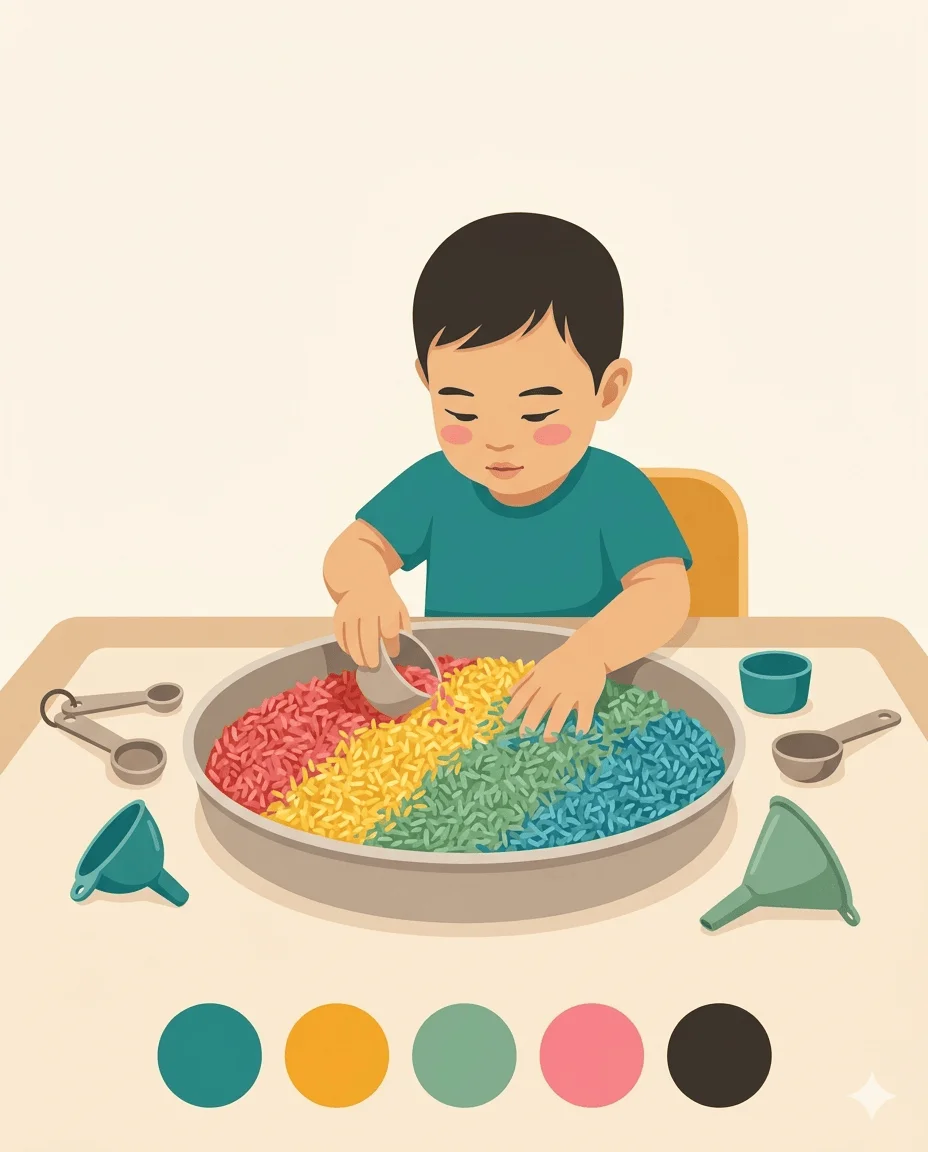
Bury small objects in a rice tray and dig for ones that start with a target sound — phonics through sensory play.
Activity details
2y–3y12 minslowindoorPlastic ContainersRice or Pasta
Instructions
Tiny Steps
Get ready
Fill a shallow tray or baking tin with dry rice (about 2cm deep).
Collect 8-10 small objects from around the house. Choose pairs that share a first sound: sock and spoon (s), car and cup (c), ball and button (b), fork and feather (f), toy and towel (t).
1/4
Fill a shallow tray or baking tin with dry rice (about 2cm deep).
Collect 8-10 small objects from around the house. Choose pairs that share a first sound: sock and spoon (s), car and cup (c), ball and button (b), fork and feather (f), toy and towel (t).
Let your child bury all the objects in the rice — the hiding is half the fun.
Say: 'I am looking for things that start with sssss. Can you dig and find something that goes sssss?'
When they pull something out, emphasise the first sound together: 'SSSS-poon! Yes! S for spoon!'
If they pull out a non-matching object: 'That is a cup — c-c-cup. Does that start with sss? No! Put it back and keep digging!'
Once all matching objects are found, choose a new sound and go again.
Finish by letting them play freely in the rice — the sensory element is a reward in itself.
Parent tip
Set out plastic containers and rice or pasta before inviting your toddler in so the first minute feels smooth.
What success looks like
Watch for focused exploration — fingers digging in, pouring back and forth, or sorting by feel. Even a few minutes of this builds concentration.
Fill a tray with rice and bury 8-10 small objects. Call out a sound — 'sss' — and your child digs through the rice to find everything that starts with that sound: spoon, sock, star. The sensory richness of digging through rice keeps hands busy while the brain practises phonemic awareness — the ability to isolate the first sound in a word, which is the single strongest predictor of reading success.
Why it helps
Phonemic awareness — specifically the ability to isolate initial sounds — is the strongest predictor of later reading ability, according to longitudinal research cited by the National Literacy Trust. Pairing this skill with a sensory-rich tactile activity creates a dual-coded memory: the feel of the rice and the satisfaction of digging anchor the phonics lesson in embodied experience. The EYFS Literacy framework identifies 'hearing and saying the initial sound in words' as a key early literacy milestone for this age range.
Variations
Use sand, lentils, or shredded paper instead of rice for a different tactile experience.
For younger children, simplify: bury only objects that start with one sound and ask them to find all the things.
Add a competitive element with a sibling: each child gets a different sound and races to find their objects first.
Safety tips
Supervise rice play closely — dry rice is a choking hazard if put in the mouth, and can be uncomfortable if pushed into ears or nostrils.
Choose objects that are too large to swallow — nothing smaller than a golf ball for children who still mouth objects.
Lay a sheet or towel under the tray to make rice cleanup easier — it will spread.
Try one of these next
A few connected ideas chosen by theme, energy, set-up, and age fit.