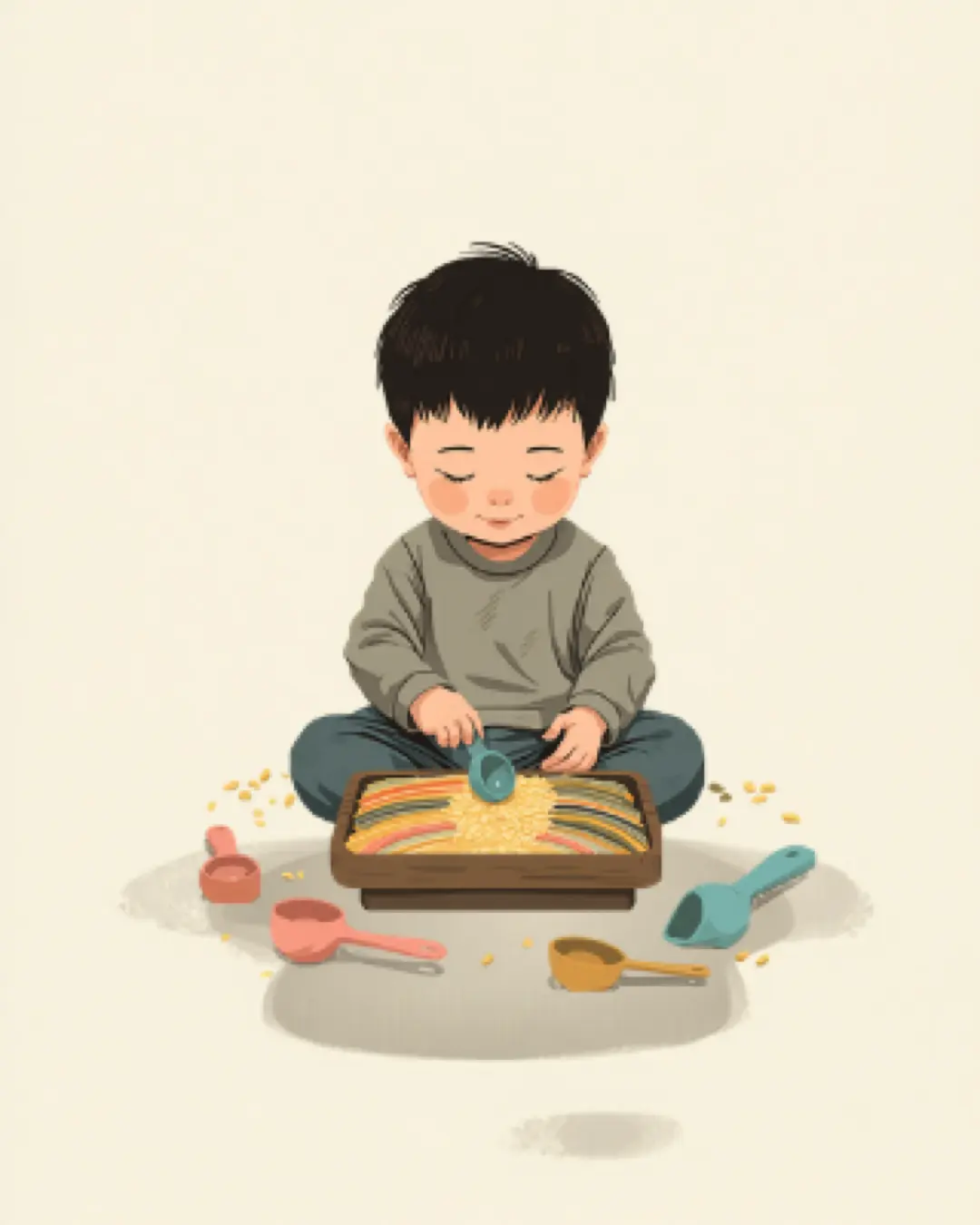
Scoop, pour, and transfer rice or water between containers — a repetitive, calming activity that builds hand control and concentration.
Activity details
12m–3y15 minslowbothMeasuring CupsPlastic ContainersRice or PastaSmall PitcherTowels
Instructions
Tiny Steps
Get ready
Place a large tray or towel on the floor to catch spills — containment is easier than clean-up.
Set out two or three plastic containers of different sizes and a small pitcher or measuring cup.
1/4
Place a large tray or towel on the floor to catch spills — containment is easier than clean-up.
Set out two or three plastic containers of different sizes and a small pitcher or measuring cup.
Fill one container with dried rice (or water if you prefer) and leave the others empty.
Show your child how to scoop and pour: 'I'm filling this cup up… and now I'm pouring it into the big bowl!'
Let them take over. Resist the urge to correct — spilling is learning, and the tray will catch it.
Narrate what you see: 'You're filling it right to the top! Now it's pouring out — whoosh!'
Introduce a funnel or a small pitcher to vary the pouring challenge — different openings require different hand movements.
When they show signs of finishing, pour everything back into one container together: 'Let's fill the big one all the way up. One, two, three… pour!'
Parent tip
Set out measuring cups and plastic containers before inviting your toddler in so the first minute feels smooth.
What success looks like
Watch for focused exploration — fingers digging in, pouring back and forth, or sorting by feel. Even a few minutes of this builds concentration.
A simple station with two or three containers and a scooping material (dried rice, water, or sand) gives toddlers an endlessly repeatable sensory and motor experience. The repetitive nature of filling and pouring is inherently calming and provides a predictable sequence that children with anxiety or attention differences find soothing. At the same time, the fine motor challenge of controlling a pour builds hand strength and bilateral coordination — both hands must work together to hold, tilt, and catch.
Why it helps
Pouring and scooping activities are a Montessori staple because they develop hand-eye coordination, bilateral hand use, and concentration in a low-pressure format. Repetitive, predictable sensory activities have been shown to reduce cortisol levels in young children, making them particularly beneficial for those with emotional regulation or sensory processing differences. The open-ended nature means there is no failure state — every pour is a success.
Variations
Add small toys hidden in the rice for a treasure-hunt element — scooping to find them adds motivation.
Use coloured water and let them pour between clear containers to see the colour mix.
Take the activity outdoors with sand and a bucket — the larger scale adds gross motor involvement.
Safety tips
If using dried rice, supervise closely with children who still put objects in their mouth — rice can be a choking hazard in quantity.
Mop up water spills promptly to prevent slipping on hard floors.
Ensure plastic containers have no cracks that could trap small fingers.
Try one of these next
A few connected ideas chosen by theme, energy, set-up, and age fit.