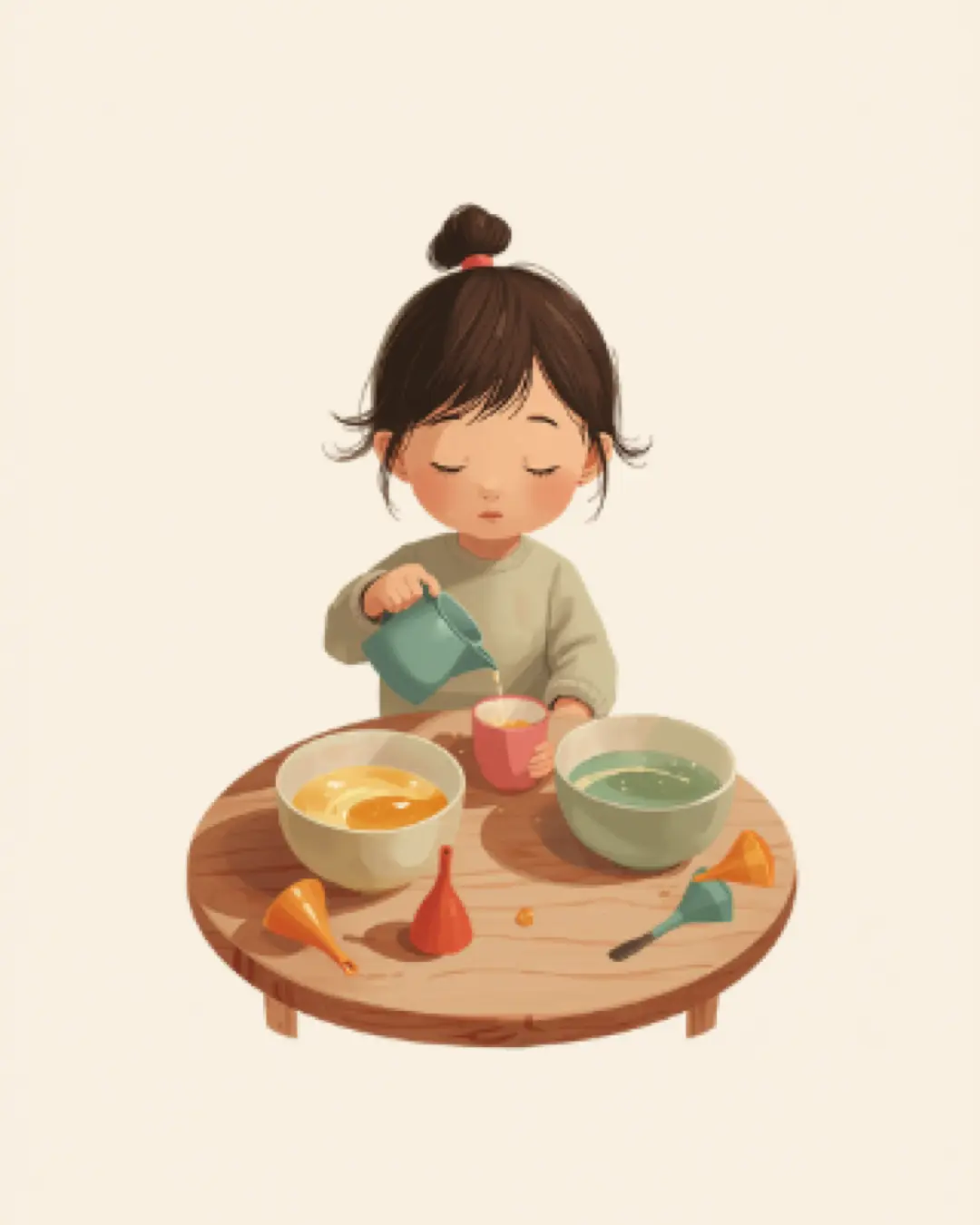
Gather a selection of different-sized containers — measuring cups, yoghurt pots, a small pitcher, plastic cups, and a funnel if you have one.
Line them up along the bath edge where your child can reach them easily from the water.
1/4
Gather a selection of different-sized containers — measuring cups, yoghurt pots, a small pitcher, plastic cups, and a funnel if you have one.
Line them up along the bath edge where your child can reach them easily from the water.
Show how to scoop water and pour it into another container: 'Fill this big cup — now pour it into the little one. What happens?'
Let your child discover overflow: 'Oh! The little cup is too full — the water's spilling over! That's because it's smaller.'
Introduce the funnel: 'Try pouring through this — watch where the water comes out the bottom!'
Count together as they fill: 'How many small cups does it take to fill the big one? Let's count — one, two, three!'
Try pouring from different heights: 'Pour from up high — listen to the splash! Now pour from down low — much quieter.'
As bath time ends, let your child pour the last cup of water over their own knees or toes as a gentle goodbye to the water.
Parent tip
Set out measuring cups and plastic cups before inviting your toddler in so the first minute feels smooth.
What success looks like
Watch for focused exploration — fingers digging in, pouring back and forth, or sorting by feel. Even a few minutes of this builds concentration.
Pouring water between containers of different sizes is one of the richest mathematical and scientific learning experiences available to toddlers, and the bath is the perfect place for it because mess is irrelevant. Your child fills, empties, compares, and transfers water while naturally encountering concepts like volume, capacity, full, empty, more, and less. The repetitive filling and pouring action is also deeply calming and meditative, making this an ideal wind-down activity before bed that keeps little hands busy while the body relaxes in warm water.
Why it helps
Pouring and transferring water develops hand-eye coordination and bilateral coordination — using one hand to hold and the other to pour. The mathematical language embedded in the play (full, empty, more, less, bigger, smaller) lays foundations for early numeracy. Montessori educators identify water pouring as a key 'practical life' activity that builds concentration, independence, and a sense of order in very young children.
Variations
Poke small holes in a yoghurt pot to create a shower effect — toddlers love watching water stream out from multiple points.
Add a sponge and show how it soaks up water, then squeeze it out into a cup — a brilliant fine motor challenge.
Float a lightweight plastic bowl and challenge your child to fill it without sinking it — an exercise in patience and control.
Safety tips
Never leave your child unattended in the bath, even for a moment — drowning can happen silently in very shallow water.
Ensure all containers are plastic with no sharp edges — avoid glass measuring jugs or metal cups.
Keep the water at a comfortable temperature and top up with warm water if the bath cools during extended play.
Try one of these next
A few connected ideas chosen by theme, energy, set-up, and age fit.