Each person holds half the puzzle pieces — you cannot finish without working together. Sharing becomes the only way to succeed.
Activity details
2y–4y10 minslowindoorJigsaw Puzzle
Instructions
Tiny Steps
Get ready
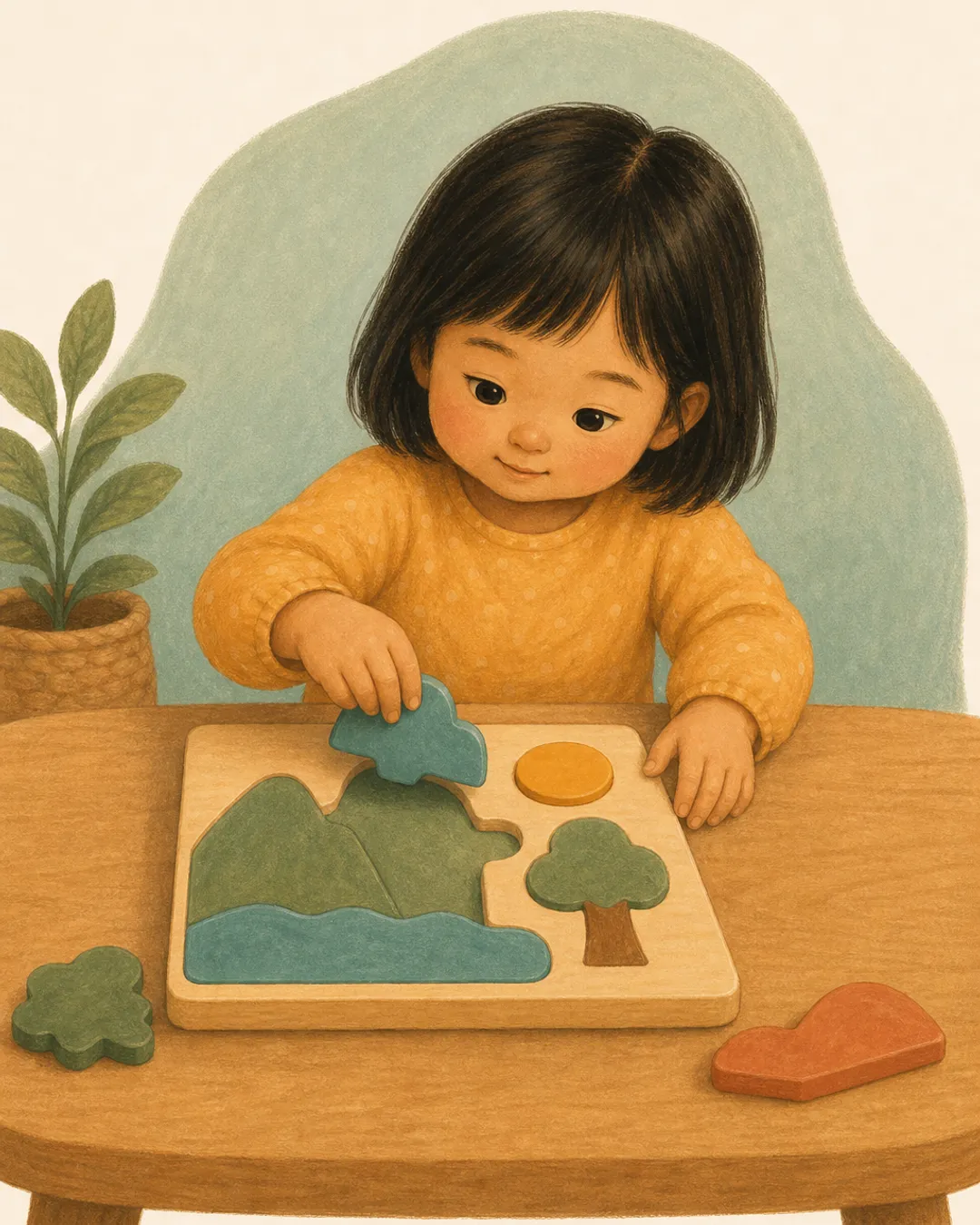
Choose a simple puzzle with 8-12 pieces that your child knows well.
Divide the pieces into two piles: 'These are your pieces, and these are mine.'
1/4
Choose a simple puzzle with 8-12 pieces that your child knows well.
Divide the pieces into two piles: 'These are your pieces, and these are mine.'
Start the puzzle board empty: 'Let us build it together! But I need your pieces and you need mine.'
Model asking: 'I need the blue corner piece — do you have it? Can you give it to me please?'
When they hand it over, celebrate: 'Thank you! You shared your piece and now the picture is growing!'
Your turn to share: 'You need this one — here you go! I am sharing mine with you.'
Continue until the puzzle is complete: 'We did it TOGETHER! Neither of us could have done it alone.'
High-five and name what happened: 'That is called teamwork — we shared our pieces and built something brilliant.'
Parent tip
Set out jigsaw puzzle before inviting your toddler in so the first minute feels smooth.
What success looks like
A few quiet minutes together without pressure. If your child relaxes even slightly, that’s self-regulation building.
Take a simple puzzle and divide the pieces between two players. Neither can complete the picture alone — they must ask each other for pieces, wait, and hand them over. The beauty of this setup is that sharing is not a sacrifice, it is the solution. Children experience firsthand that cooperation achieves something neither person could do alone, which is a far more powerful lesson than being told to share.
Why it helps
Cooperative play — where children must work together toward a shared goal — develops later than parallel play and is a key social milestone in the EYFS Personal, Social and Emotional Development framework. This activity scaffolds cooperation by making it structurally necessary rather than optional. The repeated experience of asking, waiting, and receiving builds the neural pathways for reciprocal social exchange, which the child can then generalise to unstructured play situations.
Variations
Use building blocks instead of a puzzle — each person has different colours and you build one tower together.
With three or more children, give each person fewer pieces so everyone must contribute and ask.
Make it a race against a timer: 'Can we finish the puzzle before the sand runs out? We need to share fast!'
Safety tips
Choose puzzles with pieces large enough not to be a choking hazard for younger participants.
Stay close during the sharing moments — frustration can escalate quickly if a child does not want to hand over a piece.
If one child becomes upset, pause and validate: 'It is hard to give away a piece you like. Your feelings make sense.'
Try one of these next
A few connected ideas chosen by theme, energy, set-up, and age fit.