Hug different trees and measure them with your arms, a scarf, or a piece of string — which is the biggest?
Activity details
2y–4y10 minsmediumoutdoorNo prep
Instructions
Tiny Steps
Get ready
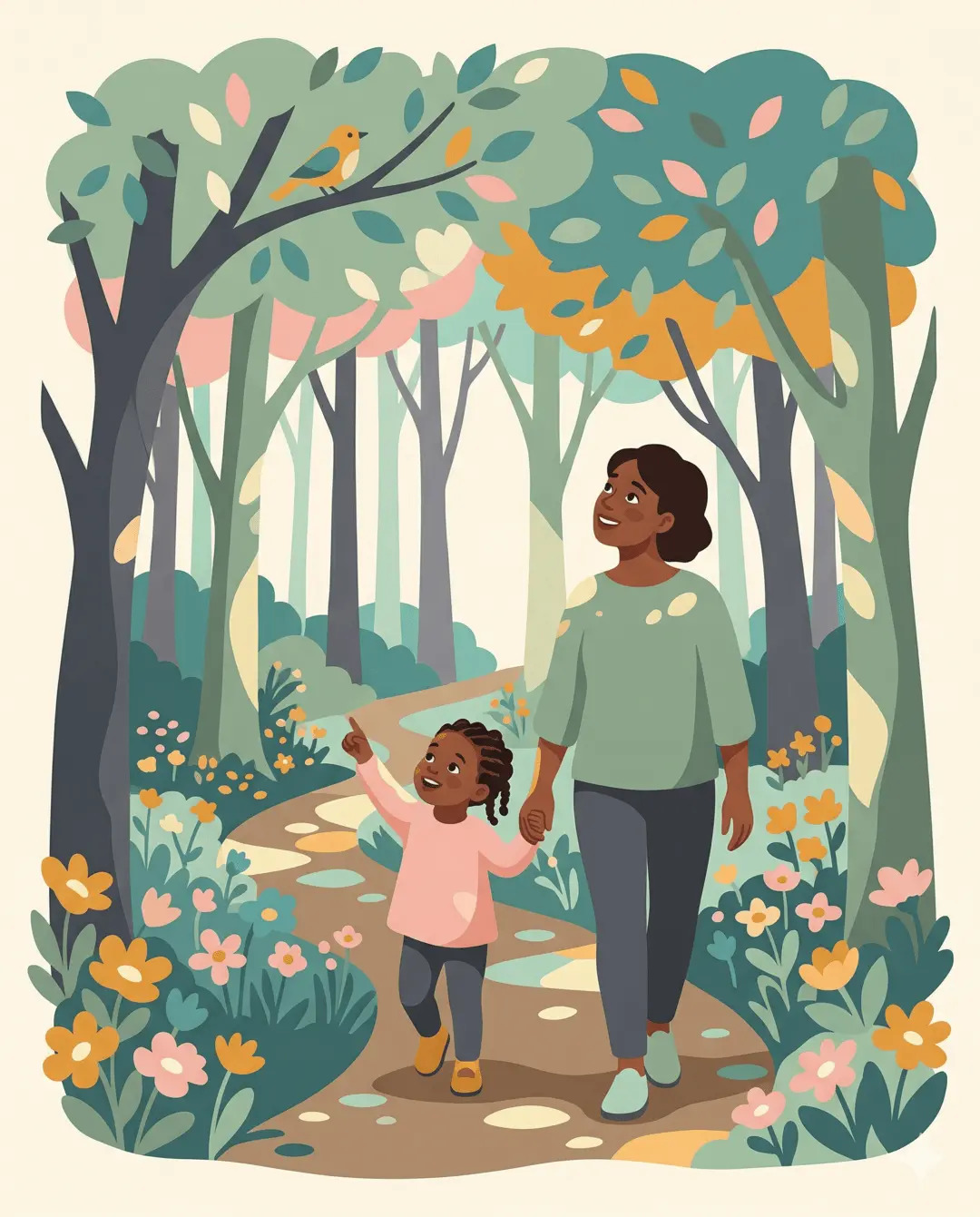
Find a tree and ask your child to hug it — wrap both arms around the trunk.
Can they reach all the way around? Say: 'Your arms are not long enough! This tree is very big.'
1/4
Find a tree and ask your child to hug it — wrap both arms around the trunk.
Can they reach all the way around? Say: 'Your arms are not long enough! This tree is very big.'
Move to a thinner tree and try again: 'This one you can hug all the way around!'
Wrap a scarf or string around the first tree and cut or mark the length.
Try the same string on the second tree: 'Look — there is string left over. This tree is thinner.'
Visit 3-4 trees of different sizes, ordering them from thinnest to thickest.
Talk about the bark texture: 'This one is rough. This one is smooth. Feel the difference.'
Finish with a favourite tree hug and say goodbye.
Parent tip
Start before you overthink it. No-prep activities work best when you begin while the moment is still recoverable.
What success looks like
Curiosity in action — pointing, collecting, asking ‘what’s that?’ A child engaged with nature is learning without knowing it.
Your child wraps their arms around a tree trunk and discovers whether they can reach all the way around. They try different trees — thin saplings, fat oaks, medium birches — and compare. Using a scarf or string to measure adds a tool-use element and makes the comparison tangible.
Why it helps
Non-standard measurement (using arms, scarves, hands) builds the conceptual foundation for understanding that measurement compares one thing against another. The Woodland Trust highlights that tree-based activities develop spatial reasoning, size comparison vocabulary (thinner, thicker, bigger, smaller), and a personal connection to the natural environment. Speech and Language UK recommends this kind of back-and-forth interaction as one of the simplest and most effective ways to grow a toddler's vocabulary.
Variations
Count how many of your child's hand-widths fit around each tree — introduces non-standard measurement.
Bring paper and crayons for bark rubbings — press paper against the bark and rub over it to capture the texture pattern.
Challenge older toddlers to find the thinnest tree they can reach around and the thickest they cannot.
Safety tips
Check bark for thorns, sharp edges, or insect nests before hugging.
Avoid trees near roads or on unstable ground.
Teach your child to hug gently — pulling bark off can harm the tree.
Try one of these next
A few connected ideas chosen by theme, energy, set-up, and age fit.