Chant rhythmic phrases while stomping, jumping, and clapping — a toddler haka that burns energy and builds language at full volume.
Activity details
18m–4y10 minshighbothNo prep
Instructions
Tiny Steps
Get ready
Stand in a clear space — indoors or outdoors, wherever there is room to stomp.
Start a simple chant with a strong beat: 'STOMP STOMP STOMP your feet! STOMP STOMP STOMP your feet!'
1/5
Stand in a clear space — indoors or outdoors, wherever there is room to stomp.
Start a simple chant with a strong beat: 'STOMP STOMP STOMP your feet! STOMP STOMP STOMP your feet!'
Stomp loudly on every beat word — exaggerate the movement so your toddler can copy.
Switch the action: 'CLAP CLAP CLAP your hands! CLAP CLAP CLAP your hands!'
Build to jumping: 'JUMP JUMP JUMP up high! JUMP JUMP JUMP up high!'
Chain them together faster: 'Stomp stomp CLAP! Stomp stomp CLAP! Stomp stomp JUMP!'
Add your toddler's name for extra excitement: '[Name] is STOMPING! [Name] is JUMPING!'
Speed up the chant until everyone collapses in giggles.
Finish with a slow-motion round — whispering the chant while doing tiny, gentle movements.
End with a big group 'ROOOOAR!' and a hug.
Parent tip
Start before you overthink it. No-prep activities work best when you begin while the moment is still recoverable.
What success looks like
Back-and-forth between you — words, gestures, shared pretend. Connection is the real outcome here.
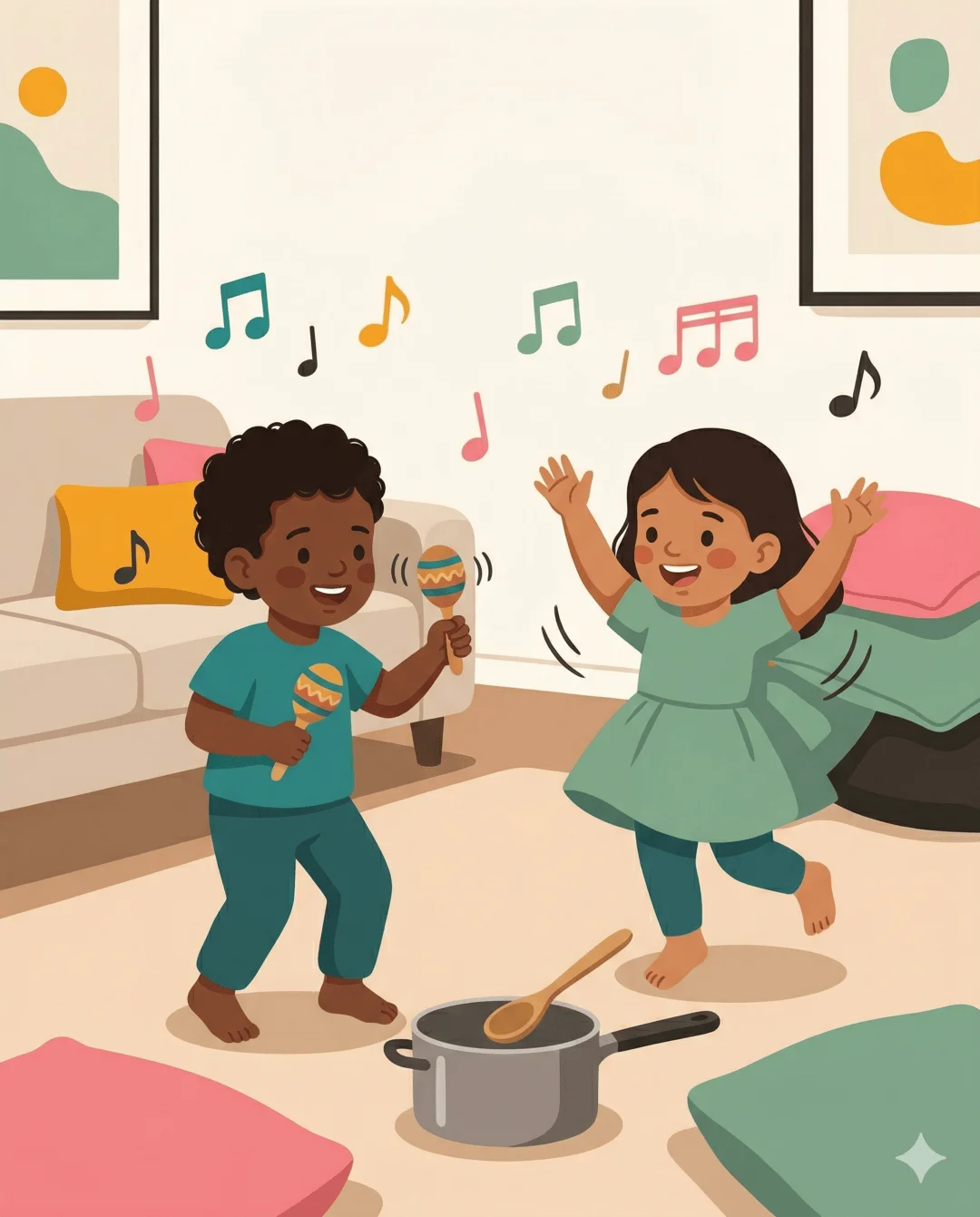
This is singing at maximum volume and maximum movement. You lead a rhythmic chant — short, punchy phrases — while your toddler stomps, jumps, and claps along. Think of it as a toddler haka: the words drive the movement, and the movement fuels the words. It is perfect for those moments when your child is buzzing with energy and needs a structured outlet that is louder and wilder than a normal song, but still has rhythm and language woven through every stomp.
Why it helps
The WHO recommends at least 180 minutes of physical activity daily for under-fives, including energetic play. Pairing vigorous movement with rhythmic language builds what the EYFS framework calls the Communication and Language strand alongside Physical Development — two areas that research shows develop faster when activated together. The chanting also supports breath control and vocal projection, which Speech and Language UK identifies as important for clear speech production.
Variations
Let your toddler invent new action words — 'SPIN SPIN SPIN around!' or 'SHAKE SHAKE SHAKE your arms!'
Try it outdoors on grass where falling over mid-jump is part of the fun.
For a sibling version, one child chants the words while the other does the actions, then swap.
Safety tips
Clear the area of furniture and hard edges before starting — energetic stomping and jumping need space.
On hard floors, bare feet or non-slip socks are safer than slippery socks.
Watch for signs of overexertion — flushed face, heavy breathing — and switch to the slow-motion round to cool down.
Try one of these next
A few connected ideas chosen by theme, energy, set-up, and age fit.