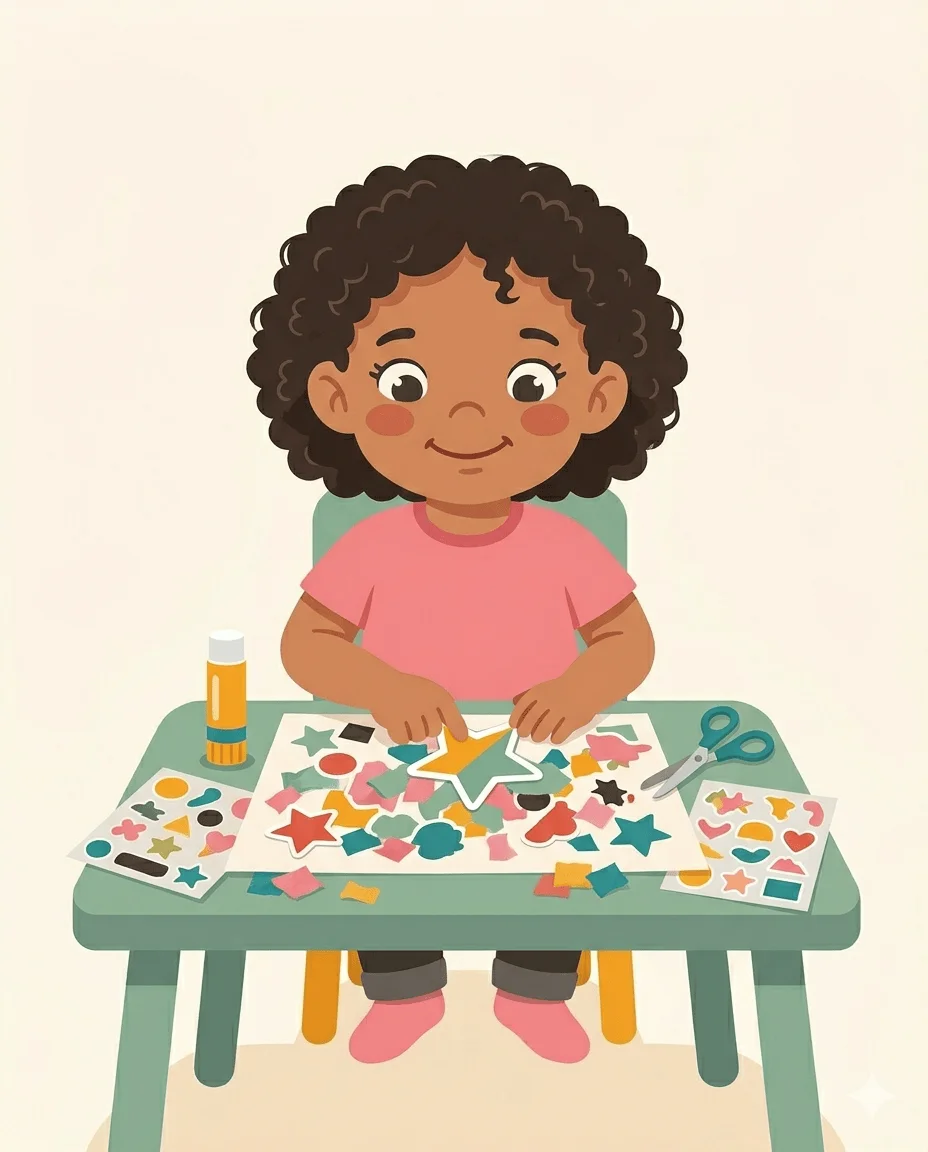
Give your toddler a sheet of stickers and a blank page to create their own scene — a quiet, portable activity perfect for journeys and waiting rooms.
Activity details
18m–4y15 minslowbothConstruction PaperStickers
Instructions
Tiny Steps
Get ready
Before your journey, prepare a small zip-lock bag with two or three sheets of stickers and a few pieces of blank card or thick paper.
When your child needs entertainment, pull out one sheet of stickers and one piece of card.
1/4
Before your journey, prepare a small zip-lock bag with two or three sheets of stickers and a few pieces of blank card or thick paper.
When your child needs entertainment, pull out one sheet of stickers and one piece of card.
Show them the stickers and ask 'What shall we make? A farm? A garden? A town?'
Peel the corner of a sticker to get it started, then let your child pull it off and place it on the card.
Narrate what they are creating: 'Oh, you've put the dog next to the tree — is the dog going for a walk?'
Let them fill the card however they wish — overlapping, upside down, in clusters — it's their scene.
When the card is full, admire it together and make up a quick story about the scene.
Tuck the finished creation into the bag as a keepsake and pull out fresh stickers and card if the journey continues.
Parent tip
Set out construction paper and stickers before inviting your toddler in so the first minute feels smooth.
What success looks like
Messy hands and a child who doesn’t want to stop. The artwork doesn’t need to look like anything — the process is the point.
Stickers are the ultimate travel activity for toddlers: they are lightweight, mess-free, utterly absorbing, and exercise fine motor skills with every peel and place. This activity provides your child with a blank piece of paper or card and a selection of stickers — animals, shapes, faces, or vehicles — and invites them to create their own scene. The open-ended nature means there is no right or wrong arrangement, and the peeling action strengthens the pincer grip that is essential for later pencil control.
Why it helps
The peeling action required to remove a sticker from its backing sheet is one of the best fine motor exercises for toddlers — it demands a precise pincer grip, careful pulling force, and bilateral coordination (one hand holds the sheet while the other peels). The creative placement element adds decision-making and spatial awareness. Because sticker play is self-directed and open-ended, it also builds sustained attention — the ability to stay focused on a chosen task, which is a key predictor of later academic success. NHS developmental guidance recognises that practising careful hand movements through play builds the foundations children need for eating, drawing, and dressing themselves.
Variations
Draw a simple background first — a road, a field, a house outline — and let your child add sticker characters to bring it to life.
Use dot stickers and challenge older toddlers to place them inside drawn circles for a fine motor precision game.
Let siblings create scenes on separate cards, then hold them side by side to make a panorama story.
Safety tips
Choose stickers large enough that they cannot be a choking hazard if mouthed — avoid tiny star or gem stickers for under-threes.
Ensure your child is not eating stickers — some toddlers will lick and swallow them if unsupervised.
Check that stickers are non-toxic, especially for younger toddlers who may still mouth objects frequently.
Try one of these next
A few connected ideas chosen by theme, energy, set-up, and age fit.