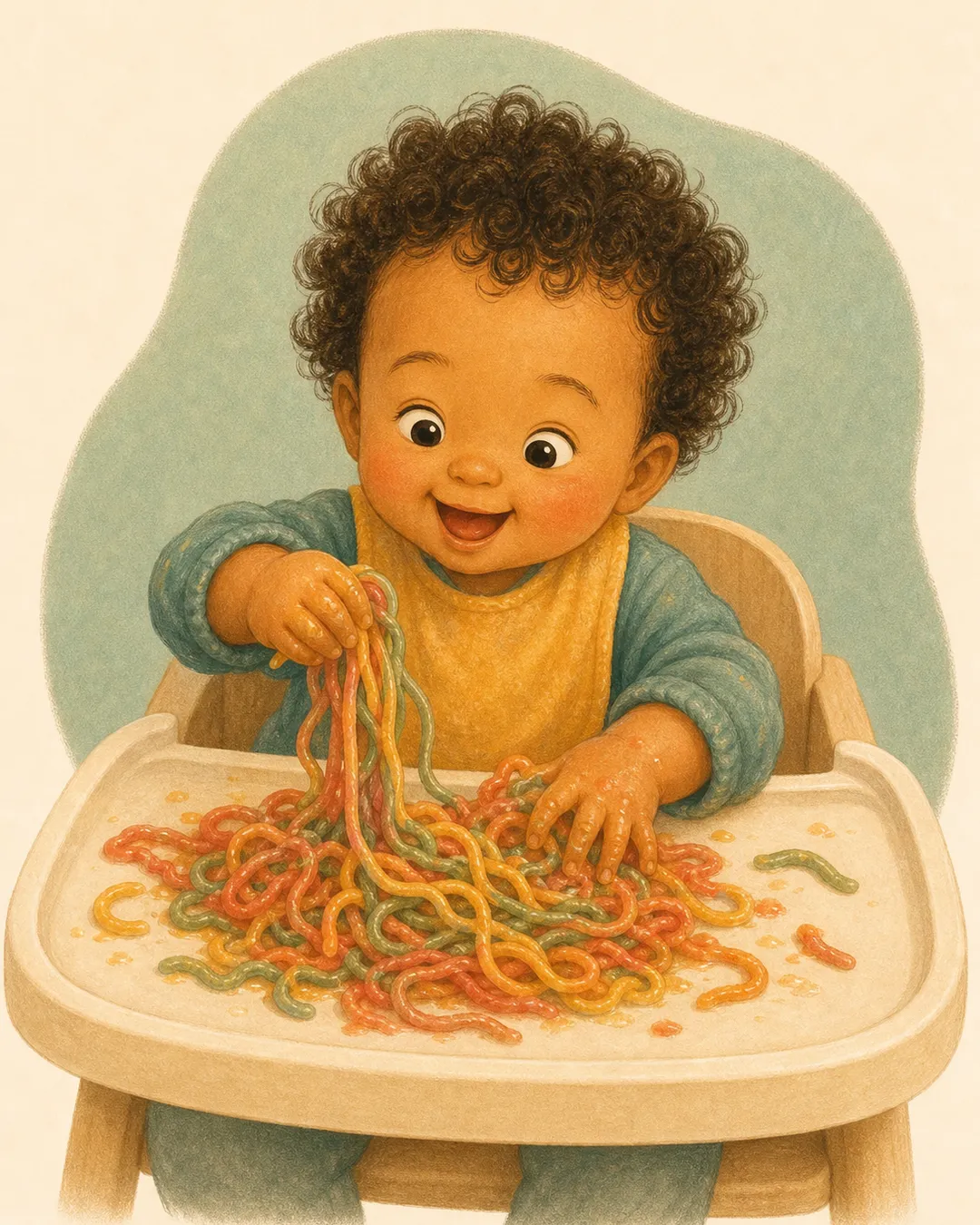
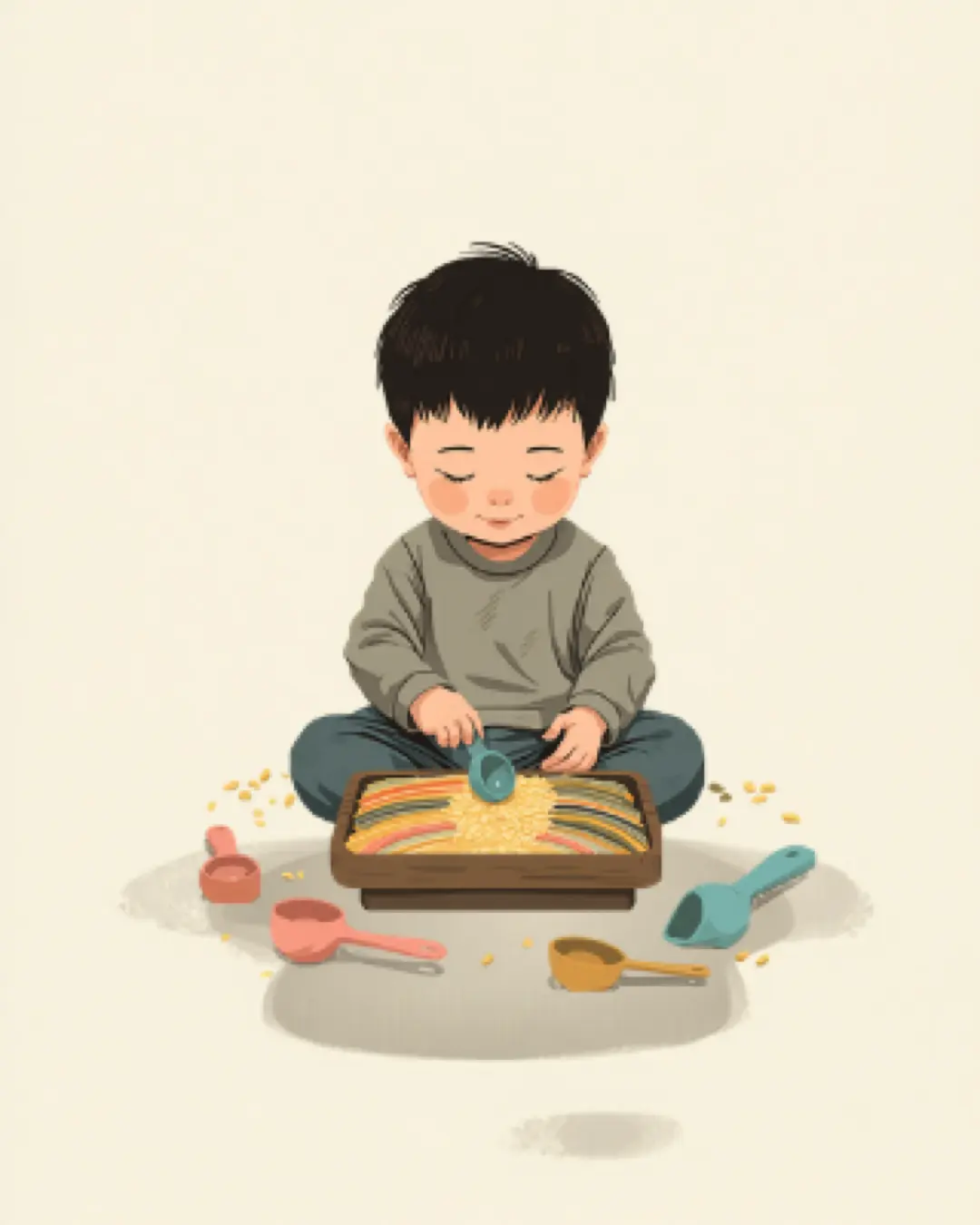
Spread salt on a dark tray and trace letters with a finger — sensory letter learning without the pressure of pencils.
Activity details
2y–4y15 minslowindoorPlastic ContainersSalt
Instructions
Tiny Steps
Get ready
Pour a thin, even layer of table salt onto a dark-coloured baking tray or shallow container — the contrast makes the marks visible.
Show your child how to draw a line with one finger through the salt: 'Look, I can write in the salt!'
1/4
Pour a thin, even layer of table salt onto a dark-coloured baking tray or shallow container — the contrast makes the marks visible.
Show your child how to draw a line with one finger through the salt: 'Look, I can write in the salt!'
Start with simple lines and curves — a straight line down, a circle, a zigzag — before introducing letters.
Trace the first letter of your child's name: 'This is M for Mia — watch my finger go up, down, up, down.'
Let your child trace over your mark, then shake the tray gently to erase it and try again: 'Like magic — it disappears!'
If they want to draw pictures instead of letters, let them — any mark-making on this surface builds pre-writing skills.
Try tracing the same letter three times in a row, then move to a new one — repetition builds muscle memory.
When finished, pour the salt into a container to reuse next time: 'We'll keep our writing salt for another day.'
Parent tip
Set out plastic containers and salt before inviting your toddler in so the first minute feels smooth.
What success looks like
Watch for focused exploration — fingers digging in, pouring back and forth, or sorting by feel. Even a few minutes of this builds concentration.
This beautifully simple activity removes the fine motor difficulty of holding a pencil and lets children focus purely on letter shape. A thin layer of salt on a dark baking tray creates a high-contrast writing surface where letters appear like magic as a finger traces through. The tactile feedback of salt under the fingertip strengthens the sensory memory of each letter shape, making this a multisensory approach to grapheme awareness.
Why it helps
The National Literacy Trust identifies early mark-making and letter awareness as foundational skills on the pathway to reading and writing. Letter formation through tactile media engages the sensorimotor system in a way that pencil-and-paper work does not. The finger traces the letter shape while the salt provides tactile feedback through the fingertip, creating a multisensory memory trace. Research in embodied cognition shows that children who learn letter shapes through touch and movement recognise those letters more quickly and accurately than children who only see them visually.
Variations
Add a few drops of food colouring to the salt for visual interest — coloured marks on a white tray work just as well.
Use a paintbrush or cotton bud instead of a finger for children who dislike the texture of salt on skin.
Place a letter card next to the tray for your child to copy — this adds a visual model and builds letter matching skills.
Safety tips
Supervise closely to ensure salt does not go into eyes — have a damp cloth nearby for quick wiping.
If your child is likely to taste the salt, use sugar or fine sand instead for a safer alternative.
Keep the activity on a table or tray that can be easily cleaned — salt can scratch some surfaces if rubbed in.
Try one of these next
A few connected ideas chosen by theme, energy, set-up, and age fit.