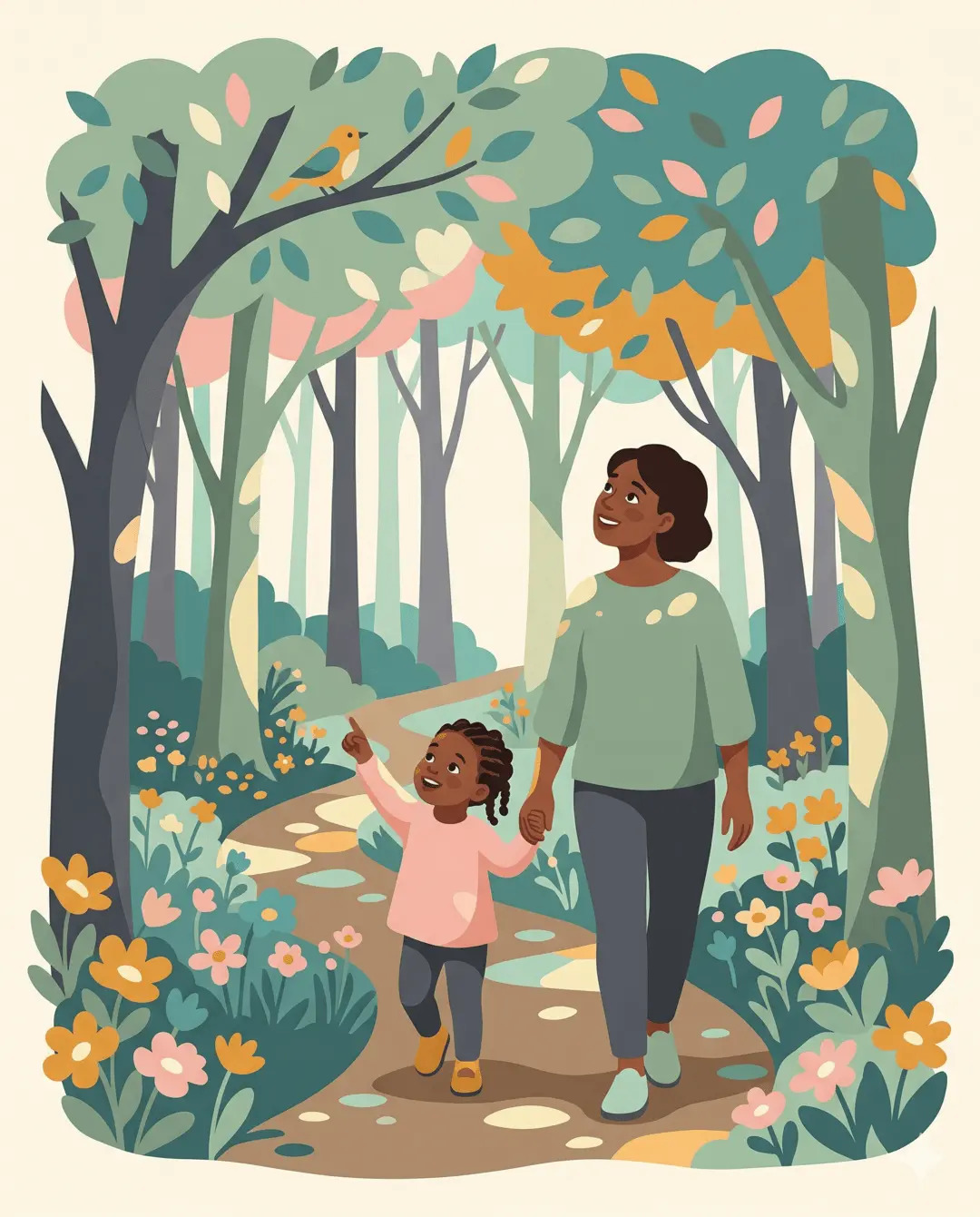
Sit outside together at dusk, close your eyes, and listen for all the sounds you can hear — birds, wind, distant voices.
Activity details
18m–3y10 minslowoutdoorNo prepBlankets
Instructions
Tiny Steps
Get ready
Choose a warm evening when the light is fading but it is still comfortable outside.
Spread a blanket in the garden and sit down together, or find a bench in a quiet park.
1/4
Choose a warm evening when the light is fading but it is still comfortable outside.
Spread a blanket in the garden and sit down together, or find a bench in a quiet park.
Say 'Let us close our eyes and listen — what can you hear?'
Stay quiet for 30 seconds — for a toddler, this feels like an eternity, and that is fine.
When they hear something, let them tell you — 'A bird! Yes, that is a blackbird singing.'
Take turns — 'My turn. I can hear... the wind in the leaves. Your turn.'
Count how many different sounds you found together — challenge yourselves to beat the number next time.
End with a few deep breaths and a cuddle on the blanket before heading inside for bedtime.
Parent tip
Start before you overthink it. No-prep activities work best when you begin while the moment is still recoverable.
What success looks like
Curiosity in action — pointing, collecting, asking ‘what’s that?’ A child engaged with nature is learning without knowing it.
As the day cools, take a blanket outside and sit quietly together in the garden or a park. Close your eyes and listen. Birds singing, a dog barking, the wind in the trees, an aeroplane overhead, a neighbour's door closing. Name each sound as you hear it. This gentle, contemplative activity is perfect for winding down after a busy summer day and builds a skill most adults have forgotten — really listening.
Why it helps
Focused listening develops auditory processing and selective attention — the ability to isolate individual sounds from background noise. These skills are foundational for language development and later phonics learning. The calm, shared experience also provides a natural transition from active play to bedtime, supporting emotional regulation. NHS early years guidance recognises that emotional development is just as important as physical or cognitive milestones, and it grows best through warm, consistent interactions.
Variations
Bring a notepad and draw a quick picture of each sound you hear — a visual listening diary.
Try it in different locations — the park, the front garden, near a stream — and compare what you hear.
Play 'Sound bingo' — before you start, predict three sounds you might hear, then listen for them.
Safety tips
Apply insect repellent if midges or mosquitoes are active in your area.
Stay on familiar ground — uneven surfaces are harder to see in low light.
Bring a torch if staying out past dusk and supervise near any garden features.
Try one of these next
A few connected ideas chosen by theme, energy, set-up, and age fit.