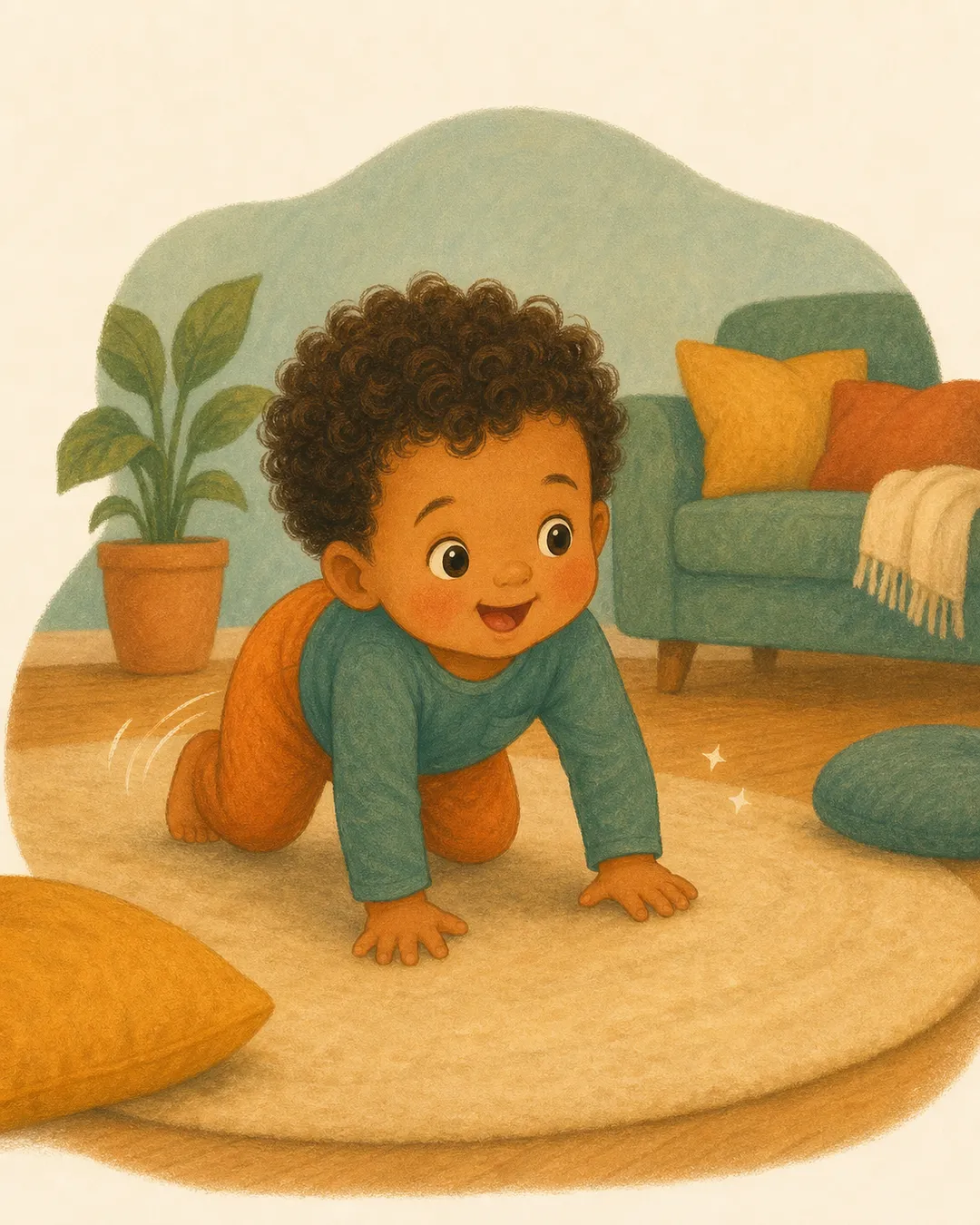
Build a safe indoor climbing and sliding course from sofa cushions, chairs, and blankets — redirecting climbing urges into structured physical challenge.
Remove breakable items from the room and push furniture against walls to create a clear central space.
Create a climbing station: stack two or three sofa cushions against the base of the sofa so your child can climb up onto the seat.
1/4
Remove breakable items from the room and push furniture against walls to create a clear central space.
Create a climbing station: stack two or three sofa cushions against the base of the sofa so your child can climb up onto the seat.
Lay a blanket from the sofa seat to the floor at an angle to make a gentle slide — tuck it firmly under the cushions.
Set up a crawling tunnel using chairs with a bed sheet draped over them.
Place cushions and pillows as stepping stones between the stations.
Walk your child through the course: 'First we climb up, then we slide down, then we crawl through the tunnel, then we hop across the cushions!'
Let them complete the course as many times as they want, offering a hand for the climbing section if needed.
When energy starts to dip, simplify to just the climbing and sliding — the repetition is deeply satisfying and self-regulating.
Parent tip
Set out bed sheet and blankets before inviting your toddler in so the first minute feels smooth.
What success looks like
Flushed cheeks, big smiles, and a calmer child afterwards. If they want to do it again, you’ve found a winner.
Toddlers who climb everything in sight are not being naughty — they are driven by a deep neurological need for vestibular and proprioceptive input that climbing uniquely provides. Fighting this instinct leads to endless battles; channelling it into a safe, sanctioned climbing course transforms the same energy into productive physical development. This activity creates an indoor obstacle course with designated climbing points, a slide element, and crawling sections, giving your child full permission to climb within safe boundaries.
Why it helps
Climbing provides intense proprioceptive and vestibular input — the two sensory systems most responsible for body awareness, spatial orientation, and self-regulation. Occupational therapists working with children who seek climbing input consistently recommend providing structured, safe climbing opportunities rather than restricting the behaviour, because the underlying sensory need does not disappear when the climbing is forbidden. A well-designed obstacle course satisfies the climbing urge while also building strength, coordination, and risk assessment skills. Development Matters highlights that physical play gives children the space to practise big movements that build coordination and spatial awareness.
Variations
Add a balance beam element by laying a plank of wood or a rolled-up towel on the floor to walk along between stations.
Time older toddlers with a sand timer and encourage them to beat their own record — competition against themselves, never others.
Take the obstacle course outdoors and use garden furniture, slopes, and logs for a natural climbing circuit.
Safety tips
Supervise every moment of climbing — stay within arm's reach, especially at the highest point of the course.
Ensure all surfaces are stable and will not slide or collapse under your child's weight — test them yourself first.
Place thick cushions or pillows at the base of any climbing or sliding point to cushion potential falls.
Try one of these next
A few connected ideas chosen by theme, energy, set-up, and age fit.