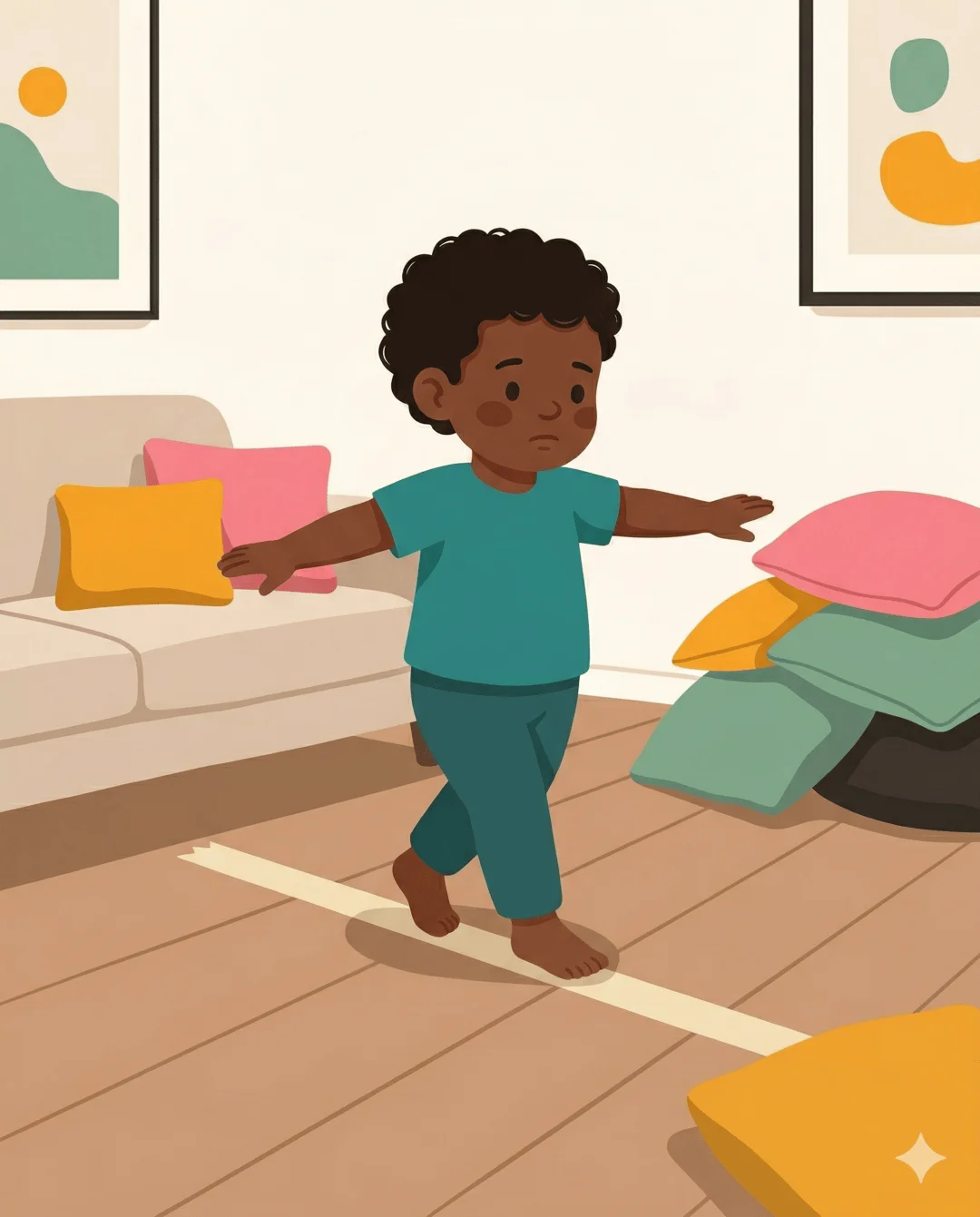
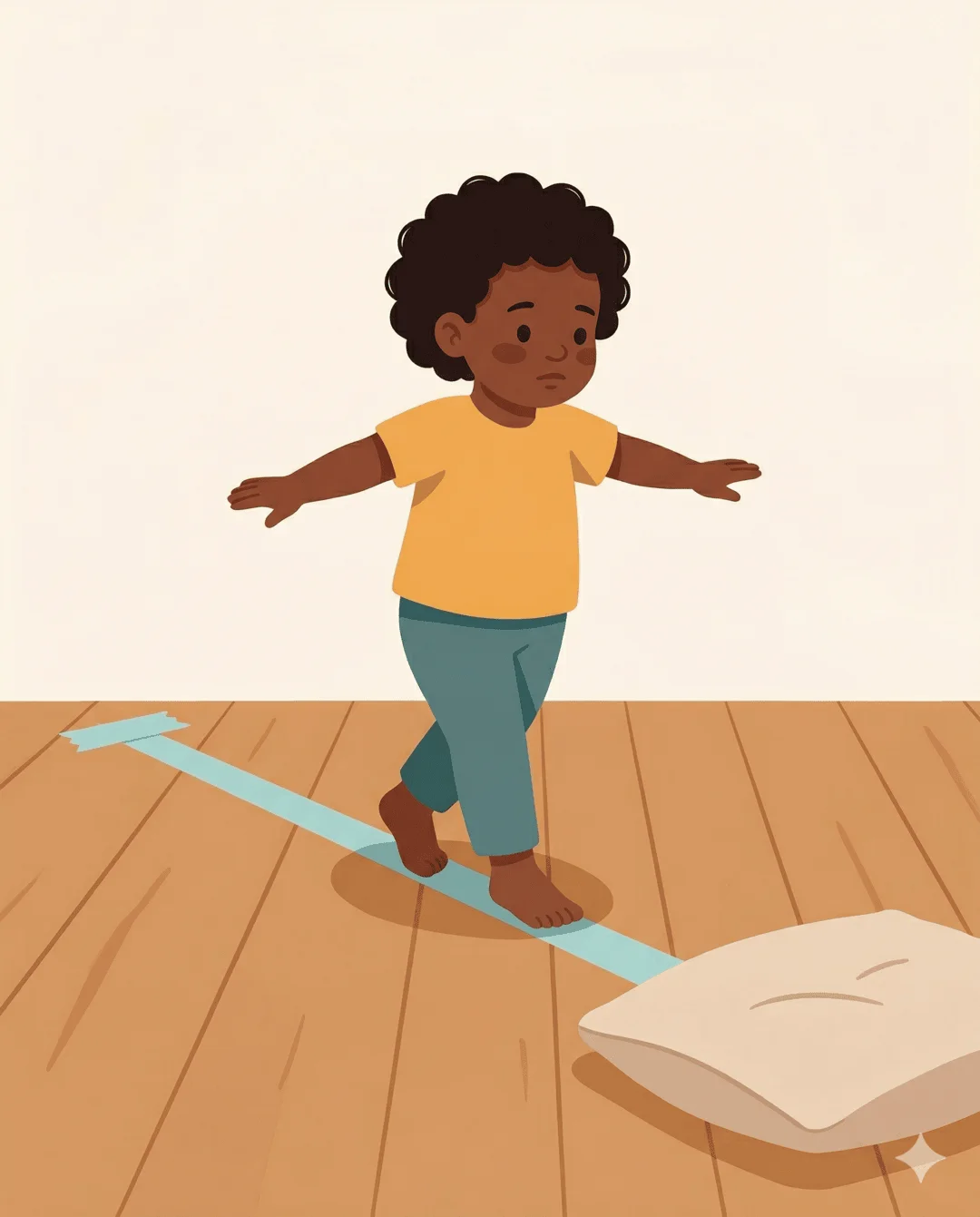
For older toddlers, try walking the line while carrying a soft toy on their head or balancing a beanbag on an outstretched palm.
Finish with a spiral that winds tighter and tighter into the centre — 'You made it to the middle! Amazing balance!'
Parent tip
Set out bean bags and masking tape before inviting your toddler in so the first minute feels smooth.
What success looks like
Flushed cheeks, big smiles, and a calmer child afterwards. If they want to do it again, you’ve found a winner.
Balance is one of the most important and least practised gross motor skills in early childhood. This activity transforms your floor into a balance course using nothing more than masking tape — straight lines, gentle curves, zigzags, and spirals that your child navigates with increasing precision. Walking along a narrow line demands core stability, ankle strength, and focused visual attention, and the progressively harder shapes build challenge without the risk of falling from a height. It is one of the simplest and most effective ways to develop the vestibular system at home.
Why it helps
Walking along a narrow line is a vestibular and proprioceptive challenge that strengthens the neural connections between the inner ear, the cerebellum, and the motor cortex. This triad of systems controls balance, posture, and coordinated movement — the physical foundation for everything from climbing stairs to sitting still at a table. NHS developmental milestones identify heel-to-toe walking as a key balance indicator between 24 and 36 months.
Variations
Add 'stepping stones' made from pieces of construction paper along the route for an extra jumping challenge between balance sections.
Play music and walk the line in rhythm — slow songs for careful balance, fast songs for quick stepping.
Create a branching path with two choices at a fork and let your child decide which way to go each time.
Safety tips
Use masking tape or painter's tape that peels off cleanly — avoid duct tape or electrical tape that could leave sticky residue on floors.
Ensure the surrounding area is free of hard-edged furniture in case your child wobbles and steps off the line.
For early walkers, always stay within arm's reach to offer a steadying hand if balance wavers.
Try one of these next
A few connected ideas chosen by theme, energy, set-up, and age fit.