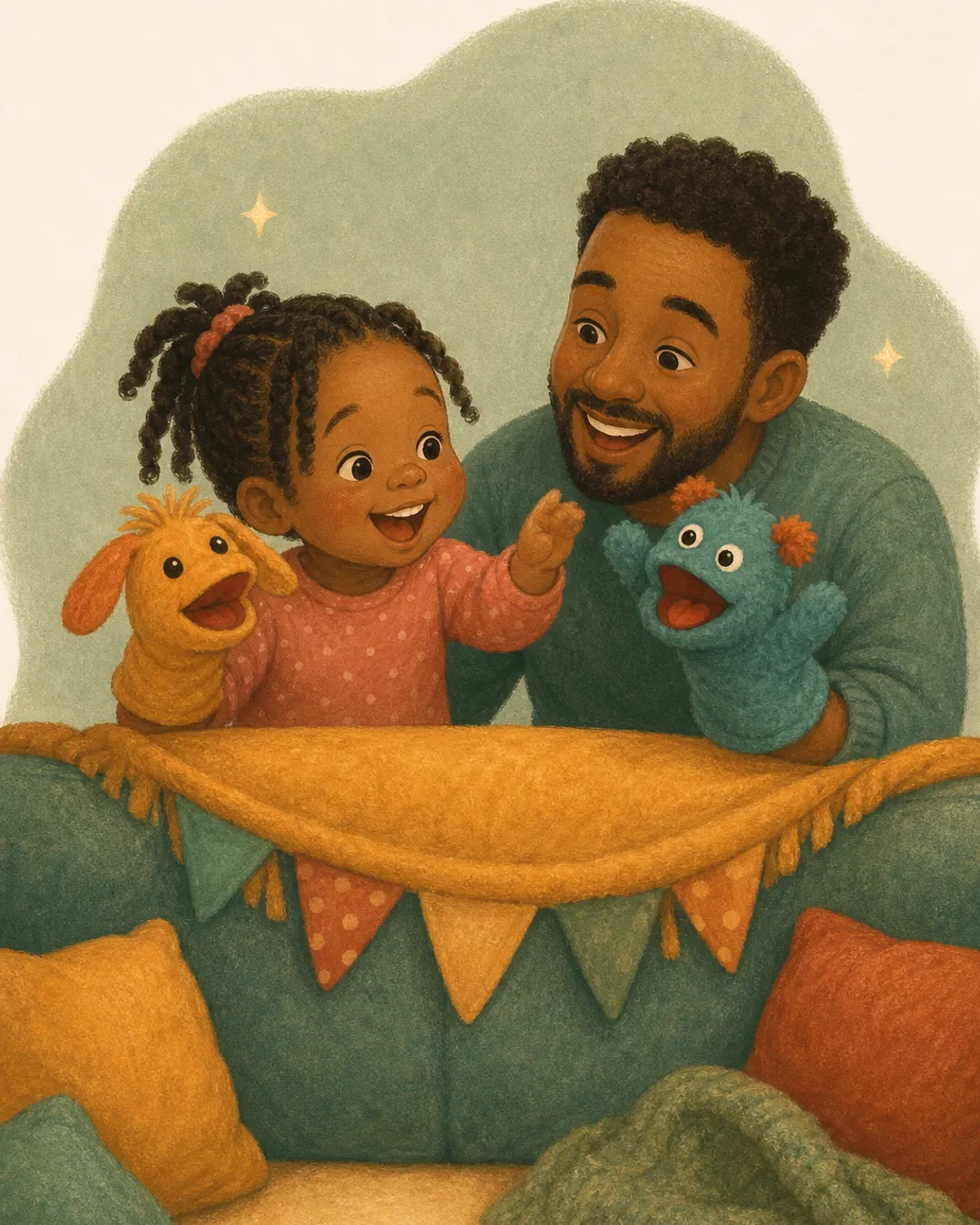
A sock puppet who only responds to clear talking voices, not whining ones.
Activity details
19m–3y10 minslowindoorSock Puppet
Instructions
Tiny Steps
Get ready
Put a sock on your hand and introduce the puppet with a name and a silly voice.
Explain the puppet's quirk: 'This is Socky. Socky can only hear talking voices — whiny voices make him fall asleep!'
1/4
Put a sock on your hand and introduce the puppet with a name and a silly voice.
Explain the puppet's quirk: 'This is Socky. Socky can only hear talking voices — whiny voices make him fall asleep!'
Demonstrate: use a whining voice and make the puppet flop over, snoring.
Use a clear talking voice and the puppet bounces up: 'Oh! I can hear you now! Hello!'
Let your child try talking to the puppet in their best clear voice.
When the puppet hears the clear voice, respond enthusiastically through the puppet.
Play a little scene: the puppet asks your child a question and listens for their 'big voice' answer.
Swap roles — let your child wear the puppet and you practise your voices.
Parent tip
Set out sock puppet before inviting your toddler in so the first minute feels smooth.
What success looks like
A few quiet minutes together without pressure. If your child relaxes even slightly, that’s self-regulation building.
A simple sock puppet becomes a playful coach for voice control. The puppet goes limp and confused when it hears whining — 'I can't understand that voice!' — but springs to life and responds warmly when it hears clear words. The puppet is a neutral third party, which makes the feedback feel like a game rather than a reprimand. Toddlers switch their voice to communicate with the puppet without realising they are practising the exact skill you need them to use with you.
Why it helps
Speech and Language UK states that gestures and signs 'actively encourage the development of speech, language and communication skills' and that 'gestures provide children with a way to communicate so can be helpful in reducing their frustration.' A puppet that responds only to clear speech gives the child a concrete reason to switch their voice — the feedback comes from a playful character, not a frustrated parent. The NHS describes a tantrum as 'your toddler's way of saying I need some help with my big feelings' — the puppet gives them a low-stakes way to practise the alternative voice before those big feelings arrive.
Variations
Use different puppets for different voice levels — a quiet one for whisper, a bouncy one for talking.
Let your child decorate the sock puppet with buttons or felt to make it their own.
Bring the puppet out at real whining moments as a gentle redirect: 'Shall we see if Socky can hear you?'
Safety tips
If using button eyes on the puppet, ensure they are sewn on securely — loose buttons are a choking hazard.
Do not use the puppet to shame: 'Even Socky thinks you're being silly' crosses the line from playful to punitive.
Let the child stop if they become frustrated — the game should feel fun, not like a test.
Try one of these next
A few connected ideas chosen by theme, energy, set-up, and age fit.