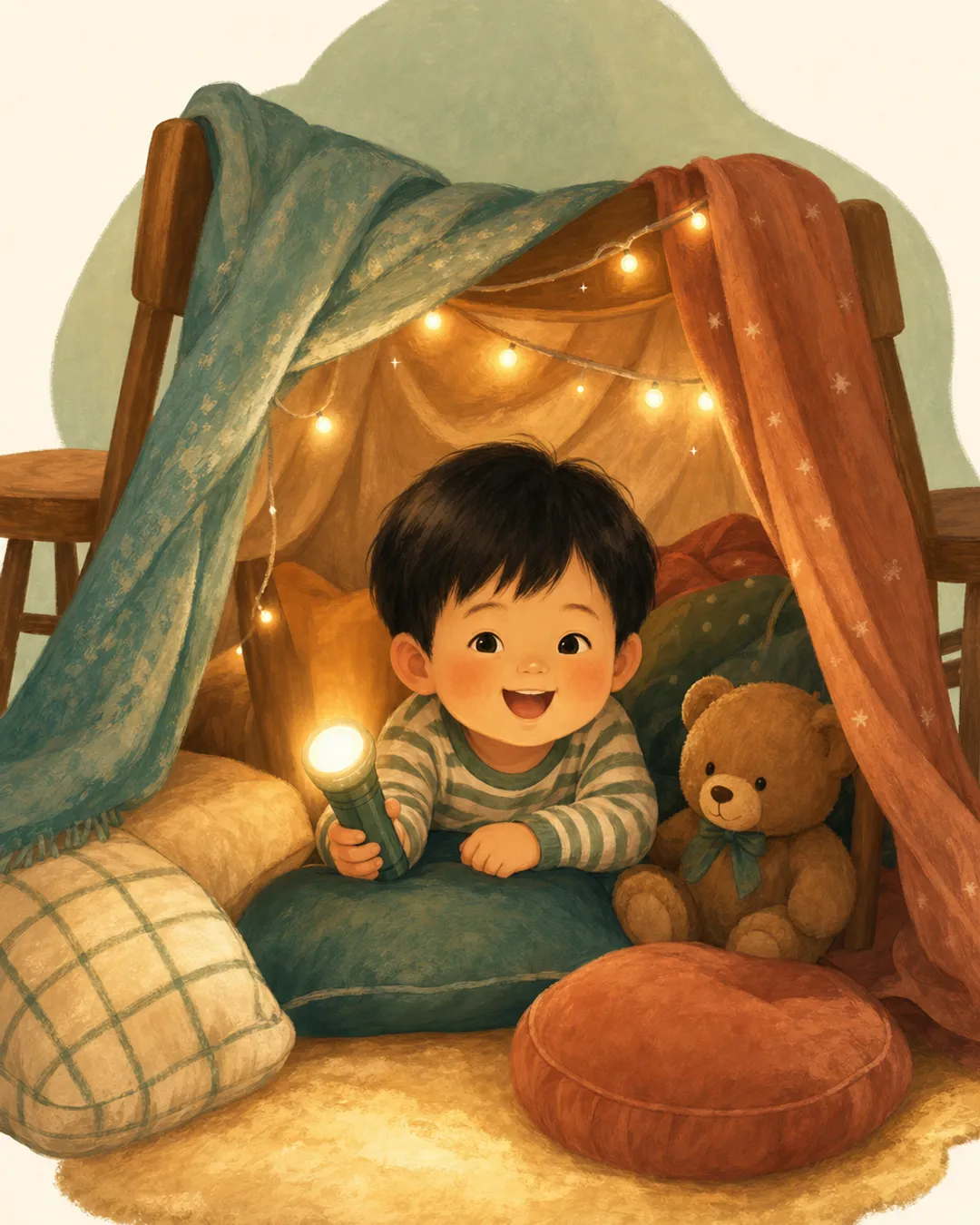
A gentle bedtime yoga sequence where toddlers stretch like sleepy animals, winding their bodies and minds down for sleep.
Activity details
19m–4y10 minslowindoorNo prepBlanketsTowels
Instructions
Tiny Steps
Get ready
Dim the lights in the bedroom and lay out a blanket or towel on the floor as your 'sleeping mat.'
Say in a soft voice: 'It's time for the animals to go to sleep. Shall we help them?'
1/4
Dim the lights in the bedroom and lay out a blanket or towel on the floor as your 'sleeping mat.'
Say in a soft voice: 'It's time for the animals to go to sleep. Shall we help them?'
Start with Sleepy Cat: kneel on all fours, arch your back up high, then slowly lower and curl into a ball. Purr softly.
Next, Yawning Bear: stand up tall, stretch arms wide overhead, do a big exaggerated yawn, then slowly slump down.
Then, Folding Butterfly: sit with soles of feet together, gently flap knees like wings, then slowly fold forward as the butterfly 'lands.'
Sleepy Snake: lie flat on tummies, slowly lift head and shoulders up, then lower down with a long 'hissssss' breath out.
Finish with Cosy Hedgehog: curl into the tightest ball you can on your side, then slowly, slowly uncurl and lie flat — 'the hedgehog is asleep.'
Stay lying down and whisper: 'All the animals are sleeping now. Let's be very still like them.' Transition straight into bed.
Parent tip
Start before you overthink it. No-prep activities work best when you begin while the moment is still recoverable.
What success looks like
A few quiet minutes together without pressure. If your child relaxes even slightly, that’s self-regulation building.
Bedtime resistance often stems from a body that hasn't been helped to transition from 'awake mode' to 'sleep mode.' This activity bridges that gap with a sequence of slow, gentle stretches themed around animals going to sleep — a cat curling up, a bear yawning, a butterfly folding its wings. The progressive muscle engagement and release mimics the tension-release cycle that promotes physiological relaxation, while the predictable sequence signals to your child's brain that sleep is approaching. It's a body-based bedtime cue that works even when verbal reasoning doesn't.
Why it helps
The EYFS framework places consistent routines and predictable transitions at the heart of supporting young children's emotional security and self-regulation. Progressive muscle relaxation — deliberately tensing and then releasing muscle groups — is one of the most well-evidenced techniques for reducing physiological arousal before sleep. This activity wraps that technique in a toddler-friendly narrative that makes the physical process engaging rather than boring. The consistent sequence also serves as a behavioural sleep cue: over time, the child's brain associates these specific movements with the onset of sleep, making the transition faster and less resistant.
Variations
Let your child choose which animal to 'be' each night from a set of picture cards — this gives them control over the routine while keeping the structure.
Add a 'sleeping sound' for each animal (a purr, a snore, a gentle hum) to extend the breathing element.
For younger toddlers, simplify to three animals instead of five and add more physical support — holding their hands during stretches.
Safety tips
Perform stretches on a soft surface to protect knees and elbows during floor-based poses.
Keep movements slow and gentle — never push a child into a stretch they resist, as toddler joints are still developing.
If your child becomes energised rather than calm, simplify to just the final two stretches (Sleepy Snake and Cosy Hedgehog) to avoid overstimulation.
Try one of these next
A few connected ideas chosen by theme, energy, set-up, and age fit.