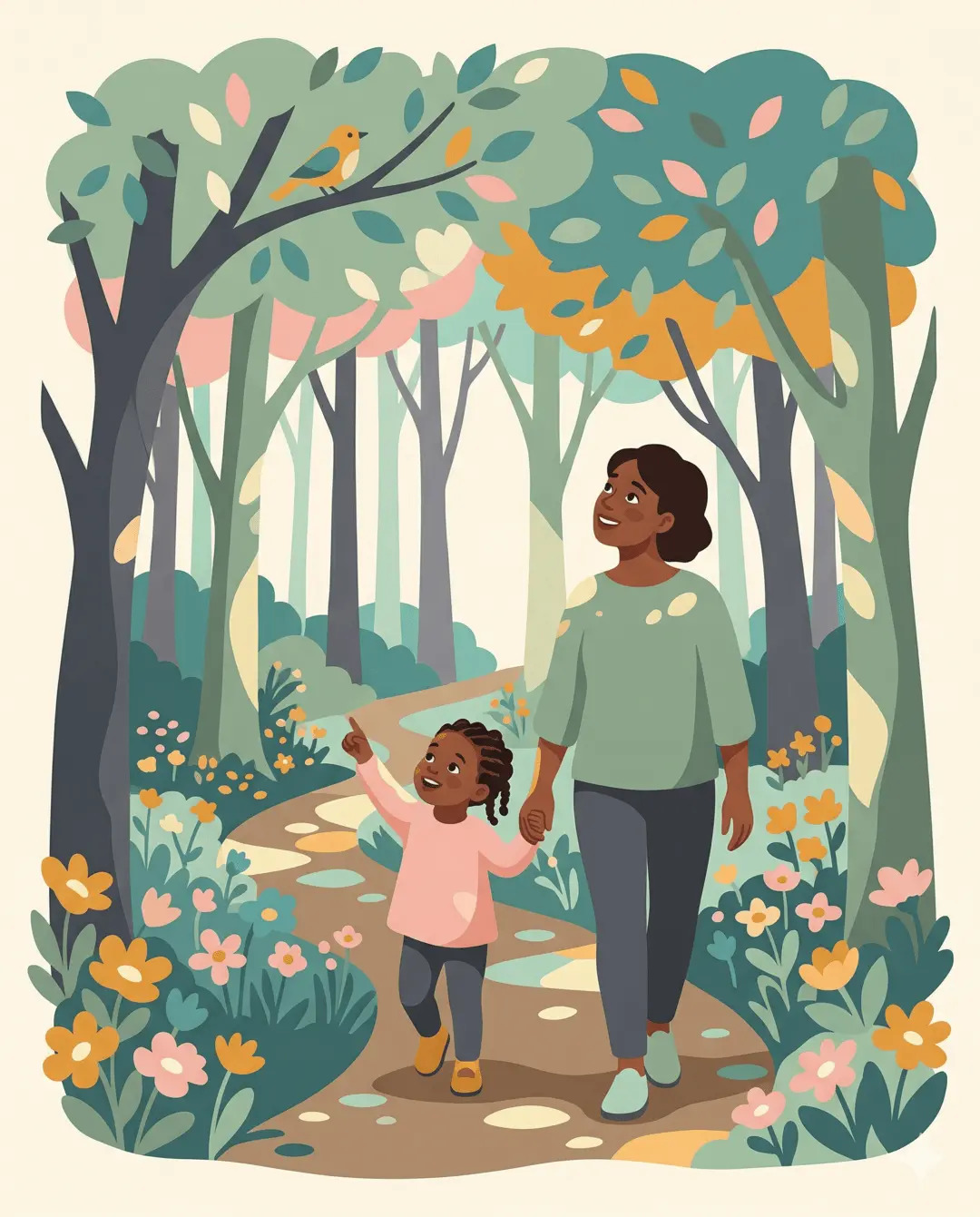
Walk together trying to step on each other's shadows — a fun way to keep your toddler close and engaged on outdoor walks.
Activity details
19m–4y15 minshighoutdoorNo prep
Instructions
Tiny Steps
Get ready
Choose a sunny time of day when shadows are clearly visible — morning or late afternoon works best.
Step outside and point to your shadow: 'Look! There's my shadow on the ground — can you step on it?'
1/4
Choose a sunny time of day when shadows are clearly visible — morning or late afternoon works best.
Step outside and point to your shadow: 'Look! There's my shadow on the ground — can you step on it?'
Walk slowly at first, encouraging your child to stomp on your shadow: 'You got my hand! Can you get my head?'
Take turns: 'Now I'll try to step on YOUR shadow — run but stay close!'
Vary your speed: walk fast, then slow, then freeze — your child adjusts their pace to match, practising speed regulation.
Point out your child's shadow doing funny shapes: 'Wave your arms — look what your shadow does!'
If your child starts to drift too far away, call 'My shadow is running away — can you catch it?' to draw them back.
Finish by making shadow shapes together: 'Let's make our shadows hold hands — we have to stand really close!'
Parent tip
Start before you overthink it. No-prep activities work best when you begin while the moment is still recoverable.
What success looks like
Flushed cheeks, big smiles, and a calmer child afterwards. If they want to do it again, you’ve found a winner.
Keeping a toddler close on a walk is infinitely easier when the walk itself is a game. Shadow stepping gives your child a compelling reason to stay near you — they can only step on your shadow if they're close enough to see it. It turns a potentially stressful outing into a laughing, connected experience while providing visual tracking practice and gross motor coordination. The proximity required by the game naturally trains the habit of staying close without any need for nagging.
Why it helps
NHS physical activity guidelines for under-5s recommend at least 180 minutes of activity a day, with running and chasing games identified as some of the best ways for toddlers to get moving. Visual tracking — following a moving target with the eyes and coordinating a body response — is a key perceptual-motor skill that develops through activities exactly like this. The game also naturally maintains proximity without verbal reminders, which is important because repeated commands like 'stay close' quickly lose effectiveness through habituation. By engaging the child's intrinsic motivation (the fun of catching a shadow), you bypass the oppositional dynamics that often drive running-away behaviour.
Variations
On an overcast day, use a torch or phone light to make indoor shadows instead — the game works in a hallway too.
Challenge your child to step ONLY on shadows (yours, lamp posts, trees) as you walk along the pavement — this forces them to stay near visible objects.
For older toddlers, introduce shadow freeze-tag: when you step on their shadow, they have to freeze for three seconds.
Safety tips
Always play in a safe area away from roads and traffic — the child's attention will be on the ground, not their surroundings.
Ensure your child wears a sun hat and sun cream if playing in direct sunlight for extended periods.
Watch for uneven pavement, kerbs, or obstacles that your child might trip over while looking down at shadows.
Try one of these next
A few connected ideas chosen by theme, energy, set-up, and age fit.