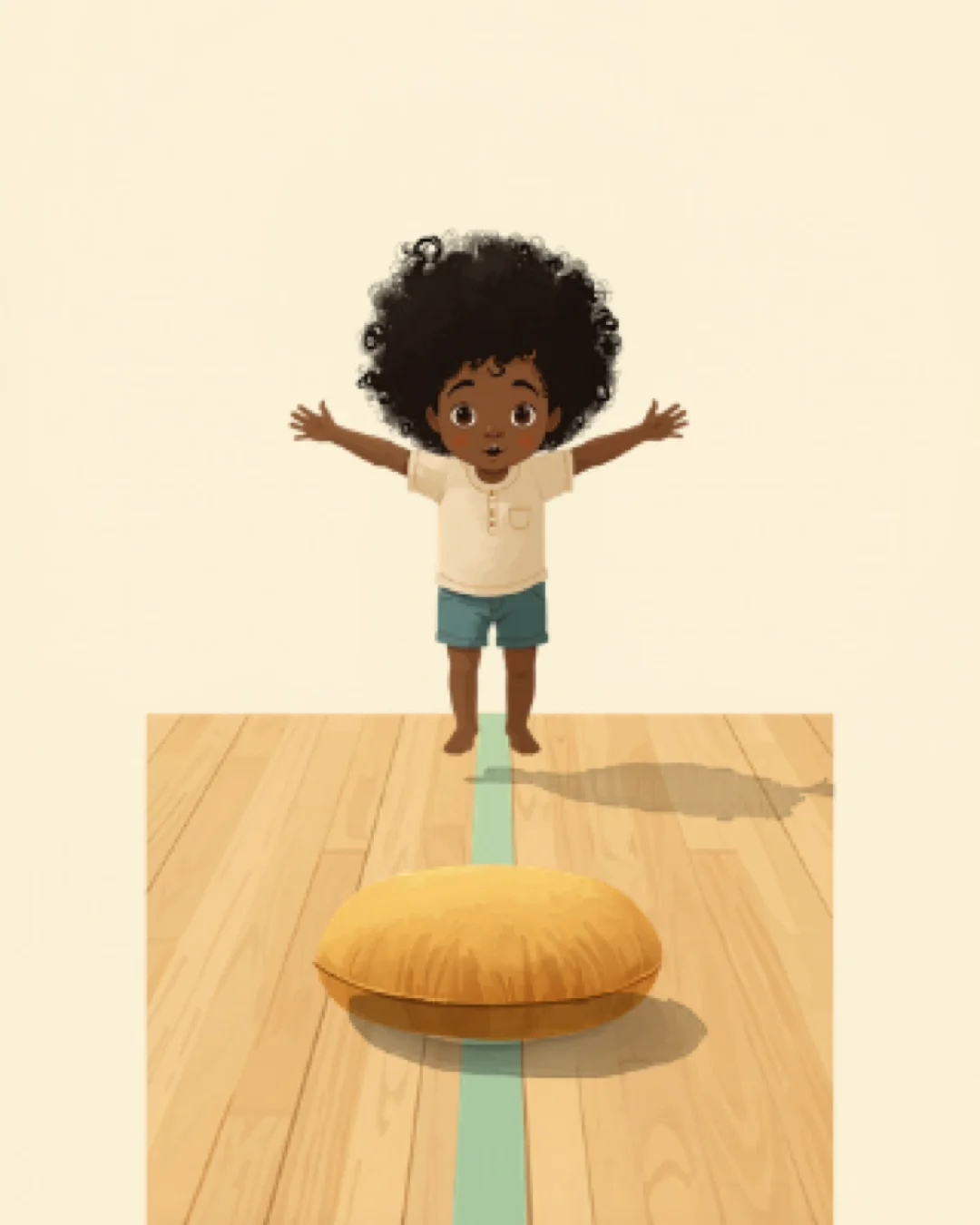
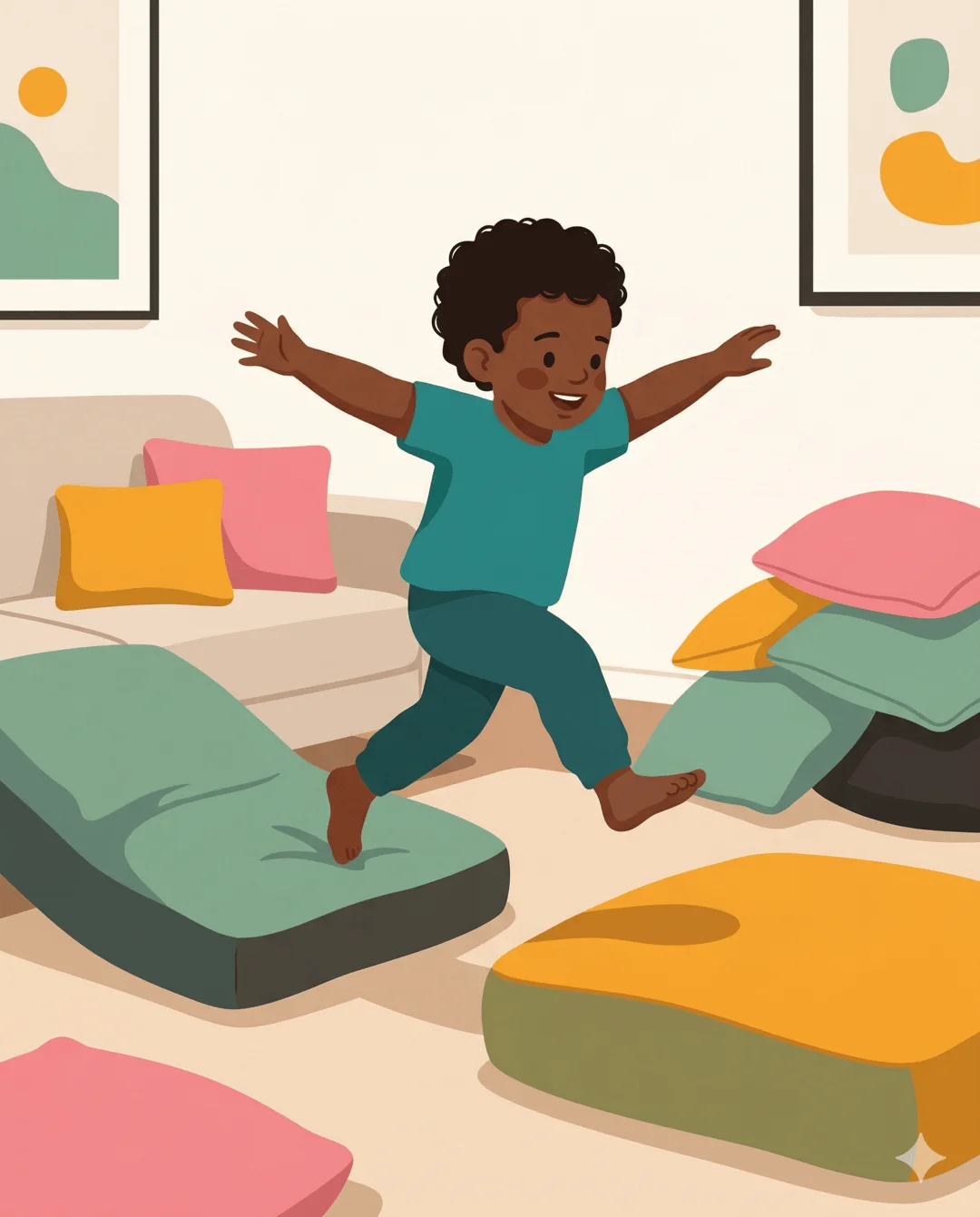
Hold a fabric strip at different heights and challenge your toddler to duck, crawl, or wiggle under it without touching.
Activity details
19m–4y10 minsmediumbothFabric Strips
Instructions
Tiny Steps
Get ready
Hold a fabric strip between your hands (or tie it between two chairs) at your child's shoulder height.
Say: 'Can you walk under the ribbon without touching it? You'll have to duck down!'
1/4
Hold a fabric strip between your hands (or tie it between two chairs) at your child's shoulder height.
Say: 'Can you walk under the ribbon without touching it? You'll have to duck down!'
Demonstrate by bending your knees and leaning back to shuffle under. Make it look funny.
Let your child try. Celebrate every successful pass: 'You made it! Let's go lower!'
Lower the strip by about ten centimetres and try again. Keep lowering after each successful round.
As it gets lower, your child will need to crouch, then crawl, then eventually slither on their tummy.
Add music: 'How low can you go?' played or sung while your child limbo-dances under the strip.
Let your child hold one end of the strip and set the height for you — watching an adult struggle to limbo is peak toddler comedy.
Parent tip
Set out fabric strips before inviting your toddler in so the first minute feels smooth.
What success looks like
Flushed cheeks, big smiles, and a calmer child afterwards. If they want to do it again, you’ve found a winner.
Limbo is a naturally hilarious game that develops body awareness, flexibility, and spatial judgement. By holding a fabric strip at varying heights, you create a challenge that forces your child to assess the gap, adjust their body position, and move through without touching the strip. Going lower each round demands increasingly creative movement solutions — bending backwards, squatting, crawling, and eventually lying flat — which builds flexibility and teaches children the limits and capabilities of their own body. The laughter and silliness make this a guaranteed mood-lifter on difficult days.
Why it helps
The EYFS framework highlights that physical play develops children's strength, co-ordination and positional awareness — the body awareness foundation for confident movement. Limbo develops proprioceptive self-awareness — the internal sense of where your body is in space and how it is positioned — which is essential for navigating the physical world safely. Judging whether your body will fit through a gap requires spatial reasoning and body schema, both of which are still actively developing in toddlerhood. The progressive lowering creates a scaffolded challenge that builds flexibility, hip mobility, and spinal articulation while teaching persistence and resilience.
Variations
Use two fabric strips at different heights, one right after the other, creating a double limbo challenge.
Try going over instead of under — hold the strip low and your child must step or jump over it, reversing the skill.
Hang small bells or jingle bells from the strip so there's an audible signal if your child touches it.
Safety tips
Use a soft fabric strip that will fall away easily if your child walks into it — never use rigid sticks or taut rope at head height.
Ensure the floor beneath the limbo strip is soft or carpeted in case your child loses balance and falls backward.
Stop lowering the strip if your child shows signs of frustration — the goal is fun and confidence, not an impossible challenge.
Try one of these next
A few connected ideas chosen by theme, energy, set-up, and age fit.