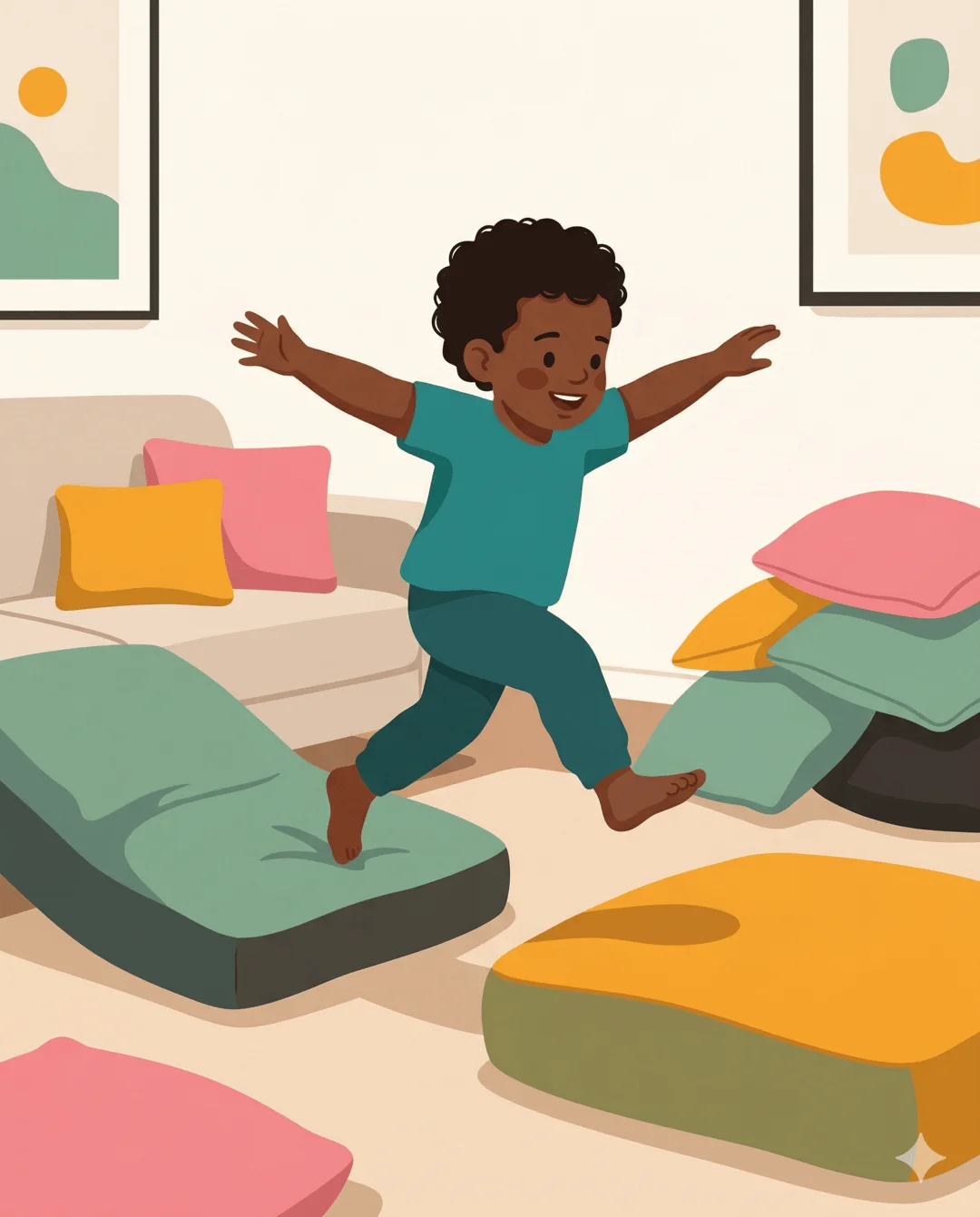
Stack cushions and pillows into a climbable mountain, then challenge your toddler to scramble up, over, and down safely.
Activity details
12m–3y15 minsmediumindoorBlanketsCushionsPillows
Instructions
Tiny Steps
Get ready
Gather all available cushions, pillows, and folded blankets from sofas and beds. Stack them against the sofa or a wall to create a slope.
Build the 'mountain' with a gradual incline — largest cushions at the base, smaller ones higher up, with the sofa seat as the summit.
1/4
Gather all available cushions, pillows, and folded blankets from sofas and beds. Stack them against the sofa or a wall to create a slope.
Build the 'mountain' with a gradual incline — largest cushions at the base, smaller ones higher up, with the sofa seat as the summit.
Show your child the mountain: 'Look at this enormous mountain! Can you climb all the way to the top?'
Stay close as they scramble up, offering a hand only if they reach for one. Let them figure out hand and foot placement.
At the top, celebrate: 'You're on top of the mountain! So high!' Then show them how to slide or climb down safely on their bottom.
Rearrange the cushions into a tunnel by draping a blanket over a gap between two stacks — 'Now crawl through the mountain cave!'
Add stepping stones: place individual cushions with gaps between them for your child to step across like a mountain path.
Wind down by collapsing the mountain together and snuggling under the pile of cushions: 'The mountain became a nest!'
Parent tip
Set out blankets and cushions before inviting your toddler in so the first minute feels smooth.
What success looks like
Flushed cheeks, big smiles, and a calmer child afterwards. If they want to do it again, you’ve found a winner.
Climbing is one of the most natural and developmentally important movements for toddlers, yet indoor opportunities are limited. This activity turns sofa cushions, pillows, and rolled blankets into a soft, safe mountain range that satisfies the climbing urge while building upper body strength, core stability, and risk assessment. The unstable surfaces force constant micro-adjustments in balance and body position, providing rich proprioceptive input that helps regulate the nervous system. For children who climb on furniture or countertops, this channelled alternative gives them a sanctioned place to practise the skill safely.
Why it helps
NHS physical activity guidelines for under-5s recommend at least 180 minutes of activity a day, listing climbing as one of the best forms of active play for this age group. Climbing over unstable surfaces provides intense proprioceptive and vestibular input, which occupational therapists recommend for children who seek physical stimulation through excessive climbing on furniture. The activity develops upper body strength, grip, and core stability while also teaching risk assessment — children learn to test a surface before committing their weight. Channelling the climbing impulse into a safe, structured activity reduces dangerous climbing elsewhere.
Variations
Hide small stuffed animals at different points on the mountain for a climbing treasure hunt — one at the base, one in the middle, one at the summit.
Add a 'lava floor' rule where your child must stay on the cushions and cannot touch the carpet, increasing the balance challenge.
For older toddlers, time the climb and see if they can beat their record — building both speed and confidence.
Safety tips
Always place the cushion mountain against a wall or sturdy sofa so the structure cannot topple away from the child.
Clear the surrounding area of any hard-edged furniture or objects a child could land on if they roll off.
Stay within arm's reach throughout — cushion mountains shift and a quick hand may be needed to steady a wobble.
Try one of these next
A few connected ideas chosen by theme, energy, set-up, and age fit.