Sing a short made-up song as you walk from one activity to the next — a musical bridge that makes every transition smoother.
Activity details
12m–3y5 minslowbothNo prep
Instructions
Tiny Steps
Get ready
Choose a simple, well-known tune — 'Here We Go Round the Mulberry Bush' or 'The Wheels on the Bus' works well.
Make up transition words: 'We're walking to the bathroom, the bathroom, the bathroom, we're walking to the bathroom, it's bath time now!'
1/4
Choose a simple, well-known tune — 'Here We Go Round the Mulberry Bush' or 'The Wheels on the Bus' works well.
Make up transition words: 'We're walking to the bathroom, the bathroom, the bathroom, we're walking to the bathroom, it's bath time now!'
Start singing before the transition begins — this gives your child a warning without a verbal instruction they can refuse.
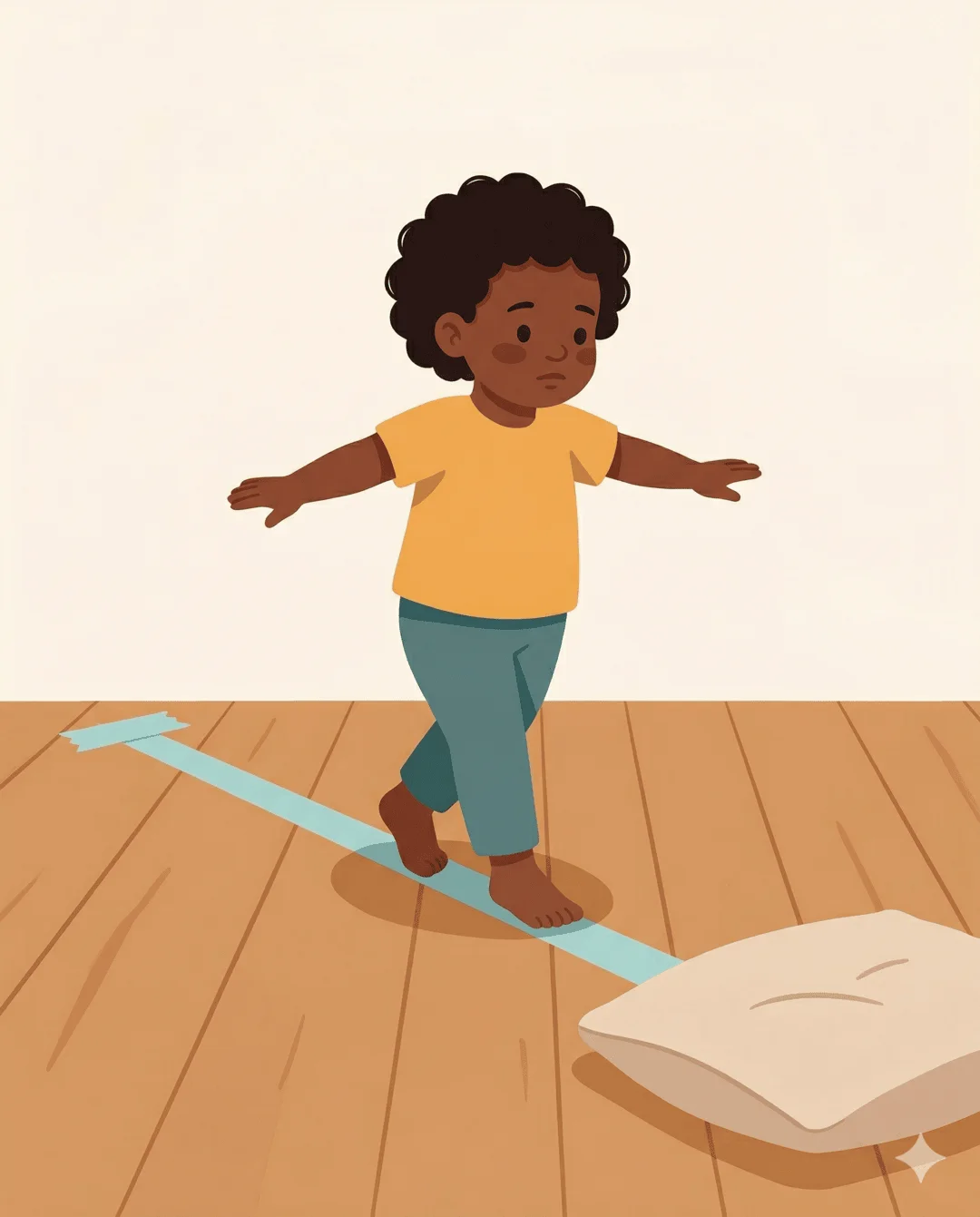
Hold your child's hand and begin walking together as you sing. The movement and music carry them along.
Keep the song going until you arrive: 'We're nearly at the bathroom, the bathroom, the bathroom — we're HERE!'
Celebrate arrival: 'We made it! What a lovely walk. Now it's time for bath!'
Use the same tune for every transition — to the table, to the car, to bed — so it becomes a reliable signal.
As your child learns the pattern, pause and let them fill in the destination word: 'We're walking to the... KITCHEN! That's right!'
Parent tip
Start before you overthink it. No-prep activities work best when you begin while the moment is still recoverable.
What success looks like
Flushed cheeks, big smiles, and a calmer child afterwards. If they want to do it again, you’ve found a winner.
This activity gives your toddler a simple, repeatable song that signals every transition throughout the day. The melody stays the same but the words change to describe where you are going: 'We're walking to the kitchen, the kitchen, the kitchen!' Singing occupies the language centres of the brain, which reduces the anxiety that often triggers transition tantrums. The physical act of walking together while singing also provides rhythmic vestibular input that is naturally calming. Within days, the song becomes a trusted signal that change is coming, and children begin to sing it themselves.
Why it helps
The EYFS framework highlights spatial and positional language as a key area where mathematical and language development intersect in the early years. Music activates multiple brain regions simultaneously — language, motor, emotional, and memory centres — which is why it is such an effective tool for easing transitions. The predictable melody provides what psychologists call a 'temporal scaffold,' helping the child understand that change is happening gradually rather than abruptly. Research in early years settings shows that transition songs reduce challenging behaviour by up to 30% compared to verbal instructions alone.
Variations
Add actions to the song for extra engagement: stomping feet, clapping hands, or swinging arms as you walk and sing.
Let your child choose the speed: 'Shall we sing it fast or slow this time?' — fast for energetic transitions, slow for calming ones.
Record the song and play it when you cannot sing yourself — in the car, for example, or when a carer is handling the transition.
Safety tips
Watch for obstacles in the path when your child is focused on singing rather than looking where they are going.
Keep the tone warm and inviting — if the song becomes associated with being forced, it will lose its effectiveness.
If your child resists, sing softly nearby rather than insisting they join in — the rhythm often draws them in naturally.
Try one of these next
A few connected ideas chosen by theme, energy, set-up, and age fit.